English

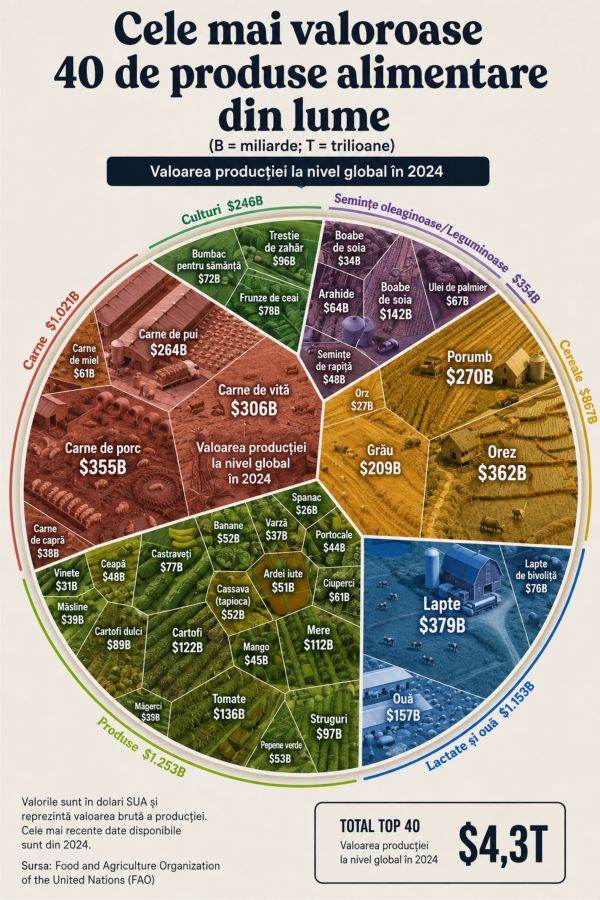
Food commodities generate trillions of dollars in agricultural output each year and include everything from staple grains and live animals to fruits, vegetables, coffee and cocoa.
Visualcapitalist.com has compiled a ranking of 40 such commodities by gross production value in 2024, based on data from the Food and Agriculture Organization of the United Nations (FAO). Together, the products featured generated approximately $4.3 trillion in value.
• Milk - the world's most valuable food commodity, with a production value of $379 billion
With a production value of $379 billion, milk surpasses rice ($362 billion) and pork ($355 billion) to take the top spot in the list. Only $24 billion separates the top three most valuable commodities in the ranking.
Milk's position reflects the scale of global dairy production. Dairy production is expected to reach 985 million tonnes in 2024, with cattle accounting for 81% of the total.
• Five meat products generate over $1 trillion
Pork, beef, chicken, lamb and goat have a combined production value of around $1.02 trillion, according to the cited source. Pork ranks third overall, with a value of $355 billion, followed by beef ($306 billion) and chicken ($264 billion). Global meat production reached 374 million tonnes in 2024, up seven million tonnes from the previous year.
Looking ahead, estimates show that live animal production will grow by 15% by 2035, outpacing agricultural production as rising wages in middle-income countries shift consumption towards more animal products.
• Commodities add up to $1.2 trillion
Tomatoes are the only agricultural product to make the top 10, with a production value of $136 billion. However, together, the commodities in the ranking generate over $1.2 trillion in value. Potatoes rank second among agricultural products, with a value of $122 billion, followed by apples ($112 billion), grapes ($97 billion), and sweet potatoes ($89 billion). Unlike meat and grains, they derive their size from a much broader range of commodities in the ranking.
• "Surprise” commodities worth over $50 billion
Beyond the world's most important staples (in terms of production value), many less obvious commodities generate tens of billions of dollars each year.
Mushrooms, for example, rank 22nd with $61 billion, ahead of bananas at $52 billion. Watermelons generate $53 billion, while cassava and chili peppers also exceed the $50 billion mark.
The rankings show how the value of production can differ from the perceived economic importance of a food. Commodities such as mushrooms, watermelons, cassava and chili peppers each generate more than $50 billion annually, underscoring the scale of foods that rarely get the same attention as wheat, rice or maize.
Together, they show the scale of the global agricultural economy, where value extends far beyond the few staples that dominate discussions about global trade and food security, the source said.
• FAO: World food prices at highest level in three years
The global food price index rose in July to its highest level in more than three years, as extreme weather events and wars pushed up grain prices on global markets, according to the FAO, Reuters reports.
In July, the index averaged 131.1 points, up from 130.3 points in June, 130.8 points in May and 131 points in April. This is the highest level since January 2023. Cereal prices rose 3.4% in July compared to June, boosted by a 5.8% increase in wheat prices, amid growing concerns about disruptions to Black Sea exports and the effects of drought on crops in key producing regions.
Vegetable oil prices also rose 2%, reaching their highest level since June 2022. The escalation of the Iran war has pushed up crude oil prices, while rising demand for biodiesel has supported the rise in palm oil and soybean oil prices, although rapeseed and sunflower oil prices have declined.
In July, sugar prices rose by 5.6% compared to June, amid growing concerns about extreme weather events in Europe and Asia and expectations of higher ethanol demand in Brazil.
In contrast, meat prices fell by 2.8% in July, after a record high in June, and dairy prices fell by 0.7%, the FAO reported, according to Agerpres.























 Euro
Euro Dolar SUA
 Franc elveţian
 Liră sterlină
 Gram de aur