English


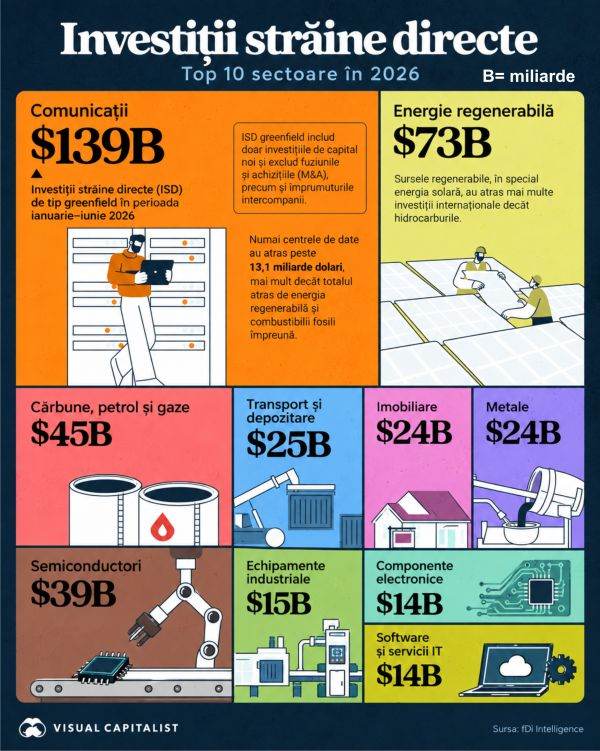
Global investors announced "greenfield" cross-border investments totaling approximately $538 billion in the first half of 2026, with artificial intelligence (AI) infrastructure emerging as a major driver of capital flows, according to visualcapitalist.com.
The cited source ranks the top ten sectors by global foreign direct investment (FDI) for the January-June 2026 period, using data from fDi Intelligence.
The figures cover only "greenfield" foreign direct investment-investments in new projects and facilities. Mergers and acquisitions (M&A) and inter-company loans are excluded.
• Communications sector dominates global investment
In the first half of 2026, companies committed $139.3 billion in new capital to the communications sector. This figure nearly equals the combined investment value of the next three largest sectors. The primary driver of this trend is data centers, which attracted over $131 billion in committed investment. Companies are pouring billions into data centers to support the continued surge of artificial intelligence (AI). This digital infrastructure provides the computing power required to train and run large-scale AI models.
Nearly a quarter of the foreign direct investment announced for data centers stems from a single transaction. In May 2026, SoftBank committed to investing over $50 billion in data centers in France. The Japanese technology company plans to develop 3.1 gigawatts of data center capacity in the country, starting in 2031. This is set to be the largest investment of its kind in Europe.
• Energy investments follow the data center boom
The development of artificial intelligence infrastructure is also extending to the energy sector. Renewable energy and fossil fuels ranked second and third, respectively, in terms of "greenfield" foreign direct investment, as new data centers drive increased demand for large-scale, reliable electricity sources.
The renewable energy sector attracted $73.3 billion in new capital investment. Solar energy drew the largest share of foreign direct investment committed to the sector, followed by hydrogen, emerging clean technologies, and wind energy. Renewable energy investments saw a slight decline in 2026, partly because US firms assigned them a lower priority. The United States is the leading source of FDI globally. Meanwhile, the coal, oil, and natural gas sectors attracted $44.7 billion in "greenfield" investments, despite instability in major hydrocarbon-producing regions such as the Persian Gulf. Approximately 75% of these investments stemmed from a new natural gas power plant in Ohio, developed to serve a data center currently under construction nearby.
• The role of artificial intelligence in the rest of the rankings
The influence of artificial intelligence (AI) and digital infrastructure is evident across much of the remainder of the top ten sectors attracting global FDI.
The semiconductor sector, for instance, attracted $38.8 billion in FDI-a figure well below the $138 billion recorded in 2025. A major commitment was announced in January 2026, when US chipmaker Micron pledged to invest $24 billion in chip manufacturing in Singapore.
Additionally, companies allocated $24.9 billion to transportation and warehousing, with the bulk of these investments directed toward freight transport and distribution.
Overall, the rankings reveal how the surge in AI-related investment extends far beyond the scope of data centers themselves. Top sectors include semiconductor and energy production, electronic components, industrial equipment, and software, underscoring the scale of infrastructure being developed to meet the growing demand for computing power.























 Euro
Euro Dolar SUA
 Franc elveţian
 Liră sterlină
 Gram de aur