 English

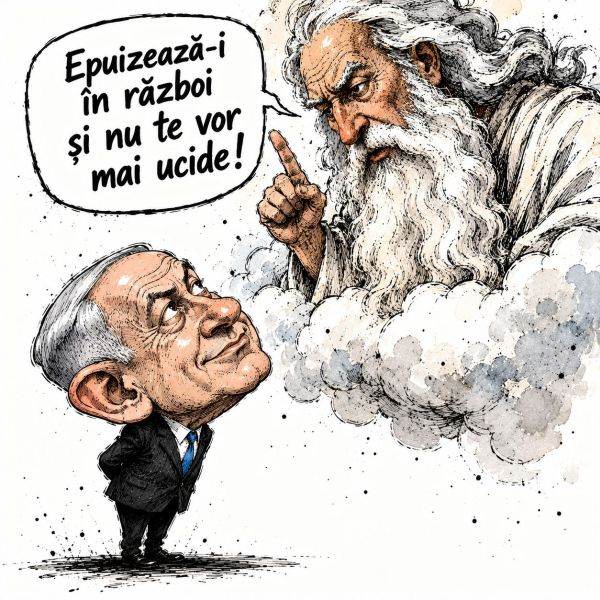
I wrote in BURSA, two days after the Hamas attack, that "Netanyahu is always favoured by the conflict with the Palestinians” (9 October 2023).
At the time, I quoted the Talmudic teaching in the tractate Temurah 16a, in which God tells Joshua to wear down in war those who wanted to kill him, so that they would leave him alone.
I had analysed the story of Joshua forgetting some of the commandments a year earlier, in the essays "Emerging from Under God's Tutelage” and "First the Farce, Then the Tragedy of Losing the Book”.
Three years later, ahead of the parliamentary elections on 27 October, the facts make it possible to test that observation.
Benjamin Netanyahu chooses his biblical references deliberately.
When he announced the ground invasion of Gaza on 28 October 2023, he said: "You must remember what Amalek did to you, says our Holy Bible. And we remember, and we fight”.
Immediately afterwards, according to the transcript of the speech, he said that the soldiers had a single goal: the complete defeat of the murderous enemy and the guarantee of Israel's existence.
• What Amalek means
The verse quoted is Deuteronomy 25:17.
The full passage (25:17-19) calls on the Israelites to remember how Amalek attacked them from behind as they left Egypt, striking the weak and exhausted who had fallen behind the column, and to blot out the memory of Amalek from under heaven.
Netanyahu quoted only the command to remember.
In Jewish tradition, Amalek is the enemy who attacks the weak without reason and seeks the destruction of the Jewish people: the passage is read in synagogues every year on the Sabbath before the festival of Purim, and in the 20th century the name was applied to the Nazis; the same verse is inscribed on the Holocaust memorial in The Hague.
But in 1 Samuel 15:3, God commands King Saul to destroy Amalek completely: men, women, children, infants and animals.
South Africa submitted Netanyahu's statement to the International Court of Justice as evidence of genocidal intent, arguing that the name Amalek invokes the command of total annihilation, which makes no distinction between combatants and children.
Netanyahu's office called the accusation absurd and said that the reference concerned Hamas's attack on civilians.
Netanyahu's words identify the murderous enemy as the target, meaning Hamas, but the name he chose also carries, in the tradition he himself invokes, the meaning of total annihilation.
The meaning of a biblical name is not determined solely by the person using it.
• What Joshua means
The same applies to Netanyahu's second biblical reference.
In the message published after the 7 October attack, he told the soldiers that they were the continuation of the heroes of the Jewish people, of Joshua, Judah Maccabee and the heroes of 1948.
Joshua is the one who conquered the Promised Land after the death of Moses.
The Talmud, in the tractate Temurah 16a, relates that after Moses's death, Joshua forgot three hundred laws, and the people rose up to kill him because he could no longer teach them those laws.
God told him that He could not restore them, but that, to escape the people who wanted to kill him, he should wear them down in war so that they would leave him alone; this is why, the Talmud explains, the first thing God commands Joshua to do after Moses's death is cross the Jordan, that is, begin the war.
• Two different years, the same effect: 2021 and 2023
Netanyahu had already experienced this effect of war in 2021.
In May 2021, Yair Lapid and Naftali Bennett were close to an agreement on a government that would remove him from power. The confrontation with Hamas, which began on 10 May, halted the negotiations: the leader of the Arab Ra'am party, Mansour Abbas, withdrew from them, and Bennett declared that the alternative government option was no longer possible.
The respite was brief: after the ceasefire, negotiations resumed, and on 13 June 2021 Bennett became prime minister.
In 2023, before the Hamas attack, Netanyahu was on trial for corruption, while hundreds of thousands of Israelis were demonstrating every week against the judicial reform that his opponents linked to his trial.
The war brought the demonstrations to an end.
The same war also weakened him: the security failure of 7 October is blamed on him by the majority of Israelis, and in June 2026 only 29.4% of them still wanted him as prime minister.
In both situations, war temporarily removed a domestic threat to Netanyahu's hold on power.
There is no evidence that he instigated either conflict to achieve this result, nor is there evidence that he had the passage from Temurah in mind when he invoked Joshua.
The parallel nevertheless remains: in the Talmudic account, war saves a leader from the fury of his own people; twice in Netanyahu's career, war interrupted a political confrontation that threatened his power.
The absence of evidence of intent does not negate the political effect.
























 Euro
 Dolar SUA
 Franc elveţian
 Liră sterlină
 Gram de aur































Reader's Opinion