English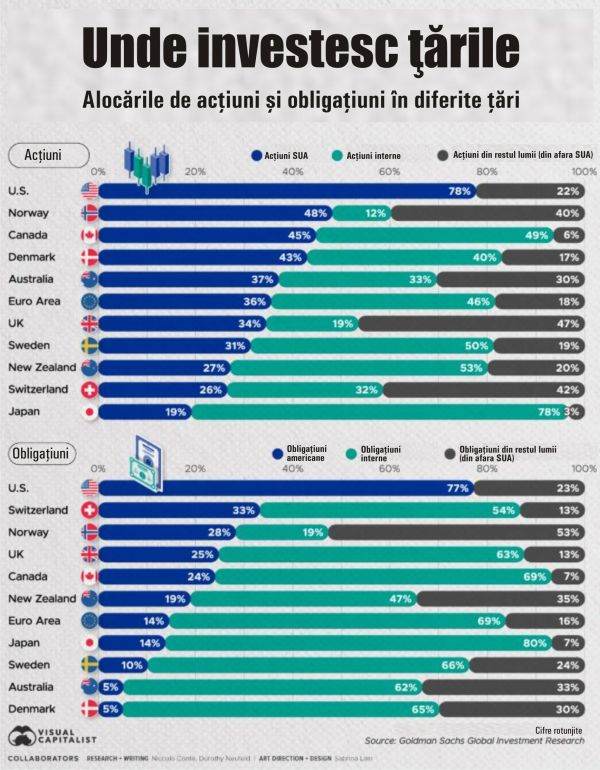
The "equity bias” is a common tendency for investors to place their money in domestic assets, according to an analysis by visualcapitalist.com, which notes that this pattern is particularly pronounced among US investors - likely influenced by their country's outsized role in global financial markets. Similarly, Japanese investors heavily concentrate their investments in local assets.
The source shows how different countries invest in stocks and bonds, based on data from Goldman Sachs Global Investment Research. Thus, US investors keep 78% of their stocks in domestic markets, a share comparable to that of Japan. The ranking presented includes the stock portfolios of different countries, including US stocks, domestic stocks and global stocks.
In contrast, many countries allocate a significant portion of their portfolios to US stocks, such as Norway (48%) and Canada (45%). Notably, Norwegian investors only hold 12% of their equity allocation in domestic stocks, despite strong average annualized returns of 13.7% in 2020.
UK investors have a similar bias outwards, holding just 19% of their equities domestically, according to the source cited. This is likely influenced by the weak stock market performance and the lingering effects of Brexit. Since 2020, the FTSE 100 index has generated annualized returns of less than 5%.
• Japan - 80% of fixed income investments are held domestically
Japanese investors have the strongest bias towards domestic investments, with 80% of fixed income investments held domestically. Meanwhile, European investors also reflect this trend, with 69% allocated to domestic bonds. Factors such as familiarity and potential tax advantages may influence this trend.
For investors diversifying abroad, Switzerland has the largest allocation to U.S. bonds, at 33%. This is likely influenced by the strength of its currency and the relatively higher yields on U.S. bonds, given Switzerland's current 0% interest rate.



























 Euro
Euro Dolar SUA
 Franc elveţian
 Liră sterlină
 Gram de aur