English

The price of crude oil futures crossed the $100 a barrel mark again on foreign markets yesterday after Iran's new leader declared that the Strait of Hormuz would remain closed and after other attacks on ships in the Gulf spooked energy traders.
In a statement broadcast by Iranian state television, Mojtaba Khamenei warned that the strait would remain closed as a "tool of pressure," CNN reports. The message from the new supreme leader of the Islamic republic - the son of former leader Ali Khamenei, who was killed in an Israeli attack at the beginning of the war - also contained a warning about possible new attacks on US military bases in the region.
West Texas Intermediate (WTI) crude for April delivery was at $95.66 a barrel on the New York Nymex at 10:38 a.m. local time, up 9.6% from Wednesday's session, while Brent crude for May delivery was at $100.22 a barrel, up 9%.
Yesterday's advance came despite the intervention announced on Wednesday by member countries of the International Energy Agency (IEA) to release strategic crude reserves.
Fatih Birol, the IEA director, said: "IEA member countries will make 400 million barrels of oil available to the market to compensate for the loss of supply caused by the closure of the Strait of Hormuz."
The decision was unanimously adopted on Wednesday by the 32 IEA member states, including the seven major industrialized countries (G7 - USA, France, Germany, UK, Italy, Japan and Canada), as well as Australia and Mexico.
The United States will contribute 172 million barrels, or 40% of its reserves. The American oil will be gradually released to the market over about three months.
French President Emmanuel Macron said on Wednesday that the commitment made by the IEA represents "approximately 20 days of volumes exported through the Strait of Hormuz".
We recall that on Monday, the oil price approached 120 dollars per barrel, which led to an increase in fuel prices at the pump, worldwide. After a significant decline on Tuesday (-11%), the price of crude oil resumed its growth on Wednesday, amid concerns about supply.
• IEA: "War in the Middle East is causing the largest disruption to global oil supply in history”
The war in the Middle East is causing the largest disruption to global oil supply in history, the IEA said in a report cited by Reuters. According to the source, the countries of the Persian Gulf have reduced their total oil production by at least 10 million barrels per day - a volume equal to almost 10% of world demand - as a result of the conflict and especially the blockade of the Strait of Hormuz.
Crude oil production is currently reduced by at least 8 million barrels per day, and in the case of an additional 2 million barrels per day is stopped, according to the IEA, which warns that without a rapid resumption of maritime transport flows, these losses will increase.
The IEA has cut its forecast for global oil demand growth in 2026 from 850,000 to 640,000 barrels per day.
• US Energy Secretary: "Oil is unlikely to reach $200/barrel"
US Energy Secretary Chris Wright said yesterday that global oil prices are unlikely to reach $200/barrel, even if oil tankers remain blocked in the Strait of Hormuz and the war between the US and Israel with Iran has expanded, Reuters reports, according to Agerpres.
"I would say it is unlikely, but we are focused on the military operation and solving a problem," Wright told CNN, when asked if prices would reach $200/barrel, as an Iranian official warned on Wednesday.
"Prepare for oil to reach $200 a barrel because the price depends on the regional security that you have destabilized,” said Lieutenant Colonel Ebrahim Zolfaghari, spokesman for the Khatam al-Anbiya Joint Operations Command in Tehran.
Chris Wright also said that for the time being, the US Navy cannot escort ships through the Strait of Hormuz, but it is "quite likely” that this will happen by the end of the month. "It will happen quite soon, but it cannot happen now. We are simply not ready,” said Chris Wright, explaining that all US military resources are "currently focused on destroying Iran's offensive capabilities.”
• Where the World's Oil Comes From
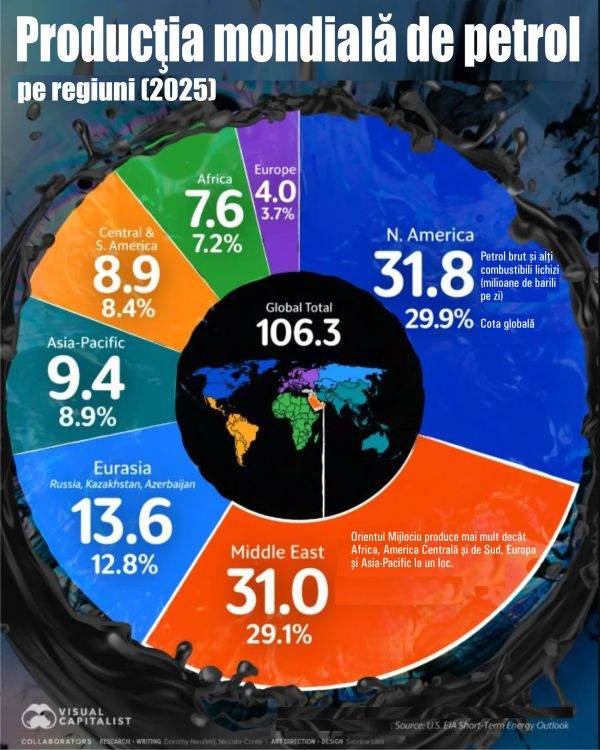
According to estimates from the U.S. Energy Information Administration (EIA), the world produced about 106 million barrels of oil per day in 2025. Only two regions dominate global supply: North America and the Middle East together produce nearly 60% of the world's oil, underscoring their major influence on energy markets, according to EIA data cited by visualcapitalist.com, which presents global oil production by region in 2025, including crude oil and other liquid fuels.
According to the cited source, North America is the world's largest oil-producing region, accounting for 29.9% of global production in 2025, with an average of 31.8 million barrels per day. Much of this supply comes from the US, where oil production reached record levels in 2025. US production has more than doubled in the past two decades, largely due to the expansion of shale drilling. Canada also reached record levels, producing 5 million barrels per day in December 2025.
The Middle East is the second largest oil-producing region, generating 31 million barrels per day in 2025. Saudi Arabia remains the largest producer in the region, with 9.6 million barrels per day. However, the number of active oil rigs in the country fell to its lowest level in 20 years in 2025 as energy investment increasingly shifts to natural gas production. Natural gas production is expected to grow by 60% by 2030.
Iran produced 3.1 million barrels per day in 2025, still below its peak of 4 million in 2007. Even so, the Middle East remains a dominant force in global oil markets. In 2025, it produced more crude than Africa, Europe, Central and South America and Asia-Pacific combined.
The South Korean government announced yesterday the implementation, starting from midnight, of a ceiling on wholesale fuel prices, in order to stop their significant increase since the start of the Middle East war, according to AFP. The measure is a first since 1997.
"The government has decided to take institutional measures to stop the recent increase in domestic fuel prices caused by the situation in the Middle East," the Ministry of Energy in Seoul said, noting that the cap applies to prices charged by refiners to distributors and gas stations, not to the retail price at the pump.
-----------------
An official from the International Monetary Fund (IMF) pleaded on Wednesday for a more integrated European energy market, with the idea of better protecting Europe from the increase in gas prices caused by the war in the Middle East, AFP reports, according to Agerpres.
"It has become almost normal: a new shock has appeared (...) whose impact we do not yet know," said Alfred Kammer, director of the IMF's Europe Department. This impact will depend on "the duration of the conflict" and "how long the Strait of Hormuz will be affected," Kammer added.
In this context, the IMF official argued that the European Union should continue to deepen the single market to boost productivity and economic growth and make progress in integrating its energy market.
"If you want cheaper, cleaner energy, less dependence on energy imports and less vulnerability to geoeconomic shocks, you need to make progress, even accelerate, on the Green Deal,” explained Alfred Kammer.


















 Euro
Euro Dolar SUA
 Franc elveţian
 Liră sterlină
 Gram de aur