 English

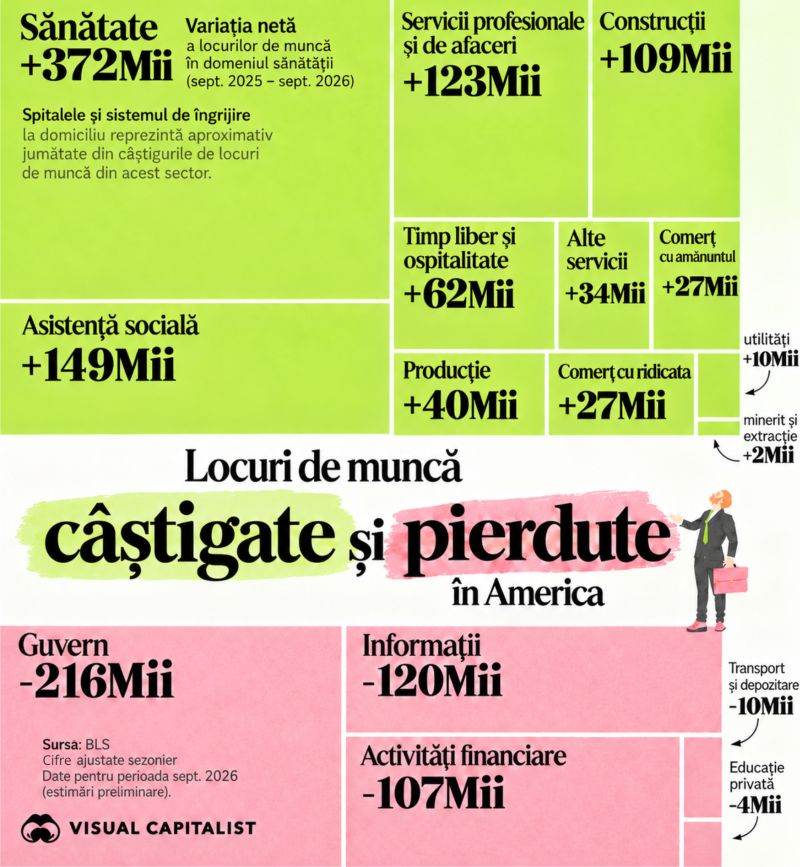
The American labor market is moving in different directions, depending on the sector. While demand in healthcare and social assistance continues to rise, the government sector and several traditional, office-based fields are reducing their headcounts, according to visualcapitalist.com.
The source presents the net change in US employment by sector over the 12-month period from September 2025 to September 2026, based on seasonally adjusted preliminary estimates provided by the US Bureau of Labor Statistics.
• Care services maintain positive employment growth
The healthcare sector (371,800) and the social assistance sector (148,600) together generated over 520,000 jobs during the year, making care services a key driver of employment growth in the US. Furthermore, the healthcare services sector has become the primary employer in over 80% of the states.
Construction (109,000) and professional and business services (123,000) also served as significant sources of new jobs. However, substantial declines in the government sector (216,000), the information sector (120,000), and financial activities (107,000) offset a large portion of these gains.
Hospitals and home healthcare providers together created 188,800 jobs, accounting for approximately half of the growth recorded in the healthcare sector. Additional hiring also took place in medical offices, outpatient centers, and nursing and residential care facilities.
Within the social assistance sector, expansion was driven by services for individuals and families, which added 152,800 positions. Conversely, the number of employees in childcare saw a slight decline, highlighting the divergent hiring trends across various types of care services.
• An aging America requires more care services
America's aging population is a major factor driving the demand for care personnel. The number of Americans aged 65 and older reached 61.2 million in 2024, an increase of 13% compared to 2020. This expanding population is driving a growing demand for medical treatments and long-term care.
There is an increasing need for care within homes and communities. Many older adults prefer to remain at home-where support can be less costly than institutional care-notes the cited source. Caregivers assist with daily activities, such as bathing, dressing, preparing meals, and traveling to various appointments, helping clients maintain a greater degree of independence.
For job seekers, these roles often provide an entry point that does not require a university degree, though the pay may be modest. Home health and personal care aides earned a median annual wage of $35,800 in May 2025, compared to $50,980 across all occupations, according to the source. Consequently, strong demand for workers coexists with relatively low earnings in a significant portion of the care sector.
• Reduction in federal workforce leads to government job losses
The number of federal-level jobs fell by 232,000 over the year analyzed-a reduction of approximately 8%. This figure exceeded the overall decline of 216,000 government jobs nationwide, as hiring at the local government level partially offset losses at the federal and state levels. State governments shed 25,000 jobs, while local governments added 41,000.
The reduction at the federal level followed an extensive workforce-trimming campaign. An executive order issued in February 2025 mandated that agencies prepare for large-scale job cuts. A separate program, which allowed for the deferral of departures, provided eligible employees with continued salary and benefits through September 2025.
Reflecting, in part, the layoffs within the federal sector, Washington, D.C. recorded the highest unemployment rate in the country, at 5.7%.
Private-sector losses affected areas such as publishing, telecommunications, and finance. Insurance companies and related activities shed 76,000 jobs over the course of the year, accounting for the bulk of the decline recorded in the financial sector. These cuts have narrowed opportunities in traditional office-based sectors, while the demand for personnel in the care sector has continued to rise.
• US unemployment rate on the rise
The US economy saw an unexpectedly low number of jobs created in September, while the unemployment rate climbed to 4.2%, according to Reuters. Analysts had anticipated an unemployment rate of 4.1%, similar to the figure for August.
The Department of Labor reported this month that the number of jobs created by US employers rose by 29,000 in September, while the data for August was revised downward to show 133,000 jobs added. Economists had expected 90,000 new jobs in September, following the 162,000-job increase initially reported for August. The number of employees in the healthcare services sector continued to grow last month, with 17,000 new positions, though the pace of expansion was slower compared to the previous 12 months. The number of unemployed people in the US remained virtually unchanged last month, at 7.1 million. Analysts have warned that the effects of the conflict in Iran-including high energy prices and supply chain disruptions-will impact the labor market in 2026 and 2027.























 Euro
 Dolar SUA
 Franc elveţian
 Liră sterlină
 Gram de aur































Reader's Opinion