English
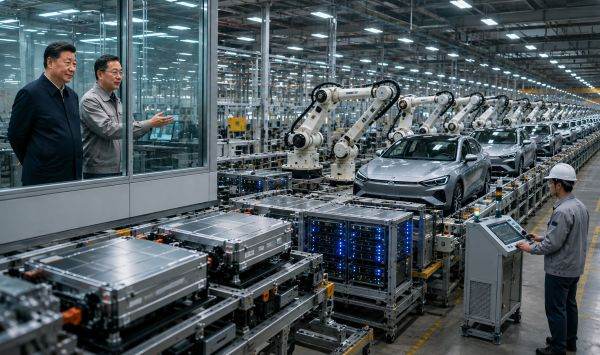
Beijing is accelerating state intervention to stop the economic slowdown, but is refusing the massive financial stimulus that markets are expecting, is the conclusion of the analysis made at the meeting of the Politburo of the Chinese Communist Party on July 30, according to information published by the Beijing press. The meeting set the direction of the economy for the second half of the year and announced the convening of the Fifth Plenary Session of the Central Committee in October. Beyond the compact, ritualistic and carefully controlled language of the official communique issued by the authorities in Beijing, the message is clear: the economy is slowing down faster than the leadership would like to admit, the state will intervene more decisively, but Xi Jinping is not ready to change the model. Beijing wants more speed, not another destination.
If in mid-spring, at the April meeting, Chinese leaders spoke of a solid economic start, indicators above expectations, resilience and vitality this year, now, at the end of July, the triumphalist formulas have thinned, and the Politburo has called for economic difficulties and challenges to be given "great importance”.
The numbers explain the nervousness hidden behind the official phrases. China's GDP growth slowed to 4.3% in the second quarter, after 5% in the first quarter, fixed asset investment fell by 5.7% in the first half of the year, private investment by 8.5%, and retail sales advanced by only 1.3%. The Beijing meeting also confirmed that the economic weakness is not just a statistical fluke: the official manufacturing PMI fell to 49.2 in July from 50.3, falling below the 50 threshold that separates expansion from contraction, while non-manufacturing activity fell to its lowest level since 2022, according to the Associated Press. China remains a giant industrial machine, but its domestic engine is coughing.
Communist leaders in Beijing responded by calling for macroeconomic policies that "act with force and improve efficiency,” leading to an acceleration of budget spending, faster use of money obtained from bonds, and the prompt preparation of additional "pragmatic and effective” measures.
Reuters, the Financial Times, and The Wall Street Journal read the signal almost identically: faster and more targeted support, but no large stimulus package. An analysis by ING shows that the measures will be moderate and punctual and keeps in the scenario a 10 basis point interest rate cut before the end of the third quarter, without the meeting having explicitly promised such a decision.
In other words, Beijing is resorting to instruments, and the first will be fiscal. The money already approved must be withdrawn from the accounts more quickly and pushed towards strategic projects: water, modern electricity, computing power, next-generation communications, underground urban pipelines and logistics. The official report presented by the Xinhua agency adds an extensive list of priorities: fundamental research, frontier technologies, industries of the future, new pillar sectors and the expansion of the "AI Plus” program. According to Reuters, about $ 1,000 billion was budgeted in 2026 for the infrastructure agenda. The choice says everything about the regime's instinct: when demand weakens, the preferred response remains capacity building, not directly feeding the population's wallet.
Here lies the central contradiction of Xi Jinping's strategy. The leadership declares that it wants to expand domestic demand, but continues to treat consumption primarily as a supply problem. The communique promises better and more services for the elderly, children, health, tourism and culture, but does not announce large transfers to households, decisive tax cuts or a major expansion of social protection. It is not the income of the citizen that is put at the center of the mechanism, but the ability of the state and industry to offer them something new to buy. This is a fundamental difference. A family that fears for their job, their pension or the value of their apartment does not start consuming just because "quality” services appear on the market. Morgan Stanley had predicted, according to the South China Morning Post, that technology would remain ahead of consumption in the real order of resources, and the meeting proved it right. The real estate crisis did not receive the spectacular treatment that investors had hoped for either. Chinese leaders have limited themselves to the formula of "stabilizing the real estate market,” without a new program to purchase unsold homes by local governments and without a financial offensive capable of quickly restoring confidence. This is a serious omission, because property has been the main reservoir of wealth for the Chinese middle class for years, a crucial source of income for local governments and the engine of dozens of industries. As long as housing prices and developers' balance sheets remain fragile, households will save defensively and local governments will spend with the brakes on. But Beijing appears determined to prevent the sector from collapsing, not to restore it to the glory that produced the bubble.
The same defensive logic is playing out in the stock market. After a two-week slump that wiped about 10 trillion yuan off market capitalization, China's regulators have pledged stability, state investors have bought shares, and public companies have announced buybacks and dividends, according to Reuters. Politburo members then called for more "resilience and confidence” in the capital market. The word "resilience” betrays the nature of the reaction: the leadership is not talking about a great bull market, but about a system that must withstand shocks and not turn investor panic into a political crisis.
At the same time, Beijing is trying to tame the excesses of its own industrial model. The meeting at the end of July called for a continued fight against "involution” competition, the term used for price wars, overcapacity, redundant local investment and companies' race to produce more and more at ever-shrinking margins. A unified national market regulation, systematic resolution of unpaid invoices to companies, reform of state-owned enterprises and a better environment for the private sector and digital platforms were promised. But this is not an abandonment of industrial policy, but an attempt to discipline it. Xi Jinping is not giving up on factories, artificial intelligence or technological autonomy; he wants stronger factories, more controlled champions and less self-destructive competition. Xi Jinping accepts more fiscal and monetary support, but not shock therapy; he wants consumption, but without decisively shifting purchasing power to households; he wants more balanced trade, but without curbing industrial advantage; it wants local investment, but also control, audit and discipline; it wants markets that inspire confidence, but not markets that dictate policy. ING's analysis captures the edge perfectly: a supportive tone, few concrete measures.
In the coming months, the test will not be whether Beijing can launch new projects or marginally reduce the cost of money. The real test is whether an economy weighed down by cheap property, local debt, cautious consumption, falling industrial yields and trade tensions can be restarted with the same levers that created some of the imbalances. The meeting on July 30 showed that Chinese leaders have heard the alarm. It did not show that they are ready to change the installation that triggered it. And this is the stakes that go far beyond China: if Beijing responds to domestic weakness by producing and exporting even more, the pressure will spill over to factories, jobs and trade policy in Europe and around the world. China is not preparing a retreat. It is preparing a new industrial offensive, financed more quickly, supervised more strictly and wrapped in a promise of stability.





















 Euro
Euro Dolar SUA
 Franc elveţian
 Liră sterlină
 Gram de aur