English

Global air travel is a well-oiled machine that can be disrupted by unplanned airport closures.
Major international airports in Dubai, Abu Dhabi and Doha were closed last week due to the Iran war and the wider conflict in the Middle East, leaving many passengers stranded, according to abc.net.au, which notes that more than 10 million passengers were expected to fly in and out of the three airports between March 2 and 6 alone. Cargo flights have also been grounded at these airports, many of which contain perishable items such as medical supplies, flowers and food, which will not reach their final destinations on time.
While the region has begun to resume passenger and cargo flights through emergency corridors, the process of rerouting in the region is difficult, and aviation experts say it will likely take months to recover from the disruption once restrictions are fully lifted.
Guido Carim Jr., an aviation expert at Griffith University, says: "If something goes "wrong' in the sector, it is very difficult to make up for lost time.”
According to Bloomberg, more than 23,000 flights have been canceled since the start of the crisis in the Middle East, the source notes. While some flights are resuming on other designated routes through the conflict zone, most air traffic uses narrow corridors to the north and south, avoiding the troubled regions.
"Flights are going north of Iranian airspace or south to avoid the conflicts,” says Rico Merkert, head of the department at the University of Sydney. Merkert says he has seen passenger flows choosing airlines other than Qatar, Emirates or Etihad, flying to and from Singapore, Hong Kong and Istanbul. He has also seen some "interesting” routes, from Helsinki to Johannesburg and to Sydney.
Qantas' long-haul direct flight from Perth, Australia to London has also been rerouted via Singapore to avoid airspace over the Gulf.
At the same time, there are concerns about the impact of the war on aviation fuel costs.
Jet fuel costs, which typically account for 20% to 30% of an airline's operating costs, could rise if the war continues, according to S&P Global.
• Tourism - $11.7 trillion contribution to GDP by 2025
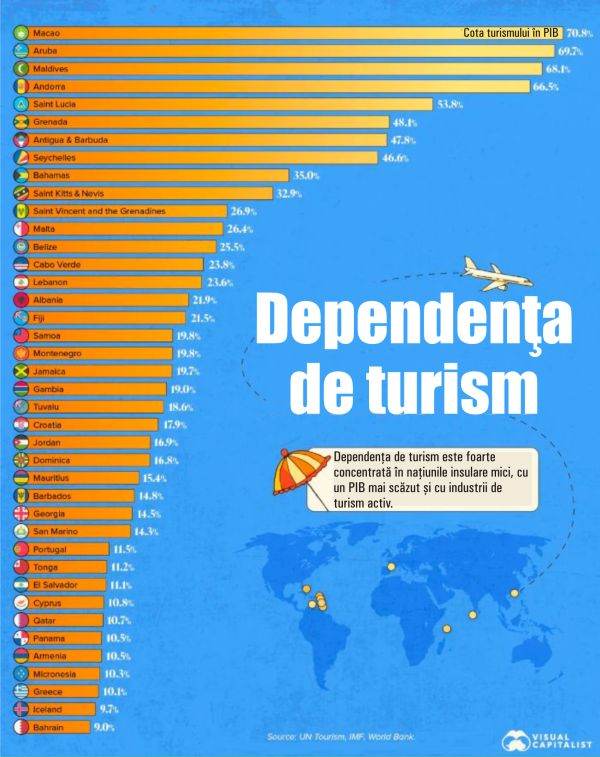
Tourism is a major global industry, with an estimated contribution of $11.7 trillion to global GDP by 2025, or about 10% of total economic output. However, its importance varies greatly from country to country, according to an analysis by visualcapitalist.com, which notes that for some nations, tourism is an additional source of income, while for others, it is the mainstay of economic activity.
The cited source presents a ranking of countries by the share of tourism in GDP, based on international tourism receipts (published by UN Tourism) and IMF GDP data.
Macau tops the list - visitor spending totaled $32.4 billion in 2025, equivalent to 70.8% of its $45.8 billion economy.
Aruba follows in second place with 69.7%, while the Maldives (68.1%) and Andorra (66.5%) also derive about two-thirds of their economic output from tourism. Saint Lucia ranks fifth, with tourism accounting for 53.8% of GDP.
The overall pattern shows that small island nations and resort economies dominate the top spots of the rankings. As their domestic markets and industries are limited, international visitors become a major source of revenue.
• Diversified economies, lower in the rankings
The United States ranks 151st on the list, with international tourism accounting for just 0.86% of US GDP, despite total revenues of $251.6 billion in absolute terms. The country least dependent on tourism is Papua New Guinea, where tourism accounts for just 0.01% of its economic output. Guinea and Angola trail behind, with 0.02% of their GDPs of $24.2 billion and $115.2 billion, respectively.
For 47 countries in the ranking, tourism generated less than 1% of GDP.
• Clusters of tourism dependence around hiking hotspots
Clusters of higher dependence are also visible in Central America, Eastern Europe and Southeast Asia, which are hiking hotspots. These countries are considered affordable destinations, according to the cited source.
While the economic benefits are huge in countries that rely on tourism, they are particularly vulnerable to global shocks. Aruba's real GDP, for example, contracted by 24% in 2020 as the pandemic halted tourism, leaving business owners and citizens in a precarious economic situation. But Aruba has since bounced back.























 Euro
Euro Dolar SUA
 Franc elveţian
 Liră sterlină
 Gram de aur