English


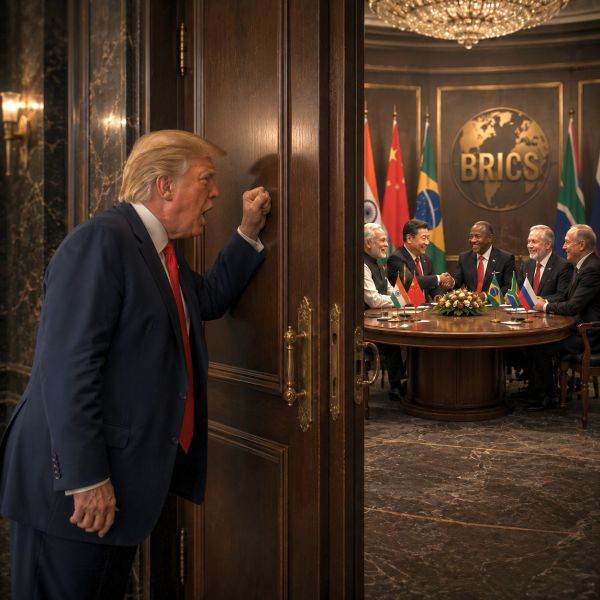
India proposes interconnecting BRICS CBDCs, China integrates UnionPay into Brazil's Pix, Argentina extends its currency swap with Beijing until 2031, while mBridge reaches the minimum viable product stage. The global financial system is fragmenting at an accelerated pace in 2026.
The international financial system is going through, this year, its most pronounced phase of fragmentation in decades. BRICS member states are advancing simultaneously on several fronts - central bank digital currencies (CBDCs), interoperability between national payment systems, and bilateral currency swap agreements - building an alternative infrastructure to the architecture dominated by the dollar and SWIFT. The European Central Bank points out in its "The International Role of the Euro” report (June 2026) that these trends highlight increasing fragmentation of the international monetary system, with more and more countries advancing technological alternatives to traditional cross-border payment systems.
• India Wants BRICS CBDCs to Be Interconnected
On January 19, 2026, the Reserve Bank of India (RBI) proposed to the New Delhi government that a plan to connect the digital currencies of BRICS member central banks be included on the agenda of the 2026 BRICS summit, according to Central Banking and IDN Financials, citing Reuters. India is due to host the summit as chair of the bloc, and the proposal was also confirmed by the ECB in its June 2026 report.
The technical model does not involve creating a common supranational currency, but rather interconnecting existing national currencies - from India's digital rupee (e-rupee) to Brazil's Drex. None of the founding BRICS states has yet launched a fully operational national digital currency, although all five are running pilot projects.
The proposal builds on the 2025 BRICS summit declaration in Rio de Janeiro, which explicitly encouraged interoperability among members' payment systems. A study published in the Asian Review of Political Economy (Springer, April 2026) by researcher Yang Lyu of the China Institutes of Contemporary International Studies identifies interoperability - rather than a single currency - as the most pragmatic trajectory for BRICS financial cooperation, examining settlement systems in local currencies and cross-border digital solutions.
• UnionPay Enters Brazil's Pix Infrastructure
On August 4, 2026, UnionPay International and the Consulate General of China in Rio de Janeiro announced the launch of a pilot project through which users of the UnionPay app and partner Chinese banks' applications can make payments by scanning QR codes at merchants connected to Pix, Brazil's instant payment system, UPI reported. The initiative expands financial cooperation between the two countries, amid an ongoing US trade case against Brazil in which the Brazilian payment system is at the center, the South China Morning Post reports.
Pix, launched by the Central Bank of Brazil in November 2020, covers approximately 15 million merchants and transfers funds between any two accounts within seconds, at no cost to individuals, according to ECNS. At a later stage, the service will gradually expand to other digital wallets associated with UnionPay's global QR payment network. Point-of-sale transactions in Brazil made with UnionPay cards issued in mainland China increased by more than 30% in the first half of 2026 compared with the same period a year earlier. Chinese tourism to Brazil increased by 34% between January and November 2025, while Brazil introduced visa-free entry for Chinese citizens in May 2026, Embratur announced.
• Argentina Extends Currency Swap with China Until 2031
On August 5, 2026, the Central Bank of Argentina (BCRA) announced a five-year extension of its bilateral currency swap agreement with the People's Bank of China (PBOC), for an amount of 130 billion yuan (approximately $19.1 billion), equivalent to 28 trillion Argentine pesos, according to Xinhua and Scio.gov.cn. The agreement was signed one day before the previous one expired.
The new five-year term is the longest in the history of the agreement, first signed in 2009, exceeding any previous renewal by two years. The BCRA said the longer term would provide greater predictability regarding the continuity of the instrument. The two central banks also decided to keep activated the 35 billion yuan tranche (approximately $5.2 billion), introduced in early 2023, aimed at supporting Argentina's financial stability and promoting bilateral trade.
The swap is one of three instruments the Argentine government is using to build gross international reserves ahead of the 2027 presidential elections, alongside dollar futures contracts and repo agreements with international banks. Argentina's gross reserves reached $49.6 billion in the week of the announcement. The decision puts an end to months of speculation regarding Argentine President Javier Milei's intentions, as he had pledged during his election campaign that he would not do business with communists and is regarded as Donald Trump's closest ally in the region. The US administration publicly described the agreement as a Chinese extortion mechanism against Argentina, while US officials urged Buenos Aires to consider terminating the cooperation, BigGo Finance reported.
• United Arab Emirates Connects to CIPS
On June 19, 2025, the Central Bank of the United Arab Emirates (CBUAE) and CIPS Co., Ltd., the operator of China's Cross-Border Interbank Payment System, signed a memorandum of understanding to strengthen cooperation in payment infrastructure and improve the efficiency of cross-border transactions between the UAE and China, the CBUAE announced. The agreement was signed by Saif Al Dhaheri, Deputy Assistant Governor for Banking Operations and Support Services at the CBUAE, and Xiangyang Wu, Vice President of CIPS.
Under the memorandum, the two sides will cooperate in designing and developing initiatives to facilitate smoother, more efficient and more cost-effective use of their payment infrastructures for cross-border transactions. The partnership also covers areas such as risk management, compliance and the exchange of technical know-how. The UAE is one of China's most important trading partners in the region, and connecting to CIPS reduces reliance on SWIFT for bilateral settlements, particularly in the energy and infrastructure sectors.
• mBridge: Minimum Viable Product for Cross-Border CBDC Payments
The mBridge project - a blockchain-based cross-border payment platform developed by the central banks of China, Hong Kong, Thailand and the United Arab Emirates, together with the BIS Innovation Hub - reached the minimum viable product (MVP) stage in 2026. The platform enables real-time settlement of cross-border payments in central bank digital currencies, eliminating correspondent intermediaries and reducing settlement costs and times from days to seconds.
mBridge represents the most advanced cross-border CBDC pilot project globally and provides a tested technical infrastructure for the future interconnection of BRICS digital currencies. Although the project is not formally part of the BRICS agenda, China - as a key participant - can transfer the technical know-how to future initiatives of the bloc, including the Indian proposal to interconnect CBDCs.
• Coordination or Coincidence?
The five areas analyzed above do not yet constitute a unified system. They are bilateral or sub-regional initiatives advancing in parallel, without a common governance architecture. But the direction is clear: reducing dependence on the US dollar and SWIFT infrastructure in favor of alternative settlement channels - whether through interoperable CBDCs, connected national payment systems, or bilateral currency swaps.
The ECB warns that this fragmentation does not necessarily mean immediate de-dollarization - the dollar remains the dominant reserve currency - but rather a multiplication of parallel payment corridors, with efficiency costs and risks of fragmentation in global liquidity. For Europe, including Romania, this dynamic has two sides: on the one hand, a more visible euro as a reserve alternative in certain regions; on the other hand, the risk that Romanian companies with exposure to the BRICS+ area will operate in an increasingly fragmented payment landscape, with technical and compliance rules changing rapidly.
BRICS is not yet building a complete alternative to the dollar. But it is building the pieces.

























 Euro
Euro Dolar SUA
 Franc elveţian
 Liră sterlină
 Gram de aur