English

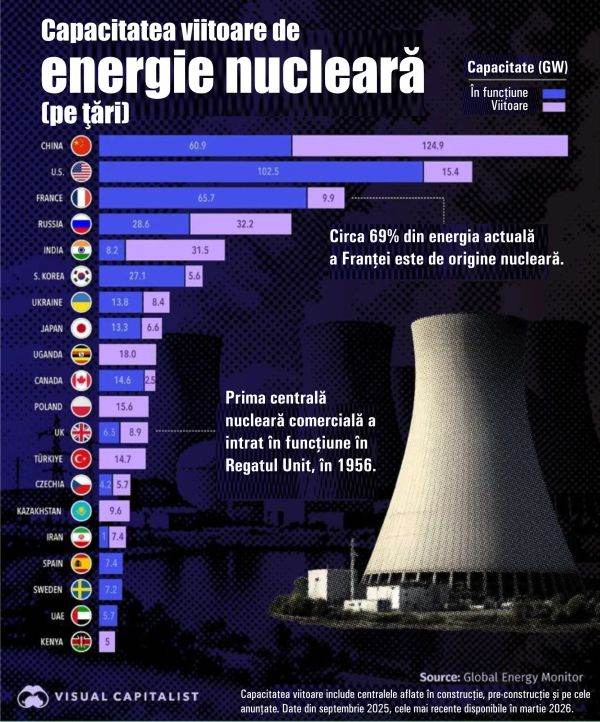
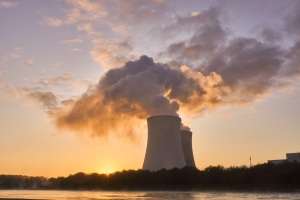
China is on track to become the world's leading nuclear power producer. Based on existing and planned projects, its total capacity could reach nearly 186 gigawatts (GW), far surpassing that of the current global leader, the United States, according to an analysis by visualcapitalist.com. The shift reflects broader pressure to provide reliable, low-carbon energy as demand for electricity grows.
The source ranked countries by current and future nuclear capacity, using data from the Global Energy Monitor.
• Current Top 3 - USA, France, China
The USA is currently the world leader in nuclear power generation, with a capacity of 102.475 gigawatts (GW), surpassing France, which has a capacity of 65.7 GW. China currently ranks third with 60.898 GW, but this will change as new plants come online. If all planned projects are completed, China will lead the field with 185.812 GW, followed by the USA with 117.91 GW and France with 75.590 GW.
This shift has major geopolitical implications. Countries that expand their nuclear capacity can reduce their dependence on imported fossil fuels, while strengthening energy security and grid stability.
France remains a historical leader in nuclear power, with around 69% of its electricity generated from this technology.
• World's first commercial nuclear power plant - hosted by the UK
The UK hosted the world's first commercial nuclear power plant, which went into operation in 1956, but has since scaled back its use of nuclear power, the source said. The government in London is now aiming for a "golden age of nuclear power”, although current commitments, totalling 15.4 GW, would place the country in 12th place globally. Of the 17 countries with zero installed capacity, Uganda is set to expand the most capacity - up to 18 GW, followed by Poland - with 15.612 GW and Turkey - with 14.7 GW.
• Betting on nuclear fusion and fission
Current nuclear expansion is centred on fission, the technology that powers all existing reactors and accounts for about 10% of global electricity generation, according to the source. Although mature, it is evolving through smaller, modular designs aimed at reducing costs, improving safety, and accelerating deployment. This explains why much of the planned capacity in the ranking includes not only large-scale plants, but also a growing wave of smaller reactors backed by governments and private capital.
At the same time, nuclear fusion, the process that powers the sun, remains a long-term ambition. Despite increasing investment and recent technical progress, it has not yet reached commercial scale.
For now, global nuclear development is firmly rooted in fission, as countries prioritize reliable, low-carbon energy that can be deployed within the next decade, concludes visualcapitalist.com.
• EU nuclear power production increased by 4.8% in 2024
The 12 EU member states with operational nuclear reactors generated, together, 649,524 GWh of electricity in 2024, 4.8% more than in 2023, the second consecutive year of increase in nuclear power production in the EU, according to data published at the end of January 2026 by Eurostat, according to Agerpres.
According to these figures, nuclear power plants were responsible for 23.3% of total electricity production in the EU.
The largest nuclear power producer in the EU, France, was responsible for more than half (58.6%) of all nuclear power produced in the EU (380,451 GWh). The following countries were: Spain, with 54,510 GWh (or 8.4% of the EU total), Sweden (50,665 GWh; 7.8%) and Finland (32,599 GWh; 5%).
Compared to the situation in 2023, nuclear energy production increased the most in France (12.5%), Sweden (4.5%) and Slovenia (4.2%). The other nuclear energy producers recorded decreases in production, ranging from minus 0.6% in Slovenia to minus 10.3% in the Netherlands.
In the case of Romania, the two reactors at Cernavoda produced 10,912 GWh in 2024, down from 11,191 GWh in 2023. Romania's nuclear energy production is lower than that of the Czech Republic, Slovakia, Hungary and Bulgaria. In the EU, the only Member States with a lower nuclear energy production than Romania are the Netherlands and Slovenia.
France remained the country with the highest dependence on nuclear energy, which in 2024 was responsible for 67.3% of total electricity production. Another Member State where more than half of the electricity was produced in nuclear power plants is Slovakia (61.6%). In contrast, only 2.9% of the electricity produced in the Netherlands came from nuclear power plants.
Between 2006 and 2024, contrary to the general trend at the European Union level, seven Member States increased their nuclear electricity production. In first place is Romania, whose nuclear energy production only started in 1996, where between 2006 and 2024 nuclear energy production recorded a jump of 93.8%. Other countries where nuclear energy production increased are: Finland (42.3%), Hungary (19%), Czech Republic (14.2%), Slovenia (5.2%), Netherlands (3.2%) and Slovakia (1.2%). During the same period, the rest of the countries (including the main producers) reduced their nuclear electricity production. Lithuania permanently closed its nuclear facilities in 2009, Germany in April 2023. Belgium recorded the largest decrease (minus 33%), followed by Sweden (minus 24.4%), Bulgaria (minus 19.6%), France (minus 15.5%) and Spain (minus 9.3%).
















 Euro
Euro Dolar SUA
 Franc elveţian
 Liră sterlină
 Gram de aur