English

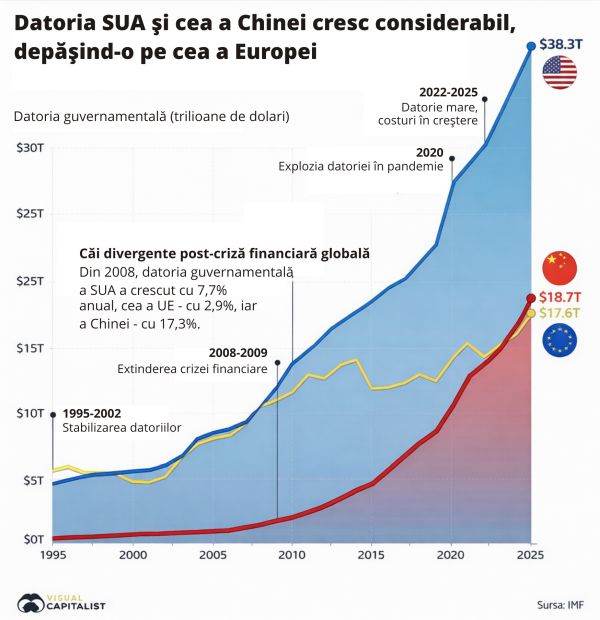
China's public debt surpassed that of the European Union (EU) for the first time in 2025, marking a major shift in the global debt landscape. Since the 2008 financial crisis, the US, China and Europe have followed very different paths in borrowing. While Europe has kept debt growth relatively contained, both the US and China have seen rapid growth - especially after 2020, according to an analysis by visualcapitalist.com, which plots the total annual public debt of the US, EU and China from 1995 to 2025 in US dollars (current terms, not adjusted for inflation), using IMF data.
In 2025, China's public debt reached $18.7 trillion, surpassing the EU's total of $17.6 trillion for the first time. The dynamics underscore how rapidly China's borrowing has grown over the past two decades.
• Rapid growth in US and Chinese government debt
In 2008, US government debt stood at $10.9 trillion, roughly equal to the EU's total of $10.7 trillion. By 2025, it had grown to $38.3 trillion, surpassing the EU by $20.7 trillion.
From just $1.2 trillion in 2008, China's public debt has grown by about 17% annually-fast enough to surpass the EU in less than two decades. Since 2008, US public debt has grown by about 7.7% per year, compared with about 3% per year for the EU.
• Fiscal constraints in Europe
While the EU's slower debt growth partly reflects weaker nominal growth across the bloc compared with the US and China, it is also a symptom of the tighter fiscal constraints imposed by the bloc after Europe's sovereign debt crisis, which peaked between 2010 and 2012. In contrast, China's sharp rise in debt was driven by credit expansion, infrastructure spending and state-backed growth.
Meanwhile, the US has combined crisis-era borrowing with persistent deficits, particularly after 2020, which has seen its debt rise far above Europe's. With fewer fiscal constraints at the federal level, Washington has maintained higher spending levels - which explains why US debt is now well above that of China and the EU.
• IMF: US economy to accelerate this year, but risks from tariffs and rising debt
A "robust" US economy is on track to grow faster this year and see a decline in the unemployment rate, but high federal debt "poses a growing risk to stability," a February report from the International Monetary Fund (IMF) said, cited by Reuters and AP, according to Agerpres.
The IMF's assessment of the world's largest economy is largely positive. The institution estimates that US GDP will register a growth of 2.4% in 2026, from a level of 2.2% forecast in 2025. Inflation rate, on the other hand, will not return to the US Federal Reserve's (Fed) 2% target until early 2027.
The Fed, which has cut interest rates three times in 2025, could afford to reduce them to about 3.4%, from 3.6% currently. But the institution should postpone deeper cuts unless there is a "material worsening” in the US labor market, IMF Managing Director Kristalina Georgieva said.
The United States has been helped by solid productivity growth. But Georgieva argues that the US economy would have performed better without the tariffs imposed by President Donald Trump.
The US president's protectionist trade policies "could be a bigger drag on economic activity than previously thought,” the report said.
The IMF has expressed concern about the level of US government debt, which is expected to rise from almost 100% of GDP in 2025 to about 110% of GDP by 2031.
The US Commerce Department recently announced that the world's largest economy grew by 2.2% last year, slowing from 2.8% in 2024 and 2.9% in 2023.
US GDP grew by just 1.4% in the fourth quarter of 2025, amid disruptions from the budget shutdown and subdued consumer spending. Analysts expect tax cuts and investments in AI (artificial intelligence) to support economic activity this year.
In addition, analysts had expected US GDP to grow by an annualized 3% in the last three months of 2025, after expanding by 4.4% in the third quarter and 3.8% in the second quarter.
Studies suggest that the increase in consumer spending was led by higher-income households, thanks to the stock market boom that increased household wealth. In contrast, middle- and lower-income consumers are being hit by the rising cost of living caused by President Donald Trump's tariffs, economists say, creating a so-called K-shaped economy.
These developments have created what economists and Trump's opponents have called an "affordability crisis.” Just 181,000 jobs were created last year, the fewest, excluding the pandemic, since the 2009 recession, and a sharp decline from a level of 1.459 million in 2024. The unemployment rate rose to 4.3% last year, from 4% in 2024.
Consumer spending, which accounts for two-thirds of U.S. economic activity, grew by just 2.2% in the fourth quarter of 2025, after a 3.5% advance in the previous three months.
Economists say these expenditures come mainly from higher-income households and come at the expense of savings, as inflation has eroded purchasing power.

























 Euro
Euro Dolar SUA
 Franc elveţian
 Liră sterlină
 Gram de aur