English

The end of the calendar spring found Romania at a time when politics, the economy and national security began to influence each other more strongly than at any other time in recent years. If the first months of the year were dominated by fiscal consolidation, the effects of the Middle East conflict on energy markets and the Government's attempts to limit the impact of inflation on the population and companies, May simultaneously brought a major political crisis, the first signals of budgetary stabilization, warnings from the National Bank and the rating agencies, as well as a significant change in the strategic priorities of the Romanian state.
The event that dominated the political scene was the adoption of the motion of censure against the Bolojan Government and the transformation of the Executive into an interim cabinet. The fall of the government came at a sensitive time for the Romanian economy, which is in the midst of a fiscal adjustment process and negotiations with the European Commission on the implementation of the reforms undertaken through the National Recovery and Resilience Plan. In parallel, the authorities tried to accelerate the adoption of measures considered essential for the absorption of European funds, the digitalization of the administration and the development of strategic industrial capacities.
In economic terms, however, May also brought the first concrete results of the fiscal consolidation that began in 2025. The Ministry of Finance announced the reduction of the budget deficit to 23.95 billion lei after the first four months of the year, equivalent to 1.17% of GDP, compared to almost 56 billion lei and 2.92% of GDP in the same period of the previous year. At the same time, the current account deficit continued to decrease, and the authorities presented these developments as evidence of a gradual change in the economic model, in which investments and European funds are beginning to replace the dominant role played by consumption in recent years.
These developments were closely monitored by international financial markets. Standard & Poor's reconfirmed Romania's sovereign rating in the investment grade category, and Fitch Ratings praised the progress made in fiscal consolidation, while warning that political instability and possible delays in reforms could affect the economy's prospects. The ratings agencies' messages were echoed by warnings from the National Bank of Romania, which decided to maintain the key interest rate at 6.50% and drew attention to the fact that inflation remains high, mainly due to the effects of the Middle East conflict on energy and fuel prices. At the same time, the month's agenda was influenced by the most serious security incident that occurred on Romanian territory since the beginning of the war in Ukraine. The crash of a Russian Geran-2 drone into a residential building in Galaţi led to the convening of the Supreme Council for the Defense of the Country, diplomatic reactions at the international level and a reassessment of priorities regarding the security of critical infrastructure. The incident heightened the perception of regional risks and provided an additional argument for accelerating investments in defense and strategic infrastructure.
In this context, May also became the period in which Romania repositioned itself at the center of the new European security architecture. The government approved the SAFE agreement with the European Commission, through which our country can access up to 16.68 billion euros for the development of the defense industry, logistics infrastructure and strategic capabilities. It is the second largest allocation in the European Union after the one granted to Poland and one of the largest investment programs ever launched in Romania.
At the end of May, the general picture indicated an economy in a fragile balance. The budget deficit and external imbalances were beginning to be reduced, public investments and European funds were becoming the main engine of economic growth, and the state was expanding its role in areas considered strategic. All these developments were taking place, however, in a context characterized by high inflation, economic slowdown, geopolitical tensions and a new period of internal political instability.
• Political uncertainty, after the adoption of the motion of censure
May began under the sign of the political crisis generated by the motion of censure against the Bolojan Government. After the PSD withdrew from the governing coalition and after the motion was submitted to Parliament, the Executive was dismissed on May 5 with 281 votes in favor of the motion, 4 votes against and 3 votes canceled. The Government remained in office with limited powers, at a time when Romania was in the midst of implementing the reforms assumed through the PNRR and negotiation with the European Commission on outstanding milestones.
Before adopting the motion, the Executive had tried to accelerate the adoption of measures considered essential for the continuation of investments and the absorption of European funds. Among these were legislative amendments regarding the defense industry, the digitalization of public administration, the government cloud and the financing mechanisms for local projects financed through the PNRR.
From an economic perspective, the immediate effects of the political crisis did not consist in a change in the direction of public policies, but in an increase in uncertainty regarding the state's capacity to continue reforms and to respect the commitments assumed in its relationship with European institutions and international investors. Precisely for this reason, both the NBR and the rating agencies included political stability among the main conditions for maintaining confidence in the Romanian economy.
• Budget execution indicates the first results of fiscal consolidation
In financial terms, the most important development of the month was the significant reduction in the budget deficit.
The Ministry of Finance announced that the budget deficit for the first four months of 2026 stood at 23.95 billion lei, or 1.17% of GDP, compared to 55.97 billion lei and 2.92% of GDP in the same period of the previous year. The data represented the Government's strongest argument in favor of the fiscal consolidation measures adopted starting with the second half of 2025.
The authorities argued that the reduction in the deficit reflects both the increase in the efficiency of revenue collection and the effects of the fiscal and budgetary measures implemented in recent months. At the same time, public investments continued to remain at a high level, mainly due to European funds and projects financed through the PNRR.
According to the four-month budget execution published at the end of May by the Ministry of Finance, total revenues amounted to 223.83 billion lei at the end of April 2026, marking a 12% increase compared to the same period in 2025. Expressed as a share of GDP, revenues advanced by 0.5 percentage points, mainly supported by collections from VAT, payroll and income tax and insurance contributions. Total expenditures amounted to 247.79 billion lei, recording a nominal decrease of 3.2% compared to the same period last year. As a share of GDP, expenditures decreased from 13.4% to 12.1%, recording a decrease of 1.24 percentage points (year/year).
In parallel, balance of payments data indicated an improvement in external imbalances. The current account deficit decreased to 5.338 billion euros in the first quarter of the year, compared to 6.153 billion euros in the same period in 2025. The reduction in the trade deficit contributed to this development, while the NBR's foreign exchange reserves remained at a comfortable level, over 64 billion euros at the end of May.
• Rating agencies confirm fiscal progress, but warn of political risks
In May, the attention of financial markets focused on the assessments made by the major international rating agencies.
Standard & Poor's reconfirmed Romania's sovereign rating at BBB-/A-3 on May 16, maintaining the country in the investment-grade category. The agency praised the efforts to consolidate fiscal policy and reduce the deficit, but maintained a negative outlook, stressing that the success of fiscal adjustment depends on the continuation of reforms and the maintenance of political stability. S&P estimates that Romania's economy could experience a temporary period of stagnation in 2026, influenced also by developments in international energy markets. For 2027, a recovery of the economy is anticipated, with economic growth of 2.5%, amid the implementation of reforms and the acceleration of investments, which could lead to the improvement of macroeconomic indicators and the reduction of external imbalances. The agency's estimate for the budget deficit is 6.25% this year, still a very high level compared to the levels recorded in Europe.
The rating action was unplanned, being outside the calendar announced at the beginning of the year, the reason being the special event caused by the dissolution of the coalition government following the vote of no confidence in the Romanian Parliament on May 5. The agency's next scheduled publication on Romania's sovereign rating is October 2, 2026.
For its part, Fitch Ratings sent a similar message on May 18. The agency noted the improvement in budget execution and the effects of fiscal measures adopted in the past year, but warned that political instability and possible delays in the implementation of reforms could affect the economic outlook and access to European funds. According to Fitch, the immediate impact of the current political situation on public finances is limited, given that the consolidation measures adopted in 2025 have started to produce visible effects. The agency notes that the budget execution in the first quarter of 2026 indicates a significant reduction in the budget deficit, standing at around 1% of GDP, almost half compared to the same period in 2024 and 2025. Fitch shows that, in the absence of a new government, the interim administration can continue implementing the 2026 budget, which targets a deficit of 6.2% of GDP, compared to 7.7% of GDP in 2025. At the same time, the agency warns that political uncertainty reduces visibility on the fiscal strategy for 2027 and 2028. The report also highlights the economic challenges in the coming period. Fitch notes that GDP contracted by 1.7% in the first quarter of 2026, and economic growth this year could be significantly below the 1.1% forecast considered in the February assessment. Fitch's next scheduled review of Romania's sovereign rating is July 31, 2026. Also in May, Fitch upgraded CEC Bank's rating, confirming the institution's consolidation and its increasingly important role in financing the economy. The bank's new long-term issuer rating is BB+, from BB, with a stable outlook. At the same time, Fitch assigned a BBB- rating for long-term deposits, signaling the bank's solid capacity to honor its obligations to depositors. Fitch's decision reflects the strengthening of CEC Bank's financial profile, solid capitalization and prudent risk management. In the published analysis, the agency also highlights the bank's ability to cope with adverse economic scenarios, including through the additional financial protection instruments developed in recent years.
The upgrade comes in a context of accelerated transformation of CEC Bank (where the majority shareholder is the Romanian state through the Ministry of Finance), which has consolidated its position in the banking system by investing in digitalization, expanding services and increasing the financing capacity of the Romanian economy.
The message sent by the rating agencies was clear: Romania has begun to reduce fiscal imbalances, but the credibility of this process still depends on the ability of the political class to ensure the continuity of reforms and avoid administrative blockages.
• BNR maintains key interest rate and warns of persistent inflation
In parallel with the developments in the fiscal plan, the National Bank of Romania continued to send signals of caution.
The NBR Board of Directors unanimously decided to maintain the monetary policy interest rate at 6.50%, the Lombard facility at 7.50% and the deposit facility at 5.50%.
According to the minutes of the meeting on May 15, inflation continued to represent the main challenge for the Romanian economy. The annual inflation rate rose to 10.71% in April, amid higher fuel prices, rising natural gas prices and indirect effects generated by the conflict in the Middle East.
The NBR estimates that inflation will reach around 10.3% in mid-year, before entering a downward trajectory. According to the central bank's projections, a return to the inflation target range is expected only in the second half of 2027.
At the same time, the central bank confirmed the slowdown in the economy. Data reviewed by the Governing Council point to a contraction in annual GDP in the first quarter of the year and a continued weakening of private consumption. In contrast, investment and net exports have started to play a more important role in supporting economic activity.
The NBR also warned of the risks generated by political instability, the persistence of twin deficits and by the volatility of international markets, underlining the importance of continuing fiscal consolidation and absorbing European funds.
• The Russian drone crashed in Galaţi shifts the public agenda towards security
One of the most important events of May was the crash of a Russian Geran-2 drone into a block of flats in the municipality of Galaţi.
The incident, unprecedented on Romanian territory since the beginning of the war in Ukraine, prompted the convening of the Supreme Council for National Defense and generated diplomatic reactions at the international level.
The event had implications that went beyond the sphere of national security. For the first time in many years, critical infrastructure, defense and economic resilience became central themes of public debate and government policies.
The incident reinforced the arguments regarding the need to accelerate defense investments, secure logistics infrastructure and develop strategic industrial capacities at the national level.
• SAFE transforms Romania into a major player in the new European defense economy
In this context of deteriorating security, one of the most important economic decisions of the month was the approval of the SAFE agreement between Romania and the European Commission.
The program offers our country access to funding of up to 16.68 billion euros for the development of the defense industry, strategic infrastructure and logistics capabilities. Romania thus received the second largest allocation in the European Union, after Poland.
The authorities announced that approximately 4.2 billion euros will be directed towards strategically relevant transport infrastructure, and a significant part of the funds will be used to develop Romanian industrial capabilities.
The Ministry of Defense claimed that approximately 60% of the program's value is to be rolled out through the national industry, which transforms SAFE not only into a security project, but also into a major economic and industrial development program.
• PNRR enters decisive phase
May also highlighted the difficulties encountered in implementing the National Recovery and Resilience Plan.
The Government acknowledged the existence of delays in meeting the milestones and targets assumed in the relationship with the European Commission. Of the 45 targets and milestones analyzed, only a part were considered fully met, and the risk of losing European funds became a major concern for the authorities.
In this context, the Executive introduced bridge financing mechanisms for local authorities and mobilized central administration institutions to accelerate projects under implementation.
Over 11,000 projects financed through the PNRR and other European programs were in various stages of execution, and the Government insisted on the need to respect deadlines to avoid losing available resources.
• Investments and new industrial policy become the main growth engine
As private consumption continues to slow down, the authorities have tried to promote a new model of economic growth based on investments, innovation and industrial development.
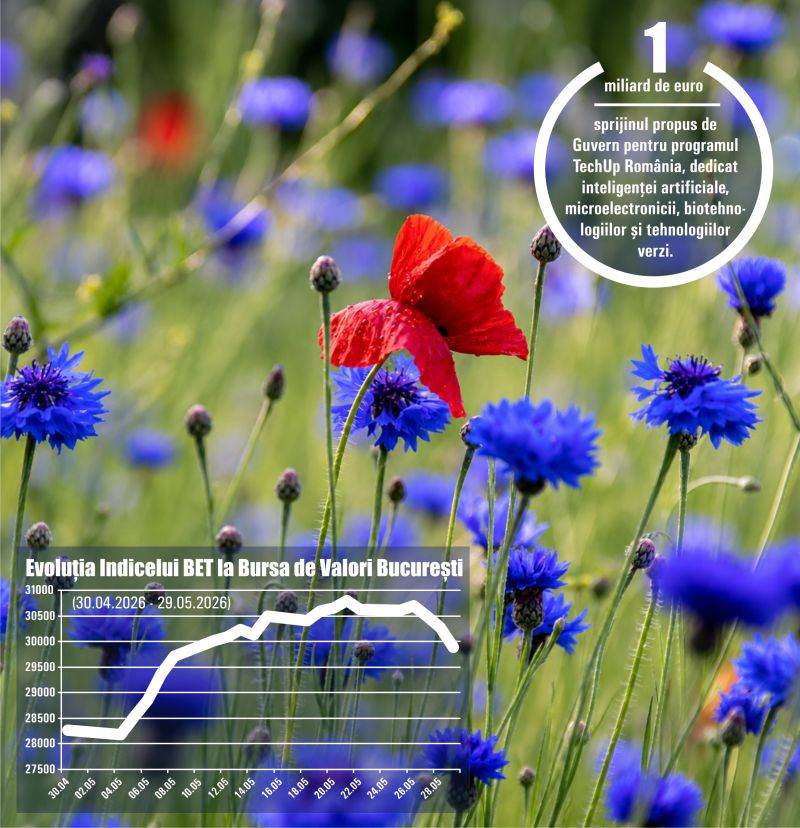
Among the initiatives launched in May was the TechUp Romania program, dedicated to artificial intelligence, microelectronics, biotechnologies and green technologies. According to the document published by the Ministry of Finance, the objective of the project is to accelerate the modernization of the economy and the creation of high added value at the national level. The program will have an annual budget of 759 million lei for the period 2026-2032 and is part of the Economic Recovery Package approved by GEO no. 8/2026. The scheme will accelerate economic growth by stimulating high-value-added investments and will support the optimization of the trade balance through technology exports and the consolidation of labor productivity by creating highly qualified jobs. The "TechUp Romania" program provides for the provision of financing for projects with an investment value between 5 million and 50 million lei, structured on two components: Component I (Research-Development) - Financing through grants from the state budget, cumulated with a 200% tax deduction for R&D expenses; Component II (Production) - Grants for initial investments in production capacities, using tangible and intangible assets.
The scheme is addressed to frontier projects in the following fields: digital - advanced computing, artificial intelligence, microelectronics; life-science - bio-technology, agri-tech, precision health; energy - green energy, storage, climate technologies; mobility&space - autonomous systems and space technologies; industry 4.0 - advanced materials and modern industrial production.
The total estimated budget of TechUp is up to 5.3 billion lei (one billion euros), allocated in stages over the period 2026-2032.
Another investment stimulus program is "Diaspora Invests at Home”, designed to attract capital and expertise from Romanians abroad. The total budget allocated by the Ministry of Finance for this program is 100 million euros. Grants can cover up to 60% of the value of the investment loan, up to a limit of 200,000 euros for each eligible beneficiary. Investment loans can have values between 5,000 euros and 500,000 euros. The support will be granted during the period 2026-2029, through the Investment and Development Bank, and the minimum own contribution is 10%, respectively 5% for entrepreneurs under 35 years of age.
At the same time, new financing schemes were approved for energy projects, local infrastructure, afforestation, energy storage and the modernization of public administrations.
In agriculture, support programs have been launched for producers, for the livestock sector and for investments in irrigation, in an attempt to increase the sector's resilience in a difficult climatic and economic context.


















 Euro
Euro Dolar SUA
 Franc elveţian
 Liră sterlină
 Gram de aur