English


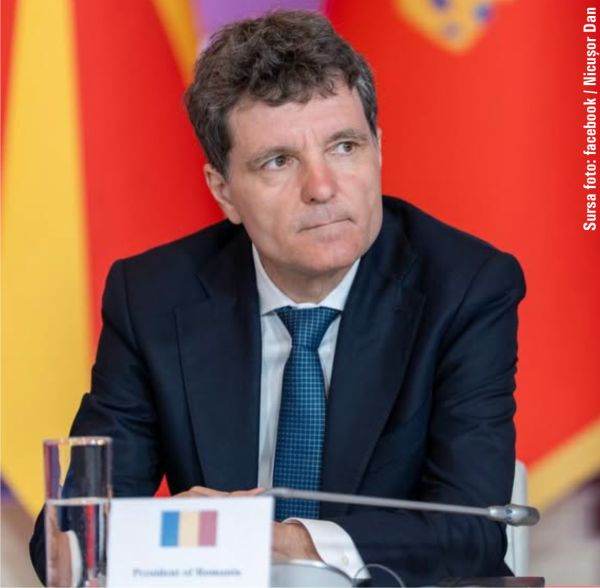
After being silent for almost a month, President Nicuşor Dan felt it was time to babble. Or rather, he found the opportunities to do so. Two days ago, he participated in three events, during which he delivered three speeches. We will not stop at the one delivered at the meeting at the Cotroceni Palace with Romanian diplomats, but we will analyze how Nicuşor Dan discovered collective guilt and self-righteousness in the speeches addressed to young magistrates and young Orthodox Christians.
In both speeches, the country's president called for responsibility, courage and decency, but in both he moved on to judging people en bloc and dividing society into moral categories.
Addressing the young magistrates, Nicuşor Dan said: "Regarding the justice system, a few observations. The most important - the justice service is a public service. It is addressed to the public and is measured by the public, and the most important indicator is people's trust in the justice system. And if this trust is what it is today, 25%, it means that all of us together are doing something wrong and it is something that all of us together must correct. There is another relationship that will take us some time to balance: the relationship between the justice system and politics. Because first it was politics that neglected, after which some excesses occurred on the other side, I am referring especially to the area of salaries, and after which, most seriously, a campaign of blaming the entire professional body began."
The formula "we all do something bad together” sounds responsible, but it is used in a convenient way by the country's president, who instead of identifying the real culprits for the low trust of citizens in the justice system, blames everyone. If everyone is guilty, the blame no longer belongs to anyone precisely. The competent magistrate is placed next to the incompetent magistrate, the independent judge next to the politician who attacks the courts, the rigorous prosecutor next to the institution that delays a case. The differences disappear into a diffuse blame, rhetorically useful and useless for correcting the system. Responsibility is not distributed equally just because distrust is general. It must be established through facts, attributions and concrete decisions. This is precisely the logic of justice that President Nicuşor Dan invokes: you do not condemn a category, but investigate the conduct of each one.
• Heads of Prosecutors' Offices, evaluated ex-ante by President Nicuşor Dan
Related to collective guilt and the lack of individual guilt, another passage from the same speech by the country's president is relevant. Nicuşor Dan said: "As for prosecutors, things are somehow simpler here. There is an expectation of society related to several things - domestic violence, drug trafficking, and so on, but the most important expectation is related to the phenomenon of corruption - grand corruption, petty corruption. I am waiting for the six months to pass since the appointment of the chief prosecutors. The impression, so far, is that the activity has become more dynamic, let's look at the numbers. One good thing is that we have separated the criminal investigation from television. The fact that important documents from important files no longer reach sources in the public space is a step forward."
In other words, the president conducted an ex-ante evaluation of the Prosecutor General, the Chief Prosecutor of the DNA and the Chief Prosecutor of the DIICOT, and found that the activity has been stepped up. What President Nicuşor Dan does not see or perhaps omits is the fact that, although the activity seems to have been stepped up, the files investigated by the prosecutors still concern small and medium-sized criminals. The files concerning white-collar politicians are becoming fewer and fewer and we do not believe that grand corruption has diminished that much in our country. But since Nicuşor Dan does not see any individual guilt, he cannot assume that he made a mistake regarding the appointment of high-ranking prosecutors and that is why he wants to assure us that the Prosecutor's Office is dum dum.
• Conformity or compliance?
Also in the same speech, the head of state also said: "Then, I think there are some temptations, from my humble experience as a litigant. I think there are some temptations that a young magistrate has, (...). There is a temptation of arrogance, because you went through a tough school, and somehow you were selected from many people who studied law. What I can say is that all the time, and from many people, you have to learn. There is a temptation of sufficiency, which, again, I saw in several of the magistrates. The same thing: one - the image of the Romanian state is at stake, two - for personal development, it is not good. I saw a temptation to give the state justice. Unhealthy. Because, if you let the state make a mistake once, it will make a mistake a second time, and a third time. And I also saw a temptation of conformism. If everyone is going in one direction, why should I go in another? And, again, here we need the courage of your own opinion. (...) Have the courage of your own opinion, that the story about the system is always much more impressive than what we call the system".
We will not refer to the first two temptations that can be observed very easily in courtrooms throughout the country, but we will stop at conformism. To conform means in the magistracy, in terms of making decisions, to be in agreement with judicial practice. You, as a young magistrate, can have as many personal opinions as you want, but in the profession, conformism is what guides you. As a young magistrate, you comply with the decisions of the Constitutional Court, the rules imposed by the Superior Council of Magistracy and the Judicial Inspection, and you are even required to comply with the instructions received from the higher court when the file whose decision was quashed on appeal or restitution returns to the court of first instance.
And then there is Lia... Savonea, the president of the High Court of Cassation and Justice. I believe that President Nicuşor Dan did not refer to the fact that young magistrates do not have to comply when sounds... Lia. Because, if they did so, then the young judges would risk being immediately sent to the SCM or the Judicial Inspection, after which they would be sanctioned... Even with exclusion from the magistracy. It does not matter if it is legal or not, the decision will be made. This is what happened in the case of the nonconformist magistrate Cristi Dănileţ, who, fortunately, obtained justice in the European courts and was able to retire from the magistracy.
• The Confessing Pharisees
At the meeting of young Orthodox Christians, Nicuşor Dan changed the audience, not the mechanism. The president of the country said: "First of all, I would like to invite you to confess publicly, and not only inside the church, the things, the values in which you believe, because it seems to me that this confession is missing from our society, and it seems that the place of a confession that is firm, but simple and decent, in the public space is taken by the Pharisees. And I am worried about the adherence that some of these they have in parts of Romanian society. The same thing about nationalism. Because this country has a history, we don't come from nowhere. There were people in these places who fought for some values and who made us what we are today. And we must be proud of these people. Looking back at what they managed to achieve, we must believe that we can make this country what they dreamed of and what each of us dreams of for our children. And precisely because in the public space there is not enough of this confession and our appreciation of the past of this country and of a healthy nationalism, we see that the public space is dominated, on the one hand, by defeatists who say that we will never be able to do anything in this country and, on the other hand, by demagogues who beat their fists in their chests and climb on some essential elements of the past, and precisely the voice of those who, with decency, believe and work for Romania is unfortunately not heard and must be heard".
The accusations are serious, especially since they were made in a Christian setting, that is, inside the Patriarchal Cathedral. According to the Christian Orthodox faith, the Pharisee is not just a man with other opinions, but the image of the one who simulates faith and virtue for prestige, influence or power.
Nicuşor Dan did not say who these Pharisees are and by what deeds they can be recognized. He launched the label and let the audience identify them. Each participant could imagine their own political or religious opponents. Thus, a discourse on decency risks legitimizing exactly the moral judgment devoid of evidence. Then, Pharisaism is not the monopoly of one camp. It is practiced by anyone who transforms values into decoration, faith into a political instrument, patriotism into a spectacle or moral superiority into an argument. You can condemn Pharisaism only by pointing out the contradiction between what someone proclaims and what they do. Otherwise, the term becomes a solemn insult.
• Patriotism - a healthy concept, unknown to Nicuşor Dan
The same lack of precision appears when Nicuşor Dan speaks of "healthy nationalism”. The president associates it with respect for the past, pride in one's ancestors and confidence that Romania can become a better country. However, these describe a healthy patriotism. The difference is not one of vocabulary, but of focus. Healthy patriotism is the attachment to the country, people, culture and institutions, accompanied by the willingness to defend and improve them. It does not need an adversary and does not assume the superiority of Romanians over other peoples. The patriot can harshly criticize the state precisely because he cares about the country. He respects his past without falsifying it and loves his community without despising other communities.
If we accept Nicuşor Dan's formulation regarding healthy nationalism, we can speak of a political doctrine through which the nation defends its continuity, sovereignty, language, culture and the right to decide of the future. In the president's view, nationalism becomes unhealthy when it transforms the nation into an absolute value, demands uniformity, seeks internal enemies, cultivates ethnic superiority or subordinates the rights of the individual to a supposed national interest.
Nicuşor Dan seems to talk about patriotism, but he calls it nationalism. When he praises those who "believe and work for Romania", when he demands respect for ancestors and hope for the future of children, he describes a patriotic conduct. The confusion matters, because the term "nationalism" can introduce into public discourse a logic of demarcation: who truly belongs to the nation, who represents it and who can be accused of working against it.
The president then denounces the "defeatists" who claim that nothing can be done in Romania and the "demagogues" who cling to the country's past. Among them would be decent people who believe and work for Romania. The scheme is convenient: we are the decent ones, the others are either defeatists or demagogues. But whoever radically criticizes Romania is not necessarily a defeatist, just as whoever invokes history is not automatically a demagogue. The difference is established by what each one says and does, not by the category in which the power places him.
A president has the right to criticize magistrates, politicians, religious leaders or false patriots. He even has the obligation to do so when there are facts. But he cannot replace facts with percentages, individual responsibility with collective guilt and argument with moral verdict.













 Euro
Euro Dolar SUA
 Franc elveţian
 Liră sterlină
 Gram de aur