English


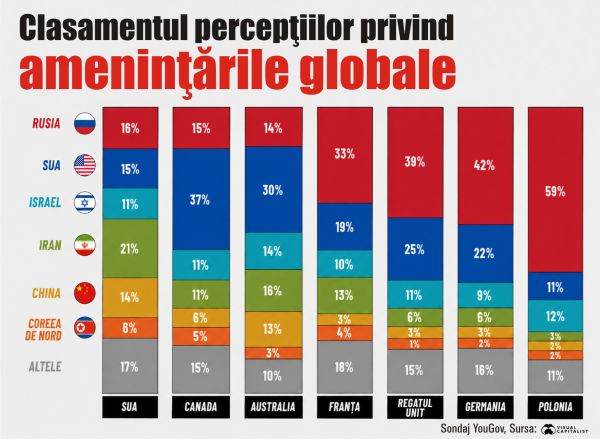
Public perception of geopolitical threats differs significantly between countries, especially between Europe and North America.
Visualcapitalist.com presents the conclusions of an international YouGov survey conducted between June 17 and July 1, 2026, on a sample of 14,725 adults from seven countries (approximately 2,000-2,300 respondents per country). They were asked which country they consider the biggest threat to world peace, and the answers differed depending on the region.
• Europe sees Russia as the biggest threat to peace
Russia ranks as the biggest threat to world peace in all European countries surveyed, according to the cited source. The strongest result is in Poland, where 59% of adults mention Russia (the highest share of all countries surveyed). It is followed by Germany (42%), the United Kingdom (39%) and France (33%).
Beyond these positions, two other patterns stand out. China is considered a threat by only 2-3% of respondents in the four European countries, compared with 13% in Australia and 14% in the United States. Israel, on the other hand, has the narrowest range of responses in the survey: between 9% and 14% in all seven countries.
• Americans see Iran, Russia and themselves as threats
Americans are more divided. Iran is the most common answer, at 21%, but no one country dominates their perception: 16% say Russia is the biggest threat, 15% name the US itself, 14% point to China, and 11% point to Israel.
Two of America's closest allies diverge significantly from the European pattern. In Canada, 37% name the US as the biggest threat to world peace, more than twice as many as the 15% who choose Russia. Australia follows a similar pattern, with 30% considering the US the main threat, compared to 14% who point to Russia.
The US also ranks second in the UK and Germany, at 25% and 22% respectively. The findings reflect broader shifts in how countries around the world perceive America, including less favorable views of the US amid trade and tariff tensions.
• ECB: Iran war significantly affects euro zone consumer confidence
Household consumption in the euro zone has fallen significantly since the outbreak of the Iran war, amid falling consumer confidence, with data suggesting that the escalation of the conflict will again affect consumer spending, according to a study published this month by the European Central Bank (ECB), Reuters reports, according to Agerpres.
Consumer confidence in the euro zone fell significantly after the outbreak of the Iran war, then recovered slightly, even if it remains below the pre-conflict level, slowing economic growth, which has been modest in recent years.
The decline in consumption in April was twice as large as historical trends and comparable in magnitude to the response of households after Russia's invasion of Ukraine in February 2022, the ECB said.
"These data show how strong the confidence channel is in the event of large shocks perceived by consumers," the report said.
After an average growth of 3%-4% in mid-2024, nominal consumption growth slowed to around 2.5% in April, as higher-income households cut back on non-essential spending.
"This supports the view that the slowdown is not the result of income pressures, but rather that some households are postponing purchases in difficult geopolitical situations,” the ECB said.
Households are also concerned about the rapid rise in inflation caused by the conflict, which could erode real income, and 40% of those surveyed said they did not expect to recover these losses.
The survey results confirm the ECB's view that the war in Iran will not severely affect euro area economic growth, despite the impact of rising energy prices on consumption and corporate profits. Economists expect the European Central Bank to raise interest rates in September.




















 Euro
Euro Dolar SUA
 Franc elveţian
 Liră sterlină
 Gram de aur