English


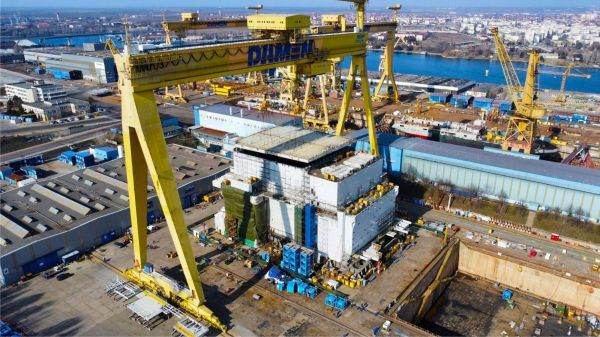
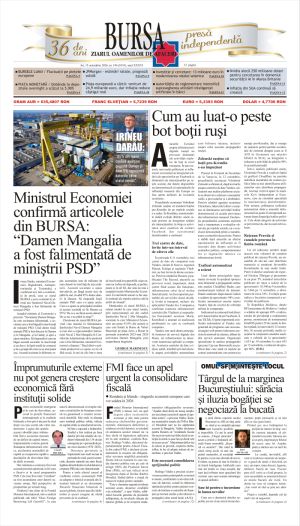
Mangalia Shipyard is approaching the final point, after the National Trade Union Bloc announced yesterday that Damen Shipyards did not approve the reorganization plan, and the direct consequence is the opening of bankruptcy proceedings.
"During the General Meeting of Creditors held today, Damen Shipyards did not approve the company's reorganization plan. Under these conditions, the reorganization procedure failed, and bankruptcy proceedings will be opened," says the press release issued yesterday by the National Bank of Romania, which warns that bankruptcy means "the forced inventory and valuation of the company's assets" and that, with the company's delisting, individual employment contracts cease and employees lose their jobs. In a shipyard where people have not received their wages for over three months, this is no longer a simple episode of insolvency, but the moment when an industrial collapse becomes official.
Damen Holding responded immediately and explained why it blocked the reorganization: the plan proposed by the judicial administrator "totally excludes the repayment of significant investments and loans granted by Damen Holding to the shipyard, both now and in the future”, which, in the Dutch group's view, creates "a major imbalance” and produces "substantial damage for Damen”. The company claims that it will not take decisions that affect its legitimate interests or those of its employees, partners and other stakeholders, but clearly states that it cannot support the current plan and that support for the future of the shipyard can only exist "within a fair framework that fully reflects the contributions of all parties involved”. In economic terms, the rift between shareholders is total, and bankruptcy no longer comes as a surprise, but as the culmination of a confrontation that has been going on for years.
In fact, what is happening now in Mangalia confirms almost point by point what the BURSA newspaper has been reporting for the last three years, more precisely since August 2023, when Damen announced that it was withdrawing from the shipyard, which meant that 1,500 employees were in danger of losing their jobs and that a collapse in activity would follow.
The decision by Damen almost three years ago came as a result of a situation created by the Romanian state, a situation in which the Dutch company had nothing but to lose. As we have previously reported in the pages of our newspaper, at the beginning of 2018, Damen announced the agreement with DMHI to take over the shipyard for 26 million dollars; after negotiations that lasted more than half a year, the Romanian state became the majority shareholder, after Damen transferred 2% of the majority stake to it for free, and in return the Dutch were to receive operational control; to make this formula possible, the Dăncilă government amended the legislation by ordinance in July 2018.
The implicit premise was that Mangalia would become the construction platform for corvettes intended for the Romanian Naval Forces. However, that contract was awarded to the Naval Group-Constanţa Naval Shipyard association, after which, on March 14, 2024, the Ciolacu government repealed HG 48/2018, abandoning the "Multifunctional Corvette” program. In other words, the strategic foundation on which the partnership with Damen had been built collapsed, and the entire edifice was left without its initial industrial justification.
In April 2024, the shipyard was blocked by the lack of decisions from the Ministry of Economy. Damen officially notified the Romanian state, on August 4, 2023, that it was withdrawing from the agreement, and from then until the spring of 2024, the state representatives, through the STNM 2 Mai, blocked, month after month, in the AGA, the taking of any decision. Practically, in the spring of 2024, the shipyard had neither the budget execution for 2023 nor the budget for 2024 approved, and the management team was prevented from signing contracts that could have brought 300 million euros to the company. It was, practically, the administrative radiography of an institutional sabotage carried out by the state: the company still existed, but was prevented from functioning. Following this situation, at the end of May 2024, the Damen group filed for bankruptcy of the Damen Mangalia Shipyard. At that point, the shareholding structure was already clear to everyone: the Romanian state held 51% through a company controlled by the Ministry of Economy and listed on AeRO, and Damen had 49%. Bankruptcy, which today seems to be materializing procedurally, was already the legal weapon prepared at the moment when the partnership became impossible.
In May 2025, the picture became even harsher: the Romanian state declared itself the majority shareholder in the Damen Mangalia Shipyard without investing a single leu, after taking over absolute decision-making control, although on paper it left a free hand to the operational management appointed by the Dutch company. Thus, the decision-making power was concentrated in the state, but without assuming the real cost of rescue, without the investment to industrially support the construction site and without the managerial coherence necessary in a platform with strategic stakes.
In February 2026, Radu Miruţă, the Minister of National Defense, declared, regarding the Damen Mangalia Shipyard: "I tell you very confidently that, if I had a unique power in this country, I would not even think about legal methods by which you could save a strategic shipyard. (...) Something worth 85 million euros cannot be bought for 85 when you have debts of 162 million. I realized that, just playing with these two parameters, that shipyard will die. That shipyard can only be saved if in the immediate future it will produce such ships (ed. - corvettes or other military ships). It is the largest shipyard in the member countries of the European Union, it is a shipyard on the Black Sea, on the eastern flank of NATO, which has a fantastic capacity".
The Defense Minister's statement does not describe a restructuring strategy, a legal solution for exiting insolvency, or a corporate governance plan that would avoid a repeat of the conflict between the state and the investor.
And a week before yesterday's announcement by the National Bank of Romania, the Government prepared the ground for the full takeover of the Damen Mangalia Shipyard, followed by its placement in a strategic circuit controlled, according to political and military sources, by Rheinmetall, for the construction of military ships financed through the European SAFE mechanism. This is a draft emergency ordinance through which the state will take over companies in certain strategic sectors, including the naval industry, a legislative initiative through which the state creates its instruments to take over the assets of the Damen Mangalia Shipyard, in order to subsequently clean up the legal and financial situation of the shipyard through takeover. After that, the "cleaned” infrastructure could be offered to an external strategic actor.
Viewed in this sequence of events, the press release issued yesterday by the National Bank of Romania and the reaction of Damen Holding mark a situation in which employees have not been paid for over three months, hundreds of people have been laid off, contracts worth 300 million euros have been missed, debts of 162 million euros are recorded and a huge industrial asset, of over one million square meters, has been systematically pushed from shipbuilding to surviving on repairs and, now, towards bankruptcy.
The harsh truth is that Mangalia is not collapsing because of a single decision made yesterday by Damen. The shipyard is falling after years of political promises, strategic improvisation, administrative blockage and war between shareholders. And bankruptcy may not be the end of the story, but just the procedure by which the state prepares the total reset of the shipyard, to remove it from the industrial logic in which it was destroyed and throw it directly into the military logic in which it hopes to revive it. However, after everything that has happened since 2018, the question is no longer whether the state can take over Mangalia, but whether it can save some of the economic credibility of this project.






















 Euro
Euro Dolar SUA
 Franc elveţian
 Liră sterlină
 Gram de aur