 English


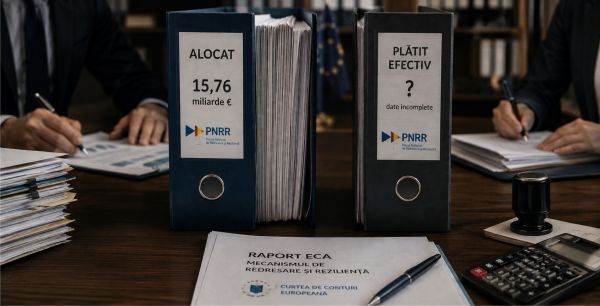
The authorities in Bucharest have only made transparent the "amounts granted” to final beneficiaries and not the "amounts actually received” by them, as required by the European Regulation for the application of the Recovery and Resilience Mechanism, according to a report published yesterday by the European Court of Auditors (ECA). According to the auditors within the European institution, the difference is essential: between the approved amount and the amount actually paid, there can be huge gaps, delayed projects, modified contracts or unused funds.
In addition, Romania is included by the European Court of Auditors in the category of countries that use actual cost data to update estimates and that sometimes reallocate funds within the NRNP when savings or cost overruns occur. However, the auditors point out that no country reviewed, including Romania, does this systematically.
The report also contains concrete data on the differences between the estimated and actual costs of some completed measures in Romania. According to the Court, for seven completed measures analyzed in detail, the costs estimated by the central authorities in Bucharest totaled euro39.4 million, while the actual costs were only euro33 million, which means an 84% ratio between the actual costs and those initially estimated. The auditors warn that if this trend continues, there is a risk that the total funding received by some Member States, including Romania, "will not be reasonably close to the actual costs”.
In other words, Brussels approved and allocated amounts calculated on the basis of estimates that, in practice, may significantly exceed the real costs of the implemented projects. The findings are all the more sensitive for our country, as we are already under pressure from delays in the PNRR, renegotiations of milestones and disputes regarding the reforms undertaken in exchange for the billions of euros promised by Brussels.
We note that, in the respective report, in addition to our country, the ECA auditors also checked the PNRRs of Austria, Bulgaria, Estonia, France, Germany, Latvia, Malta, the Netherlands and Spain.
In the case of Romania, the European auditors also identified other problematic aspects. One of the most important observations concerns the way information about the largest beneficiaries of PNRR funds is published. European auditors insist that the traceability of European money must allow the financial flow to be traced "from source to destination”, including to the contractors and subcontractors who actually carry out the works or provide the services financed by the PNRR. This is precisely where one of the most important vulnerabilities identified by the European Court of Auditors appears.
Although all member states are required to publish the list of the 100 largest final beneficiaries of MRR funds, the auditors show that these lists only provide a partial and incomplete picture. The reason is simple: in very many cases, the final beneficiaries are ministries, public agencies or state-owned companies, and European rules do not require the publication of payments subsequently made by these institutions to private companies that execute the contracts.
The Court's conclusion is devastating for the idea of total transparency: "Public information on who ultimately benefits from the MRR and in what amount is therefore incomplete.”
The report reveals that public bodies represent over half of the beneficiaries included in the lists of the 100 largest final recipients and concentrate, on average, over 80% of the published amounts.
In the case of Romania, the analysis carried out by the European Court of Auditors indicates a total value of approximately 15.76 billion euros associated with the list of the 100 largest final beneficiaries. However, the auditors explicitly note that Romania reports on the basis of the amounts "attributed” and not those actually paid.
In fact, the Court offers in the report as a positive example Bulgaria, where the public management system allows for a detailed view of beneficiaries, contractors, subcontractors and the amounts actually paid, including the possibility of tracking all entities involved in projects financed from European funds. In contrast, at the European level, the auditors argue that transparency regarding the real beneficiaries of the money remains insufficient.
The Court draws attention to the fact that the lack of data on real costs and the complete flow of money also affects the assessment of the efficiency of the European program. According to the auditors, the information published by Member States and the European Commission focuses mainly on administrative achievements and the fulfilment of milestones and targets, not on the actual results achieved.
In the official statement accompanying the report, Ivana Maletić, the member of the European Court of Auditors who led the audit, issues one of the strongest institutional warnings yet on the use of MRR funds.
"Citizens have less trust in public finances if the money is not spent in full transparency,” says Ivana Maletić. The European official continues in a very direct tone: "We do not have a complete picture of how MRR funds are used. Citizens have the right to know how public funds are used, who receives the funds and how much is actually spent. These transparency gaps in the MRR should not have repercussions on future EU budgets.”
The European Court of Auditors stresses that the problem is all the more important given the huge financial size of the MRR. By the end of January 2026, the European Commission had already committed euro577 billion to all 27 Member States, of which euro360 billion in grants and euro217 billion in loans. The European instrument, officially created in February 2021 to support the post-pandemic recovery and transformation of European economies, will end in August 2026, but payments to Member States can continue until the end of this year.
The European Court of Auditors' report is thus not just a technical audit of the functioning of the MRR, but also a major political warning for the future of how the European Union will distribute hundreds of billions of euros. The European auditors make it clear that the lessons of current failures must be integrated into future European financial mechanisms.
In this regard, the Court makes two major recommendations. The first recommendation aims to introduce rules to ensure "the complete, systematic and timely collection and publication of information on the use of EU funds”, including information on "all public and private beneficiaries, recipients, final beneficiaries, contractors and subcontractors, including amounts committed and paid up to the level of contractors”. The second recommendation calls for the systematic use of real cost data to assess the efficiency of spending European money. The Court explicitly asks the European Commission, in the case of the MRR, to use already available real cost data to assess ex-post the efficiency of the use of resources and to determine whether "the total real costs were reasonably close to the estimated costs”.
For the government in Bucharest, the conclusions of the European Court of Auditors come at a delicate moment, when the implementation of the PNRR is already marked by delays, contested reforms, renegotiations with Brussels and pressures on the absorption of funds. The report shows, however, that the problem is not only the speed with which European money is spent, but also the state's ability to clearly demonstrate where this money goes, who actually receives it and how much the funded projects actually cost. And the message of the European Court of Auditors is clear: without full transparency and without real traceability, public trust in European financial mechanisms risks being eroded at the very moment when the European Union is preparing a new generation of budgets and funds built on the same financial model used for the PNRR.



















 Euro
Euro Dolar SUA
 Franc elveţian
 Liră sterlină
 Gram de aur





























