 English


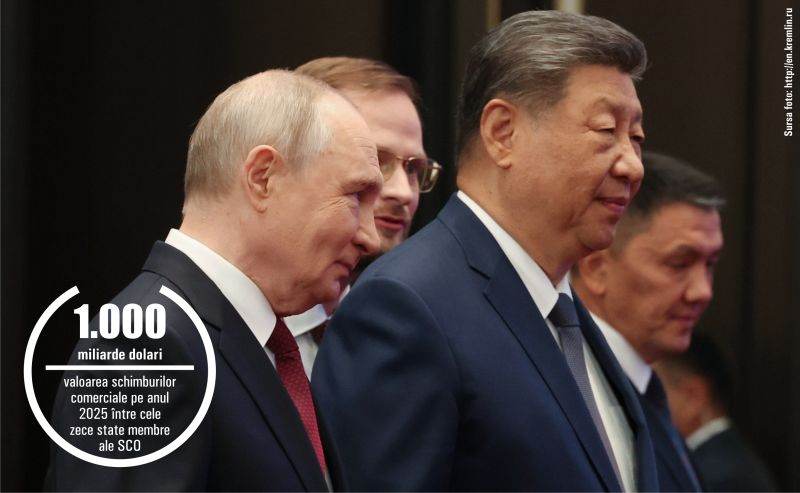
The Shanghai Cooperation Organization (SCO) summit, which took place in Kyrgyzstan, did not bring the consensus desired by Vladimir Putin - the President of the Russian Federation and Aleksander Lukashenko - the President of Belarus, to transform the SCO Development Bank into a functional institution. Although the political decision to establish the bank had been taken at the previous summit held in Tianjin (China) on September 1, 2025, at yesterday's event the leaders of the ten member states of the organization did not agree on the mechanisms necessary to operationalize this international financial institution, but they established that negotiations on essential elements would continue.
Vladimir Putin explicitly supported the operationalization of the SCO Development Bank and said that it should be as independent as possible from the financial systems of states that use economic instruments for political pressure. He added a very important number: in Russia's transactions with the SCO states, over 98% of settlements are already made in national currencies. Moreover, according to the Kremlin leader, Russia's trade with the SCO states exceeded 400 billion dollars in 2025.
Alexander Lukashenko, in turn, called for the acceleration of the establishment of the SCO Development Bank and an increase in the share of national currencies in transactions between members, explicitly linking the bank to the "financial sovereignty" of the SCO space.
Kassym-Jomart Tokayev, the President of Kazakhstan, offered his country to host the headquarters of the future SCO Development Bank, if the members reach a consensus. He proposed that the bank should primarily finance infrastructure, technology and industrial projects.
The blockage in the operationalization of the SCO Development Bank does not mean that the project will be abandoned, but quite the opposite. In May 2026, the finance ministers and central bank governors of the SCO states noted progress in consultations on the bank and agreed to continue work on developing the organization's financial infrastructure. The discussions also covered expanding the use of national currencies in mutual settlements. At the end of June, the fourth round of consultations on the Development Bank, held in Shenzhen under the co-chairmanship of China and Kyrgyzstan, brought together delegates from 28 countries and the SCO Secretariat. Negotiators continued discussions on the key elements of the bank and the work plan for the next stages, implicitly confirming that the institution still exists more as a political project than a financial reality.
• Three-year roadmap for the operationalization of the Development Bank
Kyrgyzstan has revealed since the spring how complicated the process is. A temporary secretariat and a three-year roadmap were created, and officials in Bishkek estimated that the negotiations would continue for about two years. At that time, the mandate, management structure, and operational procedures were being discussed, without even the size of the authorized capital having been established.
This is precisely where the difference between geopolitical rhetoric and the difficulty of institutional construction becomes apparent. A multilateral bank is not just about a headquarters and an initial capital. States must agree on capital contributions, voting shares, veto rights, governance, lending criteria, currencies used, the institution's rating, and, inevitably, on the relationship between China - the organization's economic giant - and the other members. Inside the SCO are radically different economies and monetary regimes, from China and India to Russia, Iran, Belarus, Pakistan, and the Central Asian republics. Building a common financial institution for all of them is incomparably more difficult than adopting a political declaration on multipolarity.
But the stakes explain the insistence of Moscow and Minsk. For Russia and Belarus, faced with Western sanctions and restrictions on access to international financial infrastructure, the development of alternative financial mechanisms is not a theoretical matter, but a strategic one. For China, such an institution could complement the existing arsenal - the Asian Infrastructure Investment Bank, the New Development Bank of BRICS, the Belt and Road Initiative, and the Chinese cross-border payment system CIPS - without Beijing being obliged to turn the yuan into a fully convertible currency. For the smaller states of Central Asia, the equation is different. They see the bank as a potential source of financing for infrastructure, energy, transport, and cross-border projects, but at the same time must avoid turning the institution into an instrument dominated exclusively by Beijing or Moscow. Kyrgyzstan has explicitly explained that the future bank could finance large-scale transnational projects and infrastructure on more favorable terms.
However, the authorities in Beijing are already building, bilaterally, the financial infrastructure that can power this system, and this fact emerged from the meeting of the Chinese and Kyrgyz leaders, which took place within the framework of the SCO summit.
Thus, according to the Chinese, Kyrgyz and Azerbaijani media, Xi Jinping and Sadyr Japarov agreed to support Kyrgyz banks eligible for connection to CIPS - China's Cross-Border Interbank Payment System - and to expand the use of local currencies in bilateral trade and investment. K-News also confirms the signing of an agreement on servicing participants in the cross-border interbank payment system for Eurasian trade corridors. This does not mean that the SCO has created a complete alternative financial system to the dollar. It would be an exaggeration to say so. But the institutional pieces are starting to be put in place.
The process is real, however, as long as the parties have discussed the key elements of the future institution and decided to continue negotiations.
• The conflict in Ukraine, omitted from the final declaration of the summit
Also yesterday, the leaders of the ten member states of the Shanghai Cooperation Organization - China, Russia, India, Iran, Pakistan, Kazakhstan, Kyrgyzstan, Belarus, Tajikistan and Uzbekistan - adopted the Final Declaration of the summit, a political document that establishes the organization's common positions on international order, security, regional conflicts and economic cooperation.
The text of the document published in full by the TASS agency shows that the international system is undergoing major geopolitical, economic and technological transformations, against the backdrop of conflicts, energy and food problems, market instability and climate change. Therefore, the SCO states support the formation of a multipolar international order and the reform of the global governance system so that states participate on more equitable terms in the international decision-making process.
The organization reaffirms its support for the UN Charter, the sovereignty and territorial integrity of states, non-intervention in internal affairs, and the political and diplomatic settlement of conflicts. The SCO further defines itself as an organization that does not represent a political-military bloc and is not directed against other states.
One of the most important elements of the Declaration is the absence of the war in Ukraine. The conflict is not mentioned in the final document, although Vladimir Putin and Narendra Modi discussed the issue during the summit, and the Indian Prime Minister advocated an end to the war and a peaceful solution. The absence of Ukraine indicates the lack of a common position of the ten members on the conflict.
Iran, on the other hand, is explicitly mentioned. The SCO states express concern about the situation in the Middle East and around Iran and support the sovereignty and territorial integrity of the Iranian state. The SCO supports a political and diplomatic settlement of the Iranian crisis and rejects the use of force in international relations outside the framework provided for by international law.
The declaration also contains an important economic position: the SCO states oppose unilateral coercive economic measures considered incompatible with the UN Charter, international law and the rules of the World Trade Organization. The position directly concerns Russia, Iran and Belarus, which are under extensive Western sanctions, but is also relevant for China, which is faced with trade and technological restrictions imposed in particular by the United States.
The member states support the reform of the global economic governance system and the maintenance of an open, transparent, fair, inclusive and non-discriminatory multilateral trading system. The declaration supports fair access to markets and the maintenance of special and differential treatment granted to developing countries. The SCO reaffirms its Economic Development Strategy until 2030 and aims to increase trade between member states, reduce trade imbalances and strengthen regional production and supply chains.
The organization supports the development of financial and economic cooperation and the reduction of vulnerabilities generated by unilateral economic measures. This objective overlaps with the expansion of the use of national currencies in trade between some member states and the development of alternative financial infrastructures.
• India opposes the implementation of the Belt and Road Initiative
According to the cited document, Belarus, Iran, Kazakhstan, Kyrgyzstan, Pakistan, Russia, Tajikistan and Uzbekistan reaffirm their support for the Belt and Road Initiative and for its connection with other regional economic projects, including the Eurasian Economic Union. As can be seen, India is not among the states supporting the Belt and Road Initiative. The position confirms New Delhi's refusal to legitimize the Chinese strategic project, although India continues to participate in the SCO and support the boosting Eurasian connectivity through other projects.
The declaration adopted yesterday attaches great importance to transport infrastructure and the development of trade corridors between member states. The SCO aims to improve connectivity, logistics infrastructure and Eurasian trade routes. This orientation is complemented by the Action Plan for the Development of Ports and Logistics Centers of the SCO States for 2026-2030, adopted separately at the summit.
Projects relevant to this strategy include the Belt and Road Initiative, the China-Kyrgyzstan-Uzbekistan railway, the International North-South Transport Corridor, the Trans-Caspian routes and infrastructure connecting China and Central Asia with Pakistan and the Indian Ocean. For China, these corridors diversify trade routes to Central Asia, the Middle East and Europe. For Russia and Iran, the development of land routes offers important trade alternatives under Western sanctions. For Central Asian states, the corridors can generate investment, transit revenues and access to more markets.
Energy is another important area of cooperation. The declaration mentions energy security, and the summit separately adopted two documents on energy efficiency and cooperation between the energy systems of the member states. The SCO brings together major oil and gas producers - Russia, Iran and Kazakhstan - and two of the world's largest energy consumers, China and India.
The organization also pays attention to food security and the stability of supply chains, which are considered components of economic security.
In the technological field, the declaration identifies digital transformation and technological development among the major factors changing the world economy. Separately, the summit adopted documents on artificial intelligence, regional data centers and computing capabilities.
The member states also approved cooperation in the field of information security. The SCO plan for international information security covers the period 2026-2028.
The declaration attaches an important role to the fight against terrorism, separatism, extremism, cross-border crime and drug trafficking. The summit separately approved the creation and operation of SCO structures to combat security threats and drug trafficking.
Essentially, the text of the document signed yesterday by the leaders of the ten SCO member states shows that they want the Eurasian region to have greater economic, financial, energy, technological and logistical autonomy, based on the development of regional trade, their own infrastructure and cooperation between states that do not have a common foreign policy or the same strategic interests.























 Euro
Euro Dolar SUA
 Franc elveţian
 Liră sterlină
 Gram de aur





























