English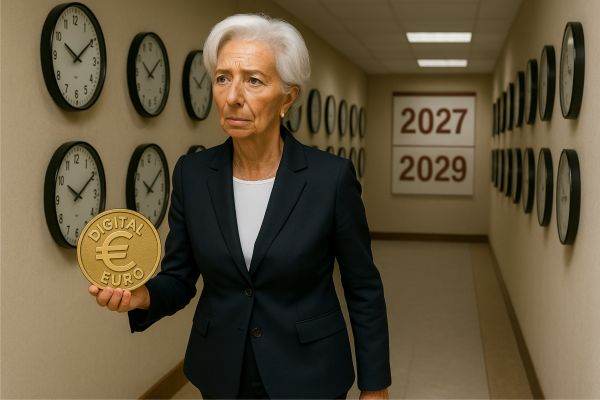
The euro-digital currency is having a hard time taking off, and this is displeasing to Christine Lagarde, the president of the European Central Bank, who pushed it to the forefront of the European agenda, according to a journalistic investigation published yesterday by the European website Follow The Money.
The cited source claims that, while the ECB is selling the project as an instrument of financial sovereignty, intended to break the dependence on the American payment giants -Visa, Mastercard and the entire infrastructure dominated by the dollar-, commercial banks and an influential part of the European political class have put the brakes on the establishment and launch of the European digital currency. The result: a project that claims to be revolutionary, but which, for now, seems more like a prolonged birth, with political, technical and geopolitical complications.
The strongest opposition is exerted by the European Parliament, through rapporteur Fernando Navarrete Rojas, who, according to the journalistic investigation cited, has become the most important ally of the banking status quo.
Christine Lagarde feels that time is pressing for her personally. Speaking in September in Helsinki, in front of central bank representatives, she said bluntly that the digital euro project is taking "too long” to get underway. She admitted, with bitter realism, that "my mandate will have expired when the digital euro is finally launched for good”, knowing that her eight-year presidency of the ECB ends in October 2027.
While the political clock is ticking, the technical project is dragging on: the digital euro has been in the works for about six years, and a possible launch is already pushed back to 2029. On the legislative front, things are moving along at a snail's pace. The European Commission's digital euro project was submitted to the Strasbourg Parliament in June 2023 and, according to the cited source, has remained stuck in a drawer ever since. Instead of being accelerated, the project has become a political battleground. Christine Lagarde openly complained that the democratic process in the European Parliament works "like too strong a brake at a time when speed is essential.” She said this not as an authoritarian whim, but out of the frustration of a central bank that sees how other states, such as China and the US, are already projecting their monetary power into the digital age, while the eurozone remains captive to high fees, slow transfers and structural dependence on private infrastructure.
• Unfavourable preliminary report from the European Parliament
But Fernando Navarrete Rojas, a Spanish MEP from the European People's Party (EPP) group, Parliament's rapporteur on the digital euro, presented a preliminary report in October in which he argued that a digital currency issued by the ECB has "little chance and would bring insufficient benefits” and that the issue should be left to "private initiative” - in other words, commercial banks.
Journalists from Follow The Money point out that since taking over as rapporteur in December 2024, Fernando Navarrete Rojas, according to data on the European Parliament's website, has had dozens of meetings with banks, financial service providers and lobby groups, while civil society organisations have been practically kept at the door. Of the 82 official meetings on the digital euro project, 35 were with banks or interest groups, 19 with financial service providers, and only two with civil society organisations.
MEPs are expected to respond to the Navarrete report by December 12, a date that could decide whether the digital euro remains a powerful public instrument or is transformed into an anemic, market-driven version.
Several MEPs, an economist and a monetary reform activist have already expressed concern about the rapporteur's position and its consequences. Nikos Papandreou, a Greek MEP from the Socialists and Democrats (S&D) group, warned, according to the cited source, that postponing the project and making it conditional on the private sector "is not a strategy”. In his opinion, what is happening is "paralysis” and "standing on the sidelines will have serious consequences”. In this context, Fernando Navarrete Rojas did not respond to requests for comment submitted by Follow The Money, which, according to the cited source, reinforces the impression that the MEP is communicating with industry rather than public opinion.
• 3,000 digital euro holding threshold per person
The idea of a digital euro did not emerge in the wake of the 2008 financial crisis. The cited source shows that, for over a decade, groups such as Positive Money have campaigned to move away from our exclusive dependence on private banks for savings and payments, and have warned that as cash withdraws from everyday life, the only form of money issued directly by a public authority is disappearing from people's wallets. In this logic, a digital currency or an account opened directly with the central bank would rebalance the ratio between public and private money, would limit systemic risk and strengthen transparency. But when the European Commission came up with the concrete proposal for the digital euro in June 2023, the initial enthusiasm was tempered: the project is limited to transforming the digital euro into a simple means of payment, not a savings instrument.
The ECB even mentioned a holding limit of 3,000 digital euros per person, although this is not yet official. Economists such as Paul Tang, a former S&D MEP, immediately criticized the paradigm shift. "The digital euro now seems to be all about payments and not about savings,” he said, recalling that the original question was whether people's savings were really safe with the big banks, and the answer, in his opinion, remains "no, not enough.”
In public discourse, Christine Lagarde has tried for years to present the digital euro as a project that "will affect society as a whole,” going so far as to say this summer that the "global moment of the euro” has arrived.
But the technological and geopolitical realities are less favorable to Europe. Transferring money between eurozone countries can still take days, with high fees, and citizens remain dependent on private banks and American credit card companies for the most mundane payments. About half of EU member states rely entirely on international card providers for debit card transactions, according to an ECB study published in February 2025.
Unlike the European Union, the People's Bank of China has been studying digital currency since 2014, and by the 2022 Winter Olympics, the digital yuan was already in widespread use. Beijing is now working with other Asian states to interconnect digital payment systems. In the US, official policy is a mix of reluctance towards CBDCs and acceleration of another phenomenon: stablecoins, i.e. cryptoassets whose value is tied to traditional assets such as the dollar. Citizens and companies around the world hold more than $300 billion in stablecoins, and the US Treasury expects this to increase tenfold by the end of the decade.
The governor of the Dutch central bank recently warned that if stablecoins continue to grow at the current pace in the US, they could threaten financial stability in Europe, echoing warnings also issued by Lagarde, who says that the introduction of foreign stablecoins could expose the EU to the risk of massive bank runs in the event of a panic.
• Big European banks want "innovative private payment solutions”
Against this backdrop, the ECB hopes that the digital euro directive will be adopted sometime in 2026. But it all depends on the final form of the Navarrete report and how MEPs amend or validate it.
The source cited, however, claims that the banking lobby has left nothing to chance. As the simple statistics of the meetings it had with the European Parliament rapporteur show, the banking sector has occupied the dominant position in the consultations and continues to press for a version of the digital euro that does not threaten their profitability. The European Payment Initiative (EPI), which brings together major European banks and financial services firms, sent a letter to MEPs after the preliminary report, warning that a digital euro issued by the ECB would slow down innovation and asking politicians to support "innovative private European payment solutions” instead.
The ECB reacted harshly, warning that the EPI letter is in fact calling for the subordination of public money to private money in the retail sector, by de facto discriminating against public money and preventing the central bank from issuing its own means of payment for the mass market. The tension is amplified by the fact that EPI is developing its own instant payment service - Wero -, designed to compete with Visa, Mastercard, ApplePay and GooglePay in Europe, and several members of the coalition have announced plans for a euro stablecoin, precisely in the logic of countering US dominance in this market. Behind the scenes, civil society organizations are trying to salvage what they can of the original idea of the digital euro. The European Consumers' Union (BEUC) reported that the meeting with Navarrete was "constructive”, although there were "different points of view” on the development of the digital currency. However, the organization Positive Money is much more critical, saying that it has tried several times to get a meeting with the rapporteur, without success. Laura Casonato, the group's policy chief, says the organization has been completely ignored, despite being one of the few civic voices working on the issue, and the influence of the banking lobby is clearly visible in the preliminary report. In her analysis, the banking lobby "successfully reduced the ambitions from the very beginning,” transforming the digital euro from a rebalancing the technical tool, strictly limited, low-cap, offline gadget with no real impact on the banks' power to control the population's deposits.
It's not just who is involved that matters, but also how the project is redesigned. Navarrete supports a simplified version of the offline digital euro, basically a chip card, and proposes postponing the development of an online version for internet payments. In the report, he writes that the introduction of an online variant should be "conditioned by the absence of a private pan-European retail payment solution”. This means that the online digital euro becomes plan B, activated only if the private market "does not deliver”. In these conditions, . Laura Casonato, head of Positive Money, warns that the report questions "the existence and rationale of the project as a whole”, and that the fact that "the banking lobby has reduced the ambitions since the beginning of the project” is no longer a suspicion, but a conclusion.
Faced with these brakes, Christine Lagarde is trying to maintain direction. At the end of October, the ECB announced that it had entered the final phase of preparations for the digital euro. Lagarde reiterated that banknotes would continue to circulate and that the ECB "wants cash to also exist in the form of a digital euro,” in a video message released a week after the presentation of the Navarrete report. The ECB president has the backing of the Governing Council and EU heads of state, but she faces a deeply divided Parliament: conservative groups see the digital euro as a threat to their banks, while more progressive factions consider it essential for the autonomy and resilience of the continent. Gilles Boyer, a French MEP from the Renew Europe group, warns that the digital euro "can only be successful if it is not reduced to an offline shadow of itself” and insists that "Europe cannot wait indefinitely for private solutions that have not materialized.” In his view, "public money cannot be absent from the digital world.”
• Mugur Isărescu calls for cybersecurity in the payment system
In this tense European picture, Romania brings a note of brutal realism through the voice of the governor of the National Bank of Romania, Mugur Isărescu, who recently linked the debate on the digital euro to an absolute prerequisite: cybersecurity. Speaking about the attempts of Sweden and New Zealand to move to full digitalization and about the plans for the digital euro, the governor of the National Bank of Romania showed that the authorities have come up against two very concrete things: on the one hand, the elderly population rejects digitalization and prefers cash; on the other hand, without robust cybersecurity infrastructures, the full transition to digital money becomes an existential risk. Mugur Isărescu stated: "If we don't have clear cybersecurity systems, the Russians will finish us off, they will block our payments in three days.”
His message goes right to the heart of the problem: it is not enough to draw digital currencies on paper or in European treaties; we must be able to defend the payment infrastructure against cyber attacks in real time, in a context in which the war in Ukraine has already shown how aggressive these attacks can be against some European states. Without solid cybersecurity, the digital euro is not just a delayed project, but a potential Trojan horse in our own financial system.
Thus, the digital euro project is caught between three major pressures. The ECB and Lagarde insist that Europe needs a public digital currency to defend its monetary sovereignty, reduce dependence on Visa, Mastercard and American stablecoins and give citizens a safe alternative to private bank money. The banking lobby, represented institutionally by the EPI and countless other structures, is fighting for the digital euro to be amputated, limited, pushed into plan B and transformed into a neutral technical product that does not touch the central nerve of banking power: the population's deposits. And the voice of central bankers like Mugur Isărescu introduces a dimension without which any discourse on digitalization would be pure propaganda: cyber vulnerabilities, technological capacity and the real preferences of citizens, from pensioners to heavy card and app users.
If the digital euro continues to be born so slowly, it is not only because democracy is "pushing the brakes”, as Lagarde complains, but because what is at stake is not a simple payment application, but a redistribution of power between public and private money, between European infrastructures and US-dominated infrastructures, between the promise of financial sovereignty and the fragile reality of our IT systems. Europe risks remaining in a dangerous zone: too slow to keep up with China and the US, too dependent on Visa, Mastercard and private stablecoins, too politically divided to undertake an ambitious project, too cyber-vulnerable to throw itself headlong into the arms of digital currency. The digital euro will, in the end, either a powerful instrument of European sovereignty or a modest offline shadow, born after years of procrastination, compromises and backstage pressures. And if Europe continues to lag behind indefinitely, while others are already consolidating their dominance in the world of digital payments, neither Christine Lagarde's most passionate plea nor Mugur Isărescu's harshest warnings will matter: the EU will miss the moment when it could dictate the rules of the game.


























 Euro
Euro Dolar SUA
 Franc elveţian
 Liră sterlină
 Gram de aur