English

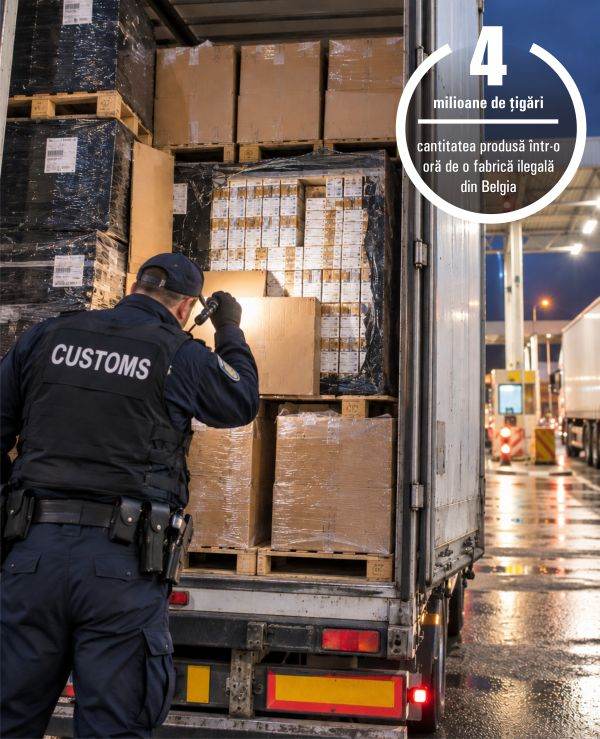
Almost one in ten cigarettes consumed in the European Union comes from smuggling or illegal production, and the losses caused to public budgets are estimated at 13 billion euros per year, according to a report published yesterday by the European Court of Auditors (ECA). The document also mentions that organized crime networks have moved their clandestine factories closer to consumers, while European institutions and national authorities act fragmentedly, exchange information with difficulty and do not even have a precise picture of the size of the black market. Romania is among the countries where the lack of a dedicated strategy, the limited competences of the Customs Authority and the technology deficit weaken the state's response.
In essence, the ECA auditors claim that the European Union is losing ground in the fight against one of the most profitable businesses of organised crime: the illegal tobacco trade. Traditional smuggling has not disappeared, but the phenomenon has radically transformed. Clandestine factories have been moved from Ukraine to the EU, illegal production lines operate on an industrial scale, transport routes are becoming increasingly sophisticated, and e-cigarettes, vaping liquids and heated tobacco products are opening up new markets that European legislation has not yet managed to control uniformly. The audit, which analysed the period 2023-2025, targeted the European Commission, the Directorate-General for Taxation and Customs Union, the European Anti-Fraud Office and the competent authorities in Belgium, Spain, Poland and Romania. The conclusion of the European auditors is severe: the actions of the Commission and the Member States are not sufficiently robust, the EU does not have clear strategic priorities, cooperation between authorities is uneven, and no one is truly coordinating the entire European response.
"Each year, according to available estimates, around euro13 billion in revenue is lost in the EU due to the illicit tobacco trade. This is not a small amount. It is euro13 billion that never reaches our hospitals, schools or other public services. And, what is more alarming, we do not have a reliable EU-wide overview of the true size, structure and economic impact of this illicit market. (...) Although smuggling has existed for a very long time and has been a problem, what is new now is that illegal production plants have been detected in almost every EU Member State. Organised crime is increasingly moving its production within the Union, shortening supply chains, getting closer to consumers and exploiting differences in law enforcement and sanctions across the European Union. The consequences go far beyond the loss of tax revenue. The illicit tobacco trade undermines public health policies by making these products cheaper and more accessible, especially for our young people. It also fuels organised crime, finances other illegal activities and creates unfair competition for legitimate businesses. Against this background, the findings of our audit are particularly worrying. Our main conclusion is clear: the current EU framework for combating the illicit tobacco trade is not robust enough,” said Petri Sarvamaa, the Member of the European Court of Auditors who led the audit, at an online press conference held at the institution's headquarters yesterday.
• Almost one in ten cigarettes is smuggled
In 2023, the European Commission estimated that products from the illicit trade represented 8.8% of total cigarette consumption in the European Union. In other words, almost one in ten cigarettes smoked on the EU market was smuggled or illegally produced.
The scale of the phenomenon is not limited to classic cigarettes, however. The ECA report shows that the illicit market for other tobacco products is estimated at almost 21,000 tonnes in the EU. At the same time, new products, including heated tobacco and electronic cigarettes, have come to represent around 13% of the value of the tobacco products market in the Union and are particularly attractive to young consumers.
The ECA auditors say that all this illegal trade simultaneously hits public finances, health and security. Cheaper products undermine policies aimed at reducing smoking, and the profits obtained feed organised crime groups. For criminals, illicit tobacco offers an almost ideal combination: very high profits, low probability of detection and sanctions that are often too mild to have a real deterrent effect.
We also note from the cited document that European Commission officials estimate that the illegal trade costs the EU and member states euro13 billion in lost revenue each year in customs duties, VAT and excise duties. However, the auditors warn that this figure should be interpreted with caution, as it is based on external studies, especially since the EU executive does not have its own, independent and reliable estimate of the size of the illegal market, its structure and its total economic impact. European data is largely based on seizures made by authorities, and seizures only show the detected part of the phenomenon. OLAF's annual report for 2025 shows that operations in which the institution participated led to the seizure of more than 427 million illegal cigarettes worldwide. Of these, 219 million were seized at the EU's external borders. OLAF also contributed to the seizure of 411 kilograms of raw tobacco and 53.6 kilograms of hookah tobacco, preventing losses of over euro178 million to the European and national budgets. However, these results do not allow the calculation of the entire black market or the real fiscal damage.
• Clandestine factories have moved within the EU
The major transformation found by the European auditors is the relocation of illegal production. Organised crime groups have strategically moved their manufacturing capacities from Ukraine to the EU to shorten supply chains and reach consumers more easily. In 2023-2024, illegal factories were dismantled in most Member States. Only Denmark, Greece, Luxembourg, Malta, Slovakia and Finland did not report such cases. Clandestine production uses sophisticated equipment and experienced technicians, and criminals divide the different stages of the manufacturing process between several locations, including border areas, to reduce the risk of the entire network being wiped out in a single operation.
The operating life of such a facility is estimated by ECA auditors to be between two and four months, but the investment can be recovered in just a few weeks. The groups quickly adapt their production to the target markets, manufacture the brands sought after in a given country and even introduce new products containing nicotine.
The industrial scale of the business is illustrated by an illegal factory dismantled in Belgium in 2025. The unit was in continuous operation, with four production lines, and each machine could produce around one million cigarettes per hour. In Spain, authorities seized three million packs of counterfeit cigarettes from the largest illegal factory discovered and dismantled to date. According to the comparison used by the European Court of Auditors, if the seized cigarettes were laid horizontally on top of each other, the resulting column would be 56 times higher than Mount Everest. Last month, French authorities dismantled a Belgian cross-border tobacco smuggling ring supplying the city of Lille. The ring had only been operating since December last year, and yet in that short time it had made around 120 deliveries to Lille, each carrying around 7,500 packets of cigarettes.
Smuggling remains a major threat. Products are brought into the EU by road, sea, in containers, but also by postal parcels and express courier services, with criminals taking advantage of the huge volume of e-commerce. Areas and countries associated with the main routes include Russia, Belarus, Georgia, Turkey, Serbia, Montenegro, Egypt, North Africa, the United Arab Emirates and South-East Asia.
To understand the scale of the phenomenon, the estimated annual damage of 13 billion euros in the case of tobacco smuggling exceeds the 11.2 billion euros that the European Commission wants to collect annually by introducing additional taxes and duties in the next European multiannual financial framework 2028-2034.
• Romania, without a dedicated strategy and with the Customs Authority limited to administrative investigations
The report reveals several vulnerabilities in Romania. Unlike the customs authorities in Belgium, Spain and Poland, which have extensive legal powers and their own investigative structures, the Romanian Customs Authority has powers limited to administrative investigations. The criminal component falls exclusively under the responsibility of law enforcement agencies.
Under these conditions, combating clandestine factories and smuggling depends to a greater extent on mixed teams, collaboration protocols and rapid exchanges of information between institutions. Any delay, interoperability issue or jurisdictional conflict can give criminal networks the time they need to move goods, equipment or evidence.
The ECA auditors also state that our country has no national strategy dedicated to combating illicit tobacco trade. Like Belgium and Spain, central authorities in Bucharest rely on broader national frameworks, while Poland is the only country among the four reviewed to treat the phenomenon as a high-priority area and has a specific strategy.
The auditors also identified a technological gap. Belgium, Spain and Poland use a wide range of advanced equipment. Romania uses technology in daily checks, but needs more high-tech equipment and a greater capacity for data management and analysis. This weakness is all the more important as Romania is located on the external border of the European Union and is exposed to both smuggling routes and the risk of developing clandestine production.
The report also highlights a dangerous legislative gap: in Romania, confiscated equipment and unprocessed tobacco can be sold or auctioned. However, there is no effective mechanism for authorities to track their subsequent use. In the absence of monitoring, the machines and raw materials confiscated by the state risk returning to the same illegal market from which they were removed.
On the other hand, the auditors also mention a good Romanian practice: the establishment of specialized organizational structures, including a service dedicated to combating illicit trafficking in tobacco products. However, the existence of the structure does not compensate for the lack of a national strategy, the limits of competence, the technological deficit and the fragmentation of cooperation.
The document also shows that our country has requested, together with Belgium and Spain, the harmonisation of definitions of crimes and sanctions at European level. The Romanian authorities have warned that differences in punitive regimes may cause criminal groups to move their activities to countries where penalties are lower.
• Criminals take advantage of legal borders within the EU
In nine Member States, smuggling and illicit production are treated exclusively as criminal offences, while others use mixed systems, where acts below certain thresholds are punished as minor offences and serious cases are brought under the criminal law. There are even situations where prison sentences for illicit production are lower than those for smuggling, even though the number of clandestine factories is increasing. The ECA auditors argue that these differences turn the legislation into a map of opportunities for organised crime: production can be set up in more lenient jurisdictions, and the goods can be transported to markets with higher prices and taxes.
The report also shows that the entire European framework is incomplete when it comes to raw materials and equipment. Raw tobacco and production machinery are not covered by the Tobacco Products Directive and are not subject to common European monitoring or traceability requirements. There are also no harmonised rules for cigarette paper, filters, flavours and packaging. The same fragmentation affects heated tobacco products, e-liquids and online sales. Member States can adopt different regulations, and loopholes between national systems are exploited by criminal networks.
The Commission proposed in July 2025 to revise the Tobacco Taxation Directive to introduce stricter monitoring of raw tobacco and to include new products. However, at the time of writing, in May 2026, the proposal had not been adopted. Furthermore, it focuses on raw tobacco, leaving other key components of illegal production outside the harmonised regulation.
• Information travels slower than illegal goods
While criminal networks operate across borders and rapidly change their routes, national authorities continue to use different systems and exchange information in an uneven manner.
We examined ten seizures in each of the four countries visited to check whether relevant information had also been transmitted to the authorities of other Member States. Cross-border cooperation was identified in only two, three, four and five cases out of the ten examined in each country respectively.
The authorities reported information that was incomplete, late or inconsistent in structure and level of detail. All four countries, including Romania, indicated that developing a faster and better structured real-time cross-border exchange of data was an absolute priority.
Several channels are currently used: Europol's SIENA application for operational and criminal information, OLAF's AFIS Anti-Fraud Information System for administrative cooperation and the framework provided by the Naples II Convention for exchanges in criminal matters between customs authorities. In practice, Member States use these tools differently and do not always interpret the legal purpose of the each channel.
The European institutions do not have access to all the necessary information either. OLAF has developed its analytical capacity through the Fraud AP platform, but it does not have access to the Import Control System 2 data, unlike DG TAXUD. Access to this information would allow it to identify suspicious shipments more quickly and prepare more effective operational responses.
• Too many institutions, but no real command centre
The report shows that at European level, responsibilities regarding tobacco smuggling are divided between DG SANTE, DG TAXUD, OLAF, Europol, the Council working groups and the European Multidisciplinary Platform against Criminal Threats - EMPACT. Each structure looks at the phenomenon from a different angle: public health, taxation, fraud, customs or organised crime. However, none has a clear mandate to align priorities and coordinate all initiatives.
Added to this is the fact that the responsible authorities at EU level do not have independent and reliable information on the true size, structure or economic impact of the illicit tobacco market.
ECA member Petri Sarvamaa added: "Without reliable data, it is very difficult to understand the scale of the problem or to direct resources where they will have the greatest impact. If you only see the tip of the iceberg, it is almost impossible to tackle the underlying problem. This weakness is also reflected in the way the current system works. Responsibility for combating the illicit tobacco trade is shared between several EU bodies and national actors, including the European Anti-Fraud Office (OLAF), Europol, Eurojust and the European Public Prosecutor's Office (EPPO). They all play an important role, but the overall response lacks the coordination and, in particular, the strategic direction that one would hope to see.”
The auditors warn that this institutional proliferation leads to duplication, repetitive questionnaires and meetings, draining the resources of already understaffed administrations. At one point, no Member State offered to coordinate a proposed European action against tobacco smuggling, so it was not included in the next action plan of the customs group.
Romania, Belgium and Spain considered that the activities of the Customs Enforcement Task Force had less impact and added value due to its regional focus. In contrast, they rated EMPACT positively, for its permanent structure and its capacity to identify and dismantle criminal networks, as well as the joint customs operations, which were considered well prepared and coordinated.
OLAF set up a task force on illegal cigarette production, but the results remained limited. Of the three specific projects announced, only one survey had been carried out by April 2025. Low participation, insufficient resources and the lack of a strategic framework meant that the new approach did not generate enough concrete measures.
All authorities in the four countries visited considered that the EU lacked a clear strategy or action plan and called on the Commission to prepare a long-term approach that was flexible enough to respond to the rapid changes in the illicit market.
• Non-transparent agreements with the tobacco industry
The report also raises questions about cooperation between authorities and tobacco manufacturers. Around half of the Member States have concluded voluntary agreements with the industry, but these are generally not public. Nor were customs authorities in the four countries visited aware of the full content of such agreements.
Manufacturers can provide technical expertise, training and help to identify equipment or verify the authenticity of confiscated cigarettes. However, the lack of transparency creates the risk that authorities' priorities are influenced by the commercial interests of companies.
The World Health Organization's Framework Convention on Tobacco Control requires strict and transparent limits on interactions with the industry. The auditors could not determine whether the voluntary agreements meet these safeguards.
Separately, the EU and its member states have legal agreements with British American Tobacco and Imperial Tobacco Limited, signed in 2010 and valid until 2030. These provide for information exchange, product traceability mechanisms, compliance obligations and payments to the EU and member states.
However, the agreements have not been reviewed or updated since they were signed, even though the illegal market has changed radically. Neither the Commission nor the companies have carried out a comprehensive assessment of their impact, and the usefulness of the agreements is not clearly demonstrated. Even manufacturers have argued that the mechanism is outdated and that the funds could be used more effectively if they went directly to national authorities and frontline staff.
• Court asks Commission to take the lead
The European Court of Auditors makes three sets of recommendations. By 2029, the Commission should build an independent and harmonised picture of the size of the illicit market and the economic damage, provide OLAF with access to the necessary data and automate the transfer of information from national systems.
By 2028, the Commission should clarify the purpose and legal basis of European communication channels, stimulate the rapid and complete exchange of information and impose more transparency in the authorities' relations with tobacco manufacturers.
By 2029, the European executive should define strategic objectives and measurable priorities, assess whether agreements with the industry should be renewed after 2030 and regularly review the effectiveness of European and national measures.
The report essentially describes an unbalanced confrontation. Criminal networks are rapidly moving their factories, using industrial technologies, exploiting e-commerce and taking advantage of legislative gaps. They are faced with a European Union that does not know the exact size of the illegal market, does not have a single command, does not exchange information quickly enough and does not measure the effectiveness of its own actions.
For Romania, the signal is all the stronger. The country is located on the external border of the Union, needs additional technology, does not have a dedicated strategy and the Customs Authority cannot carry out criminal investigations. In addition, the legislation allows confiscated machinery and raw tobacco to be sold without an effective mechanism for tracking their destination.
In an illegal industry where the investment in a factory can be recovered in a few weeks, any legislative gap, institutional delay or information that does not reach European partners in time turns into profit for organized crime and losses for taxpayers.























 Euro
Euro Dolar SUA
 Franc elveţian
 Liră sterlină
 Gram de aur