 English

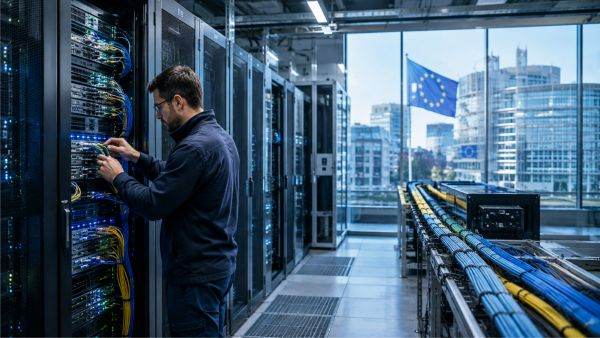
Europe is gradually changing its strategy in the field of technology, at a time when dependence on American companies has become a problem of economic and strategic security. Brussels and several national governments are trying to develop European alternatives for cloud infrastructure, software, artificial intelligence and digital services, and France is among the most active states in this direction. The stakes are not just to replace American programs, but to reduce the risk that European administrations, companies and essential infrastructures depend on decisions made outside the continent, Reuters reports.
• From technological comfort to strategic risk
For years, European companies and administrations have chosen the services of large American groups primarily on criteria of efficiency, performance and cost. Microsoft, Amazon Web Services and Google have come to occupy dominant positions in digital infrastructure, while many institutions use American software for communications, data storage, collaboration and analysis. The problem has become more visible as technology has gained a strategic importance similar to energy or transport infrastructure, according to The Guardian. In the case of energy, dependence on an external supplier can become a vulnerability during a geopolitical crisis. In the case of technology, the risk is less visible, but the consequences can be similar: loss of access to services, the inability to control data or unilateral changes to the terms of use.
The European Commission is already talking about the need to reduce "risky dependencies” in areas such as cloud computing, artificial intelligence and semiconductors.
• The cloud has become the new battlefield
One of the most important stakes is cloud infrastructure. Much of the data and applications used by European companies run on infrastructure controlled by American providers. According to an analysis cited by Reuters, Amazon Web Services, Microsoft Azure and Google Cloud dominate the European cloud infrastructure market, while European providers have a much smaller share. For Brussels, the problem is not just where the servers are physically located. Even if a European institution's data is stored in a data centre located within the European Union, the company controlling the infrastructure may be subject to the legislation of its home country. This is where US legislation comes into play, including the CLOUD Act, which can oblige certain US companies to provide US authorities with data located outside US territory. This situation fuels European concerns about the difference between "data stored in Europe" and "data effectively under European control".
The European Commission is not limited to declarations. In April 2026, the institution awarded contracts worth up to euro180 million for sovereign cloud services for EU institutions and agencies, the European Commission informs.
The contracts were awarded to four providers, in a strategy aimed at avoiding dependence on a single operator and stimulating the development of a European market for cloud services that comply with EU requirements on data security and control.
• Important signal for the market.
European public procurement can become one of the tools through which local companies gain enough critical mass to compete with American groups. In a sector dominated by huge investments in data centers, networks and computing capacity, the support of public institutions can make the difference between the existence of a European supplier and its disappearance in a market dominated by global giants.
France is one of the most visible examples. Paris is trying to reduce the use of American services in public administration and develop local alternatives or based on open-source software. In the case of videoconferencing, France plans to gradually abandon the American platforms used by the administration and expand the use of an in-house solution, Visio, with the aim of implementing the change at the administration level by 2027.
• Direction is more important than the product itself.
France is trying to build a model in which the state is not dependent on the infrastructure, licenses and commercial decisions of companies outside Europe for basic administrative operations. The trend is not limited to France. In Germany, the state of Schleswig-Holstein has become one of the best-known European examples of the migration to open-source software. The regional authorities announced that around 30,000 workstations had switched to Linux by the end of 2025, as part of a strategy to reduce dependence on proprietary providers, according to Reu. ters. The advantage of open-source software is that authorities are not as dependent on a single supplier. But this solution also has its limits. Migrating from one software ecosystem to another involves costs, training employees, compatibility with existing applications and, in some cases, developing new tools. Therefore, "digital sovereignty” does not automatically mean immediate savings.
• Software is only the first step
The problem is much deeper than Microsoft Office, operating systems or videoconferencing applications. Europe is dependent on external suppliers for a large part of the technology chain: processors, network equipment, cloud, data centers and artificial intelligence models. In the case of AI, the gap is even more obvious. The United States is home to most of the companies developing frontier models, and the infrastructure needed to train them requires huge amounts of processors and energy. Europe is now trying to close this gap.
• Brussels invests billions in artificial intelligence
The European Union announced this summer a plan worth around euro10 billion to develop seven artificial intelligence "factories”, with the aim of attracting more private investment. The projects are designed to provide European researchers and companies with high-power computing infrastructure and to close the gap with the United States and China. The stakes are high because without computing capacity, Europe risks remaining dependent on the infrastructure of others even as it develops its own AI models. Building European models without controlling the infrastructure on which they run would only solve part of the problem.
• Mistral shows that Europe can have its own champions
France is trying to build its own AI ecosystem around companies like Mistral AI. In July, Microsoft signed a multibillion-dollar deal to support the expansion of Mistral's European infrastructure, including the use of French data centers. But the situation also illustrates the paradox of European digital sovereignty.
Europe is developing its own companies and data centres, but they continue to depend on components and infrastructure from outside the continent. In the case of AI processors, for example, European industry is still heavily dependent on American technology. Digital autonomy cannot therefore be built through a single project.
For Europe to become truly technologically autonomous, it would need to control as many links in the chain as possible. A data centre built in France is geographically European. But if the servers use processors designed in the United States, American software and network equipment produced in Asia, autonomy is limited. This is one of the reasons why the European strategy includes cloud, semiconductors and artificial intelligence simultaneously. The European Commission presented a package of measures to strengthen European technological capacity in June, with a focus on these areas.
• The costs of digital independence
But there is also an economic problem. The services of the large American providers have become popular precisely because they offer high-performance infrastructure on a global scale. Replacing them with European solutions may require higher investments, at least in the first phase. European companies need to build data centers, develop software, recruit specialists and achieve sufficient scale to compete with existing operators. In addition, administrations must bear the costs of the transition. Therefore, the European strategy must resolve a delicate issue: how can dependency be reduced without the European economy losing competitiveness?
• Sovereignty versus efficiency
This is one of the main controversies of this policy. A European provider can offer a higher level of control over data and reduce geopolitical risk. But if the service is more expensive or less efficient, European companies may end up paying a price for independence. In this case, industrial policy must create the conditions for European providers to become competitive, not just protected.
This requires investment in research, infrastructure, education and access to capital.
A term that has increasingly entered the European discussion is that of the "kill switch” - the possibility that an essential technological service can be stopped or restricted by a decision outside European control. The European Commission has explicitly invoked the need to avoid situations in which a government or company outside the Union could interrupt critical technological services, The Guardian reports. This is not necessarily about the existence of such a physical "button”. The risk is rather a geopolitical and legal one: In an international crisis, access to essential technologies could be affected by sanctions, trade restrictions, legislation or political decisions. For critical infrastructures - banks, hospitals, energy, telecommunications - such a risk becomes much more important than for an ordinary user.
• Banks and hospitals enter the front line
Brussels is paying special attention to sectors where a disruption of digital services could have systemic consequences. The cloud is already essential for banks, insurance companies, hospitals and public administrations. For this reason, the European proposals on technological sovereignty provide for stricter requirements for providers operating in sensitive areas. In these sectors, the issue is no longer just who offers the cheapest service. It becomes important who controls the infrastructure, where the data is located, who has access to it and what happens if the provider can no longer provide the service.
For European technology companies, this change represents a major opportunity. Companies like OVHcloud, Scaleway, Mistral and other European companies stand to benefit from the growing demand for products and services that offer a greater level of European control. At the same time, European institutions are trying to create a market where the criterion of "sovereignty” counts more in public procurement. This can generate investment and jobs in Europe. But the result is not guaranteed. European providers must demonstrate that they can offer services on a scale comparable to the large American platforms.
The change in European strategy does not mean that American companies will disappear from the continent. On the contrary. Microsoft and other providers are trying to meet European demand with cloud solutions that emphasize data localization, operational control and compliance with European requirements. Microsoft argues, in fact, that digital sovereignty should be seen as a form of risk management and resilience, not necessarily as a complete separation from American technology. This could become one of the main market disputes in the coming years: Europe will try to reduce dependence, while large American companies will try to demonstrate that they can remain suppliers of European infrastructure without compromising sovereignty requirements.
• This is not a new technological "Iron Curtain”
Europe does not seem to be seeking isolation from the United States. Transatlantic trade, research and technological cooperation remain essential. Rather, the objective is diversification. Instead of an administration or a company depending on a single supplier for a critical function, Europeans want to have more options. In this sense, digital sovereignty is more like European energy policy after the Russian gas crisis: it does not necessarily mean giving up imports, but avoiding a dependence that could become dangerous. The fundamental problem is that Europe starts at a disadvantage. The United States has technology companies with huge capitalization, access to capital and global markets. China has a massive industrial base and a state-backed technology development strategy. Europe has researchers, competitive companies and a huge market, but it is more fragmented and has allowed foreign suppliers to consolidate their position in many areas. The digital sovereignty strategy is therefore also an attempt to make up for lost time. Investments in the cloud, AI, data centres and open-source software aim to create an ecosystem in which Europe is no longer just a consumer of technology.
What is changing in Europe is not just the list of programs installed on civil servants' computers. What is changing is the way technology is viewed by authorities. A few years ago, the cloud, software and digital platforms were mainly treated as commercial services. Now they are increasingly seen as strategic infrastructure. This change explains Europe's investments in sovereign cloud, AI projects, the promotion of open-source software and the pressure on foreign suppliers. For companies, the effects will be significant: new suppliers will emerge, new requirements for data localization and security, and, probably, additional transition costs. For administrations, the stakes are even higher. Europe is trying to get to a situation where, if geopolitical relations deteriorate, its economy and administrations can continue to function without access to essential digital infrastructure depending on a decision made thousands of kilometers away.























 Euro
Euro Dolar SUA
 Franc elveţian
 Liră sterlină
 Gram de aur





























