 English



The Fed unanimously raised interest rates by 25 basis points on September 16, 2026, and projections from Fed officials indicate another hike before the end of the year. However, Fed Chair Kevin Warsh refuses to signal the central bank's next moves to the markets-a choice that has consequences for global financing costs, including for Romania.
• An interest rate just above inflation
The hike brought the federal funds rate target range to 3.75%-4.00%, marking the first increase since 2023. When measured against the Fed's projected headline PCE inflation of 3.7% for 2026, the real interest rate remains only slightly positive-at around 0.2 percentage points-meaning the Fed's monetary policy is barely restrictive. This calculation is an approximation: it uses the midpoint of the Fed's target range (3.875%) and the inflation projection for the full year 2026, rather than the expected inflation for the coming 12 months. Projections released by the Fed on September 16 show real economic growth revised upward to 2.3% and the unemployment rate falling to 4.1%-figures that do not, in themselves, call for a more restrictive monetary policy. The pressure stems from elsewhere. US retail sales rose by 1.2% in August 2026 compared to July-surpassing the 0.8% growth forecast by economists polled by Reuters-and increased by 6.0% compared to August 2025, according to the Census Bureau. Import prices climbed 7.0% year-over-year, marking the largest annual increase since August 2022, according to the Bureau of Labor Statistics (BLS). Higher-than-expected demand indicates that interest rates to date have not sufficiently dampened price pressures. The Fed's implicit calculation: the short-term equilibrium rate is higher than the current one.
• Rejection of forward guidance
What distinguishes this phase from the 2022-2023 rate-hiking cycle is the Fed Chair's deliberate refusal to signal future decisions to the markets. Kevin Warsh has repeatedly rejected the use of monetary policy forward guidance.
Without such signals, any future Fed decision has the potential to surprise the markets.
Uncertainty regarding the direction of interest rates is reflected in long-term yields. The yield on 10-year US Treasuries rose to 5.01% on Monday, September 14-crossing the 5% mark for the first time since 2023, according to Bloomberg. The 5% level had been touched briefly in 2023; otherwise, the 10-year yield had not reached this level since 2007, according to CNN. In a press conference on September 16, Warsh attributed the rise in 10-year Treasury yields to economic strength, competition for capital, and geopolitical factors, according to iShares.

• Dot plot projections: the Fed's only public signal of intent
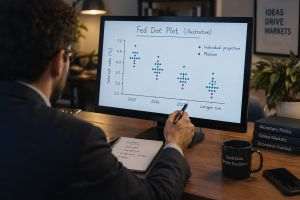
In the absence of explicit verbal guidance, the "Summary of Economic Projections" document published by the Fed remains the central bank's only public signal of intent. The projections for September 2026 are clear and constitute a form of communication in themselves, even if Warsh does not present them as such.
The median projection for the federal funds rate at the end of 2026 rose to 4.1% from 3.8% in June, according to the Fed's projections.
Of the 18 FOMC participants who submitted projections, 12 see the federal funds rate at 4.125% (the midpoint of the 4%-4.25% range) by year-end-implying one more 25-basis-point hike-while four foresee two more hikes (an additional 50 basis points), and two anticipate no change from the current level, according to the Fed's projections.
Warsh did not submit an individual projection in September, according to Charles Schwab, nor did he do so in June 2026-his first meeting as Fed Chair-according to iShares. Consequently, the FOMC Chair's stance remains unknown within the very document markets use to anticipate interest rates. However, markets do not rely solely on the absence of the Chair's dot; they look at the median projection, the dispersion of the dots, and the FOMC statement (see the "What is the "dot plot'?" box).
• The cost of borrowing in the US
Higher yields on 10-year US Treasury bonds translate into higher costs for Americans buying homes, financing cars, or taking out other loans. By the numbers: the average rate for a 30-year fixed-rate mortgage in the US stood at 7.04% on September 21, while the average 30-year refinancing rate reached 7.50% on the same day, according to data from Zillow, as reported by Yahoo Finance and Norada Real Estate.
The Fed's central projections-forecasting 2.3% economic growth and 4.1% unemployment-do not point to a near-term recession, though they do not rule out the risk of economic deterioration. In the scenario outlined in this analysis, the more likely risk is a gradual decline in credit quality and a drop in asset values, which could materialize six to eighteen months after the rate hikes.
• White House Pressure
Christopher Phelan, Chairman of the White House Council of Economic Advisers, told CNBC the day before the decision that raising interest rates would be a mistake, according to CNBC.
Warsh declined to comment on his discussion with President Donald Trump, stating he had nothing to disclose on the matter, according to CNBC.
At the Jackson Hole symposium on August 28, Warsh stated that the central bank bore responsibility for the 65-month period during which inflation remained above target, according to PBS News.
Taking ownership of this responsibility can be seen as a deliberate attempt to convince markets that the Fed will continue raising rates even in the face of political pressure.
Analysts at Charles Schwab believe a second rate hike in 2026 is likely, with the interest rate trajectory in 2027 depending on the pace at which inflation falls toward 2%.
• Cost of protection against Romania's default risk is the highest among more than 60 investment-grade rated nations
Romania feels the impact of the Fed's decision through two distinct channels that can reinforce each other.
1. The first channel is the cost of external financing; Romania enters this period with greater vulnerability than its regional peers.
International investors treat Romanian bonds as if they were the only speculative-grade sovereign securities in the European Union-even though Romania retains an investment-grade rating. Furthermore, the cost of five-year default protection, measured by credit default swap (CDS) contracts, is by far the highest among the more than 60 investment-grade nations tracked by Bloomberg, according to the publication. On Tuesday, September 15, Romania's CDS cost stood at 144 basis points, down from 167 basis points at the end of April, when the political crisis intensified. The next investment-grade rated countries in this ranking-Oman and Indonesia-had CDS costs of approximately 85 basis points, according to Bloomberg. On July 31 and August 7, respectively, Fitch and Moody's affirmed Romania's rating at the lowest rung of the investment-grade category-BBB- and Baa3-with a negative outlook, according to Bloomberg.
The disparity is also evident in the domestic market: the yield on two-year Romanian government bonds denominated in lei, at 6.52%, is the highest in the European Union, exceeding the yield on similar Polish bonds by approximately 180 basis points and that of similar Czech bonds by about 235 basis points, according to Bloomberg. The gap relative to Poland and the Czech Republic indicates a risk premium specific to Romania-linked to perceptions of the fiscal and political situation-rather than merely reflecting global interest rate movements.
2. The second channel is the NBR's policy. The NBR has maintained the monetary policy rate at 6.50% per annum since August 2024. ING economists expect the NBR to implement its first monetary policy rate cut in January 2027.
If the Fed continues to raise interest rates-and its September projections indicate at least one more hike by the end of 2026-the NBR's room for rate cuts could narrow, depending on the leu's exchange rate trajectory, Romania's risk premium, and capital flows. In such a scenario, premature easing could accelerate capital outflows and the depreciation of the leu, thereby negating expected disinflationary effects. However, the NBR is not obliged to follow the Fed's decisions.
ING economists estimate that inflation in Romania will end 2026 at approximately 6.5%-matching the 6.50% monetary policy rate-implying that the NBR is also operating with a real interest rate close to zero. The parallel with the Fed's situation is no coincidence: both the Fed and the NBR face partially imported inflationary pressures stemming from energy and supply chains-pressures that interest rates can indirectly temper but cannot eliminate.
• Implications for investors
The Fed's September projections indicate a median federal funds rate of 4.1% even at the end of 2027; this benefits savers holding fixed-income products while disadvantaging holders of long-duration assets.
High government bond yields may reflect strong economic growth, not merely inflationary pressures; In this context, iShares analysts recommend managing interest rate risk through intermediate maturities.
For investors in Romania, the FIDELIS issuance (running from September 4 to 11, 2026) offered interest rates of up to 7.50% for 10-year RON-denominated bonds and 6.90% for 4-year RON-denominated bonds-yields that remain positive in real terms relative to projected inflation through maturity, provided the NBR's disinflation scenario holds true.
There is a risk that a further deterioration in the perception of Romania's sovereign risk-exacerbated by the global environment and domestic political tensions-could dampen demand for Romanian securities on the secondary market.
• Scenarios for the coming months
The most probable scenario likely remains a controlled tightening, with a second hike in October or December 2026-at one of the FOMC's final two meetings of the year.
The risk scenario-less probable but carrying disproportionate consequences-would be an unexpected acceleration in inflation forcing the Fed to hike rates more rapidly, given that Warsh's refusal to provide explicit guidance leaves markets without the information needed to prepare.























 Euro
Euro Dolar SUA
 Franc elveţian
 Liră sterlină
 Gram de aur





























