English

Nuclear energy is regaining momentum as countries seek a stable supply of electricity and low-carbon sources. This has brought uranium, the fuel used in nuclear reactors, back into the spotlight.
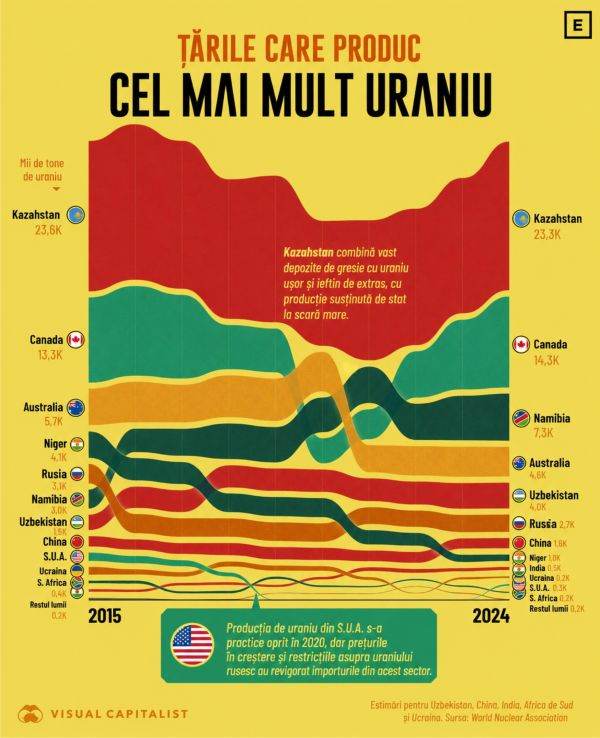
Visualcapitalist.com presents, using data from the World Nuclear Association, a ranking of annual uranium production by country from 2015 to 2024. According to the cited source,
Kazakhstan remains the dominant supplier by a wide margin, while countries such as Canada and Namibia have rapidly expanded their core production in recent years.
• Over 23,000 tonnes of uranium produced by Kazakhstan
Kazakhstan mined 23,270 tonnes of uranium in 2024, accounting for more than a third of global production.
The country combines large uranium deposits in sandstones with low-cost in-situ mining techniques that are generally cheaper and less labor-intensive than conventional mining. State-backed producer Kazatomprom has maintained efficient production growth over the past decade. Kazakhstan also ranks second globally in uranium reserves.
While Kazakhstan's production fell during the pandemic years, it rebounded strongly by 2024 as uranium demand and prices recovered.
• Canada, Namibia expand production
Canada ranked second among the world's uranium producers in 2024, with 14,309 tonnes. Production in the country had previously collapsed in 2020 due to mine closures and weak market conditions, but the restart of major projects such as Cigar Lake and McArthur River has contributed to a major recovery.
Namibia, ranked third in the world, also consolidated its position as a major supplier, producing 7,333 tonnes in 2024. The country has become one of the world's fastest-growing uranium suppliers, supported by large open-pit mines and growing foreign investment linked to growing demand for nuclear fuel.
Positions 4-10 in the ranking of major uranium producers are as follows: Australia (4,598 tonnes), Uzbekistan (4,000 tonnes), Russia (2,738 tonnes), China (1,600 tonnes), Niger (962 tonnes), India (500 tonnes), Ukraine (288 tonnes).
• US production begins to recover
US uranium production nearly disappeared in 2020, falling to just six tonnes as low prices made domestic mining unprofitable. However, the sector has begun to recover amid rising uranium prices and geopolitical concerns over global supply chains. Restrictions on uranium imports from Russia have also increased interest in rebuilding domestic production capacity.
Even after recovering from near-zero production in 2020, the US is expected to mine just 260 tonnes of uranium in 2024, compared to more than 23,000 tonnes brought to market by Kazakhstan. The difference highlights how dependent global markets remain on a small number of uranium suppliers.
• New strategic mineral deposits discovered in China
China announced in March the discovery of new deposits of strategic minerals in several provinces, including rare earths, fluorite, barite and antimony, in the context of persistent technological and commercial tensions with the United States, EFE reports, according to Agerpres.
Thus, deposits were identified in the provinces of Sichuan (center) and Gansu (northwest) as part of a new exploration cycle promoted by the Chinese authorities.
The identified minerals have different uses. Rare earths are essential for advanced technological sectors, antimony is used in areas such as defense and batteries, while fluorite and barite have applications, mainly of an industrial nature.
According to China's Ministry of Natural Resources, these discoveries are part of strategic actions aimed at strengthening mining prospects during the 14th Five-Year Plan period (2021-2025), a period in which China has also increased its reserves of resources such as uranium, copper, gold, lithium and potassium.
The official report also records the discovery of several large oil and gas deposits, as well as the identification of new large-scale mineral resource bases in various regions of the country. These include a copper deposit of more than one hundred million tons in Tibet (southwest), a gold deposit in Xiling, Shandong province (east) and a large lithium deposit in Sichuan, considered the largest in Asia.
China, which owns 49% of the planet's rare earths, also controls more than 70% of global production and almost 90% of their processing.
The Asian giant has consolidated its control over these resources in recent years, considered essential for industries such as electronics, automotive and defense, in the context of technological restrictions imposed by the US.























 Euro
Euro Dolar SUA
 Franc elveţian
 Liră sterlină
 Gram de aur