English

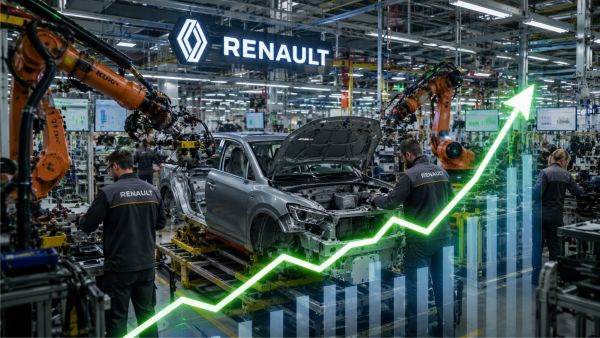
French automaker Renault SA reported a 9.4% increase in its revenue in the first half of 2026, returning to profit thanks to solid sales of electric vehicles (EVs), despite increasing pressure from rivals in China, Reuters reports.
Renault said sales of fully electric vehicles rose 47.6% compared to the same period in 2025, supported by the success of the new Renault 5. EVs were responsible for one in five new vehicles sold, Agerpres notes.
"The first-half results confirm that our strategic model is working even in a complex environment,” Renault CEO Francois Provost told reporters.
The carmaker, which expects pricing pressures in Europe to continue this year, reported an operating margin of 5.2% in the first half of 2026, down from 6% in the same period in 2025 but above analysts' expectations of 5%.
Despite increased competition in Europe from Chinese automakers including BYD and Chery, Renault confirmed that it expects an operating margin of 5.5% in 2026, compared with 6.3% in 2025.
The Renault group reported a net profit of 700 million euros in the first half of 2026, compared with a net loss of 11.18 billion euros in the same period in 2025, including 9.3 billion euros from the impairment of its investment in partner Nissan.
Revenue rose to 30.25 billion euros, a 9.4% increase from 27.64 billion euros in the first half of 2025, while analysts estimated revenue of 29.4 billion euros.
• Renault, Volkswagen and Stellantis ask EU to protect car sector
Last month, Renault, Volkswagen (German car company) and Stellantis (French-Italian-American car giant) joined forces to demand simpler regulations and subsidies to encourage the production of cars "Made in Europe", opposing the arrival of electric vehicles from China, according to the Financial Times.
The three car manufacturers, responsible for 60% of European car production, sent the European Parliament a package of joint measures, explicitly asking for rewards for manufacturers that localize production and maintain engineering, research and development activities in Europe.
In a joint document, the three presented their goal for Europe to remain a world power in the car industry, calling for a simple to apply and monitor mechanism that would favor European cars and domestic industry.
In March, the European Commission adopted a legislative proposal to increase demand for low-carbon technologies and products made in Europe. The Industrial Accelerator Act (IAA) will boost production, grow businesses and create jobs in the EU, while supporting the adoption of cleaner, future-proof technologies by industry, the EU executive said. The Buy-European strategy aims to increase the independence of local production. Current Commission proposals suggest that company fleet cars and small electric vehicles must be assembled in the EU to benefit from subsidies and participate in public procurement tenders. The proposals also foresee a 70% share of locally produced vehicle components, excluding batteries.
In contrast, Renault, Volkswagen and Stellantis propose a simpler system, based on a ceiling in which 70% of vehicles produced in Europe would have to contain at least 70% of components from the 27 EU member states, as well as Iceland, Liechtenstein and Norway. The remaining 30% could still come from countries outside the EU.
The three automakers say the definition of "Made in the EU" should include not only final assembly but also engineering, research and development (R&D) activities. They are calling for higher subsidies to offset the higher energy and labor costs that European manufacturers face compared to rivals in countries such as Turkey and Morocco.
Renault, Volkswagen and Stellantis also support extending so-called "super credits" currently aimed at small electric vehicles made in Europe to all electric vehicles made within the EU, which would make it easier to meet emissions targets.
The proposals have been criticised by some carmakers outside Europe, including Toyota, Jaguar Land Rover and Honda. They have raised concerns about the exclusion of components made in Britain, Japan and Turkey, saying the new requirements would increase the cost of vehicles for European consumers.


















 Euro
Euro Dolar SUA
 Franc elveţian
 Liră sterlină
 Gram de aur