English


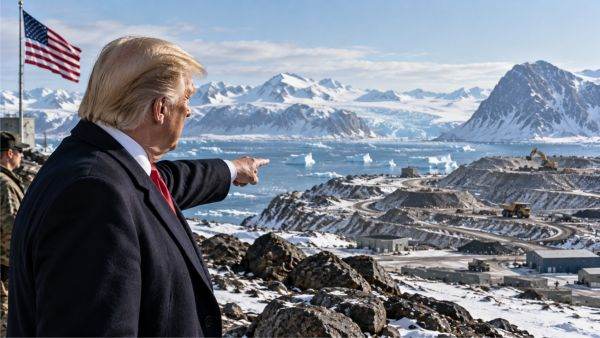
International rules regarding the full sovereignty of the world's states are no longer what they were when established after World War II; the latest proof of this is the agreement reached by the US, Denmark, and Greenland concerning the status of the island, which is part of the Danish state. The agreement, signed two days ago, introduces-at least regarding the investment aspect-a form of "enlightened" or "soft" colonialism.
Donald Trump had sought to acquire Greenland since the very first day of his new presidential term; throughout the intervening period, he refused to rule out the use of force and threatened European states that opposed him with tariff hikes. After twenty months of constant pressure on the central authorities in Copenhagen, European NATO allies, and even the EU, Trump signed an agreement with Denmark and Greenland on September 22, 2026, granting the United States an expanded military presence on the island-though not ownership of it. There is something else, too: Donald Trump called for the acquisition of Greenland citing America's defense, yet a race for rare earth elements, investments, and mining contracts-involving American companies and figures from his political and business circles-has been unfolding around the island for years. Thus, beneath the rhetoric regarding military bases, Russian ships, and Chinese ambitions lies a massive economic stake.
Consequently, the agreement signed two days ago grants the Americans a significant military advantage, while its provision on investments directly links to the issue of minerals. Under the terms of the agreement, states or investors falling outside the categories defined by the treaty-namely NATO members, NATO partners, and EU member states-cannot acquire control or significant influence over activities deemed particularly sensitive (if doing so would threaten national security or public order) except under conditions agreed upon by the parties. Resource extraction is explicitly listed among the activities that may fall into this category. The responsibility for applying this screening process lies with Greenland, acting in close cooperation with Denmark and in consultation with the US. It is a mechanism for screening and restricting certain investments, not an American mining concession or a ban on European investors. This is precisely where the economic impact of the compromise will become apparent. It is estimated that American mining firms will find Greenlandic projects more attractive if an expanded military presence reduces strategic uncertainty and if US public funding for critical minerals continues.
At the same time, the framework leaves room for European and Canadian capital. According to Reuters, in March 2026, Greenland's Minister of Resources, Naaja Nathanielsen, stated that interest in mining investments had risen following Trump's threats, with the interest coming primarily from the EU, the UK, and Canada; a French official declared that France was willing to take minority stakes in local projects. Thus, the agreement could intensify competition among Western investors, even while limiting access for strategic rivals.
According to World Bank data, Greenland holds deposits of rare earth elements and other minerals used in military, electronic, and energy technologies.
• The Trump camp's interest in exploiting resources in Greenland
It is worth noting that, according to CNN and PBS News, in February 2025, Ronald Lauder-a long-time acquaintance and supporter of Trump-publicly defended the US president's interest in the island. According to the cited sources, Lauder described the resources beneath Greenland's ice as strategic for artificial intelligence and advanced weaponry, stating that he had been working for years with Greenlandic business and government representatives to develop investments. According to an investigation by • The Guardian• , Lauder also held business interests in Greenland; the projects identified in that report involved bottled water and hydroelectric power.
Closer to the actual exploitation of minerals-according to the cited US sources-was Drew Horn, a former official in the first Trump administration and head of the American company GreenMet. In March 2025, Horn publicly stated that Greenland's reserves represented a significant opportunity for US investment in mining and energy, and he spoke about the involvement of the US private sector in their development. In April, GreenMet announced a partnership with Tanbreez Mining Greenland, the holder of a license for a rare earth project. An investigation OCCRP revealed that GreenMet's shareholders included George Sorial, a former executive at the Trump Organization, and Keith Schiller, Trump's former head of security. Both stated that they held passive minority stakes and did not manage the company's operations.
According to the cited investigation, the Tanbreez project illustrates just how tangible this race had become by 2025. Critical Metals Corp sought U.S. funding to develop the deposit; Reuters reported on a request for $50 million through a federal program and a $120 million loan under review by the U.S. Export-Import Bank. In October 2025, four individuals familiar with the discussions told the agency that the Trump administration was even considering converting the proposed support into a U.S. government equity stake in Critical Metals. While the negotiations did not amount to a finalized investment, they demonstrated that Washington's interest in Greenland's minerals had shifted from rhetoric to the consideration of concrete financial instruments.
• The EU: the second beneficiary of the resource development investment agreement
For the European Union, the agreement regarding Greenland holds dual significance. Politically, Brussels can claim that its core principle has been upheld: Greenland remains under Danish sovereignty, and the future of the Greenlandic people was not determined through annexation. Economically, the EU retains the opportunity to invest in resources deemed vital for industry and the energy transition, though it will compete for projects against U.S. firms that could benefit from Washington's funding and strategic backing. Militarily, a stronger U.S. presence could bolster Arctic defense while simultaneously increasing U.S. influence over practical decisions regarding Northern European security. The military clauses in the cited agreement explain why the Trump administration views it as a major win. Under the terms of the document, U.S. aircraft gain the right to overfly and land in Greenland, while U.S. government vessels secure broad access to its territorial waters. The text also mentions the potential use of the territory for the U.S. "Golden Dome" defense system. Non-NATO states are barred from establishing military facilities or maintaining a persistent military presence in Greenland without the parties' consent. In sectors deemed particularly sensitive-including critical infrastructure and resource extraction-the agreement restricts control or significant influence by investors from states outside the permitted categories. For the U.S., the stakes thus encompass missile defense, military access, and the exclusion of strategic rivals.
On a global scale, Greenland could become an even more critical focal point for competition regarding missile defense, access to the North Atlantic, and critical mineral supply chains. Should extraction efforts progress, the U.S. and Europe could gain an additional source of raw materials, thereby mitigating some of their vulnerabilities. However, the gap between the existence of a deposit and industrial-scale delivery involves investments, infrastructure, permits, costs, and the requirements of local communities. Reuters has noted that mining development in Greenland has been slow, with only two small mines operational as of the 2025 report. While the security agreement may alter investor calculations, it cannot, on its own, extract minerals from the ground.
• Agreement reached following pressure from the Trump administration
Beyond the fanfare in Washington, what is at stake is the new balance of power in the Arctic: who builds the bases, who controls military access, and who can invest in a territory situated between North America, Europe, and the northern routes.
At the ceremony held on the sidelines of the UN General Assembly, Donald Trump proclaimed that the agreement grants Washington permanent control over Greenland's security and "all other needs" within the territory, according to a press release posted on the White House website. The text of the signed agreement-also published on the White House website-is more specific: it reaffirms the sovereignty of the Kingdom of Denmark and the Greenlanders' right to self-determination, yet allows the US to expand the Pituffik base, establish defense zones at Narsarsuaq and Mestersvig, and secure extensive air, land, and maritime access rights. Regarding additional sites, implementation depends on consultations and the agreement of the parties. In practice, Greenland is not becoming American territory for the time being, but the US strategic presence on the island could become significantly larger and more extensive.
The signing of the agreement takes on added significance when viewed alongside the political rhetoric that preceded it. Even before his inauguration on January 20, 2025, Trump refused to rule out economic or military pressure to secure his interests in Greenland. In March 2025, against the backdrop of Vice President JD Vance's visit to Pituffik Base, he insisted that the United States "must" acquire Greenland for the sake of international security. Vance accused Denmark of making insufficient efforts to protect the territory. For Copenhagen and Nuuk, this was no longer merely an eccentric commercial proposal, but a series of repeated demands from Denmark's most powerful military ally.
By January 2026, the pressure had become explicitly economic. Donald Trump threatened to impose additional tariffs of 10% starting February 1-rising to 25% by June 1-on imports from eight European nations that opposed the takeover of Greenland: Denmark, Norway, Sweden, France, Germany, the United Kingdom, the Netherlands, and Finland. Instead of negotiating solely on strengthening Arctic defense, the allies found themselves forced to respond to a trade threat linked to the fate of one of their own territories. At the World Economic Forum in Davos on January 21, Trump ruled out the use of force, dropped the announced tariffs, and spoke of a framework for a future agreement following discussions with NATO Secretary General Mark Rutte. This shift in tone paved the way for the negotiations that resulted in the September document, according to AP News.
• Rebuilding trust among the signatory partners: a priority
It should also be noted that the European Union had, from the outset, defined the political limits of any compromise regarding Greenland. Antonio Costa and Ursula von der Leyen invoked sovereignty and territorial integrity, expressed solidarity with Denmark and the people of Greenland, and warned that tariffs would damage the transatlantic relationship. Following the meeting of European leaders in January, Costa articulated an unequivocal principle: only Denmark and Greenland can decide on matters concerning them. At the same time, the EU acknowledged the shared interest in Arctic security, and in February, NATO announced the "Arctic Sentry" initiative, aimed at better coordinating Allied efforts in the region. Europeans accepted the need for stronger Nordic defense while maintaining sovereignty as a condition of the agreement.
The agreement also seeks to withstand future political changes. It has no expiration date and can only be modified by mutual consent. Should Greenland become independent, the text requires the new state to remain in NATO and assume the obligations established under these defense arrangements. This is one of the most significant provisions for the island's future: while potential independence is acknowledged as a possibility, the military framework currently being negotiated is designed to remain in effect beyond that point. However, signing the agreement does not mean it enters into force immediately; it requires the completion of necessary parliamentary procedures in Denmark and Greenland, followed by diplomatic notification to the US.
Nevertheless, there is a cost to the Greenland agreement that is harder to quantify: the trust between allies. At the signing, Danish Prime Minister Mette Frederiksen and Greenlandic Prime Minister Jens-Frederik Nielsen welcomed the strengthening of shared security. Yet, after the ceremony, Nielsen noted that the people of Greenland need to rebuild trust in the United States-trust that had been damaged by threats regarding the potential acquisition of the island. The statement explains the paradox of this agreement: it may stabilize Arctic defense, but a single signature cannot erase the months during which the partner called upon to defend Greenland spoke of acquiring it against the wishes of its leadership.
• Greenland in figures
As of January 2026, the world's largest island had a population of 56,740, with 20,508 residents living in the capital, Nuuk. It is an autonomous region of the Kingdom of Denmark with its own 31-member parliament; Jens-Frederik Nielsen is the head of government, and his party, Demokraatit, won 10 seats in the March 2025 elections.


















 Euro
Euro Dolar SUA
 Franc elveţian
 Liră sterlină
 Gram de aur