English


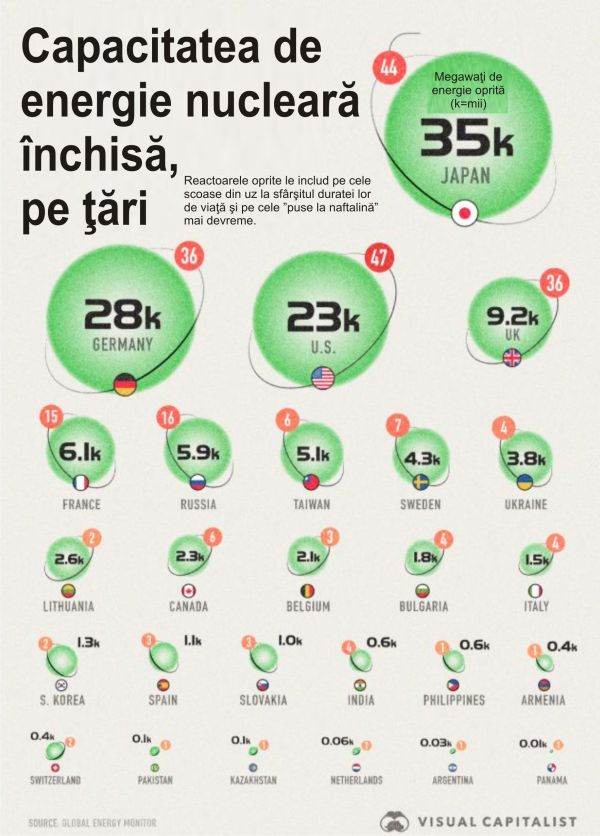
Nuclear power is on the verge of a "golden age”, but globally 250 plants with a total capacity of 136,823 megawatts were shut down from 1957 to 2025, according to an analysis by visualcapitalist.com, which notes that electrification, the development of domestic production and artificial intelligence have led to an increase in energy demand.
Politicians and leaders in the field of artificial intelligence are turning to nuclear power as a solution, considering it a low-carbon energy source. However, the perception of this energy source is mixed due to radioactive waste, large-scale disasters and its association with nuclear weapons.
Based on data from the Global Energy Monitor, visualcapitalist.com presents the number of nuclear power plants shut down by country from 1957 to 2025, including the number of plants closed. The data includes both end-of-life and previously decommissioned capacity.
• Japan has closed the most plants: 44 plants, with a total capacity of 35,284 megawatts
Japan, where the devastating Fukushima disaster occurred, has closed the largest total capacity, 35,284 megawatts, or 44 plants, according to the above-mentioned source. The Asian country temporarily suspended most of its nuclear power plants after the 2011 accident, and only a few have been restarted.
In second place in terms of closed capacity is the largest European economy - Germany. Nuclear power accounted for 29.5% of Germany's total electricity supply at its peak, but since then the country has shut down all of its reactors: 36 units, or 27,862 megawatts. The decision was made in the wake of the Fukushima accident, and the last reactor was decommissioned just last year. The US ranks third in terms of the number of megawatts shut down (23,311), but has actually closed the largest number of installations, or 47. In fourth place is the UK (36 plants closed; 9,163 megawatts), and in fifth place is France (15 plants; 6,087 megawatts). Up to the tenth position, the ranking looks like this: Russia (16 closed plants; 5,879 megawatts), Taiwan (6 plants; 5,144 megawatts), Sweden (7 plants; 4,268 megawatts), Ukraine (4 plants; 3,800 megawatts), Lithuania (2 plants; 2,600 megawatts).
Nuclear power in Ukraine has attracted particular attention, as the Russian invasion threatened the stability of the Zaporizhia nuclear power plant, the largest nuclear power plant in Europe, with a capacity of 6,000 megawatts. Russia took over the plant in 2022 and still has control. Ukraine has closed only four plants. The Global Energy Monitor data does not specify their names, but the former Soviet Union country is home to the Chernobyl plant, which was destroyed in 1986. The plant had a normal operating capacity of 1,000 megawatts.
Notably, the Chinese government has not halted any nuclear projects. China is pursuing an ambitious goal of having 150 gigawatts of nuclear power capacity by 2035 as it diversifys its energy sources.
• Nuclear power, back in service
Despite decades of reactor shutdowns, nuclear power is gaining renewed attention as global demand for electricity grows. The rise of artificial intelligence, electrification, and manufacturing is leading many countries to reconsider nuclear power as a reliable, low-carbon energy source.
In some cases, facilities that were decommissioned are being brought back into service. For example, the Three Mile Island facility in the US, notorious for its partial reactor meltdown in 1979, is now poised to help power the data centers of technology giant Microsoft.
• Italy Considers Returning to Nuclear Power
Prime Minister Giorgia Meloni has long championed nuclear power as a solution to Italy's faltering economy, and now her government is considering how to revive the banned technology, Bloomberg reported, according to Agerpres.
Nearly 40 years after Italy shut down its last nuclear reactor, and 15 years after a failed attempt to reverse that decision, the prime minister's team is consulting with experts and holding talks on how to restart atomic energy production, according to sources close to the discussions. The sources said Italian officials have traveled to Canada to evaluate different technologies and have also spoken to French officials about their nuclear industry. The government in Rome has also discussed South Korean and American options internally, the sources added.
For Meloni, the campaign to restart nuclear power production is a key part of his promise to help companies struggling with high energy prices, which are among the highest in Europe. Meloni has argued that nuclear power could be part of the long-term solution, tying his political future to the success of plans for atomic energy.
Italy should restart its nuclear power program "as soon as possible,” Italian Energy Minister Gilberto Pichetto Fratin said recently, stressing that the plants must be safe and "economically viable.”
Italy has already taken some preliminary steps to reintroduce nuclear power. Last year, the Cabinet in Rome approved a new legal framework to revive nuclear energy, laying the groundwork for a national strategic plan to be implemented by 2027. The move marked the first concrete step towards lifting the 1987 nuclear ban, which was all but lifted in 2011 before the Fukushima nuclear disaster undermined the momentum for re-introducing nuclear power.
Italy's energy companies have also set up a nuclear research and development company, Nuclitalia, to study whether atomic energy would be economically viable in the country. Italian energy producer Enel SpA holds 51% of the shares, Ansaldo Energia SpA controls 39%, and defense company Leonardo SpA has a 10% stake.
• European Commission presents plan for small modular reactors by 2030
European Commission President Ursula von der Leyen presented plans this month to expand nuclear power production, including the installation of small modular reactors (SMRs) in the EU, to ensure affordable and environmentally friendly electricity supply, DPA reports, according to Agerpres.
"In recent years, we have seen a global resurgence of nuclear energy and Europe wants to be part of it. That is why we are presenting the new European strategy for small modular reactors," the EC chief said at a summit on civil nuclear energy.
The aim is to have small modular reactors in the EU by the early 2030s. SMRs should "play a key role, alongside traditional nuclear reactors, in a flexible, safe and efficient energy system."
SMRs are reactors with an output of up to 300 megawatts (MW), compared with around 1,000 MW for most nuclear power plants. Their components can be mass-produced in factories.
To boost the development of mini-nuclear power plants, regulations must be harmonised across the bloc, the European Commission president said, adding: "The rationale is very clear. When it is safe to install, it must be easy to install across Europe.”
The EU executive will support investment in the technology with a euro200 million guarantee.
















 Euro
Euro Dolar SUA
 Franc elveţian
 Liră sterlină
 Gram de aur