 English


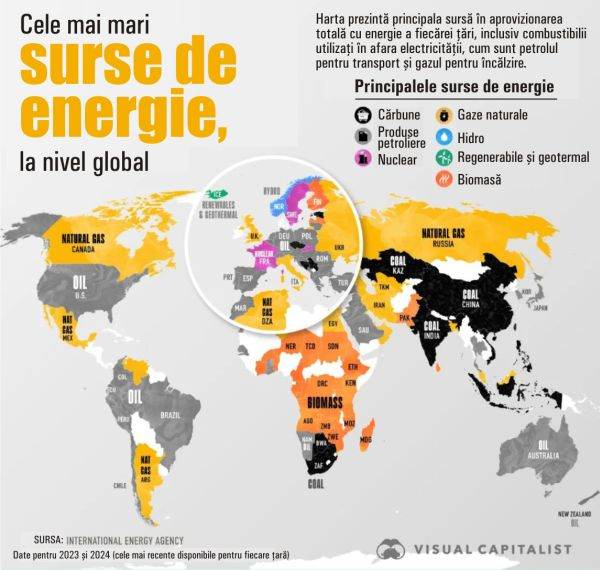
Much of the world still relies on a small group of traditional energy sources, despite the rapid growth of renewables. In many countries, oil, coal or natural gas continue to provide the bulk of the energy used in transportation, industry and electricity generation, according to a visualcapitalist.com analysis, which presents the largest primary energy sources for 112 countries, based on data from the International Energy Agency (IEA). Primary energy refers to energy in its raw form, before it is converted into electricity or refined fuels.
The global landscape highlights how different regions depend on different fuels. Oil dominates in many countries, coal still powers most major economies in Asia, and traditional biomass remains essential in parts of Africa.
• Oil - leader in most countries
Oil is the most common primary energy source globally, with 39 of the countries surveyed relying on it more than any other fuel. Crude oil, as an energy source, dominates much of Europe, the Middle East, and large parts of Asia-Pacific.
In many economies, petroleum products remain essential for transportation and heavy industry. Even countries that produce natural gas, coal, or hydropower domestically often rely on oil for a significant portion of their total energy supply.
Major economies such as the United States, Japan, and Germany still rely primarily on oil, despite increasing investment in renewable energy and electrification.
After oil, natural gas is the second most common source of primary energy globally, with 29 countries relying on it the most.
• Coal remains essential in major Asian economies
Coal continues to dominate the energy mix in several of the world's largest emerging economies. China, India, Indonesia and Vietnam all rely on coal as their largest primary energy source.
The reason is simple, according to the cited source: availability. Many of these countries have large domestic coal reserves and long-established energy and mining infrastructure built around the fuel.
At the same time, coal remains one of the largest emitters of carbon emissions, making these economies central to the future trajectory of the global energy transition.
• Biomass, a staple in many African countries
In much of Africa, biomass remains the largest source of primary energy. This includes fuels such as firewood, charcoal and agricultural waste. In many rural areas, these fuels are still widely used for everyday needs such as cooking and heating, especially where access to electricity or modern fuels remains limited.
Outside Africa, only three other countries in the group under review rely primarily on biomass for energy: Finland, Latvia and Pakistan.
• Europe is increasing coal-fired power production
Europe is burning more coal as rising natural gas prices force utilities to switch to cheaper fuels to keep the lights on, Bloomberg reports, according to Agerpres.
Coal-fired power plants in Germany increased their share of electricity production by about 2% this month compared to February, even as weather conditions boosted renewables, according to data from ENTSO-E, the European Network of Transmission System Operators for Electricity. At the same time, gas-fired power production in Europe's largest market fell by more than a third.
If this shift takes hold, the implications will extend far beyond energy markets. It underscores the fragility of Europe's energy strategy, which relies heavily on gas as a bridge between coal and renewables. It also raises the prospect that governments will prioritize energy affordability and security over emissions reductions.
"We estimate that it is still about 30% more expensive for a power plant to burn gas than coal to generate electricity in Europe. We see potential for the EU to restart idle coal-fired power plants if the energy crisis worsens,” says Myles Allsop, an analyst at UBS Group AG.
However, any broader shift from gas to coal could be limited as spring advances and warmer weather leads to lower electricity demand. Germany's electricity load fell by about 10% in March from February and is slightly lower than it was a year ago, according to ENTSO-E.
European benchmark gas prices have doubled this month as the Iran war fuels concerns about global energy supplies. By comparison, coal prices have risen by around 30% this month.
Higher fuel costs will eventually feed through to electricity prices, increasing pressure on households already facing a high cost of living and testing industrial competitiveness across the region.
It is also a worrying trend for the climate. Even though renewables provided more than 40% of Germany's electricity this month, the volatility of these sources leaves gaps that fossil fuels have yet to fill. Coal accounts for around a quarter of Germany's electricity generation, serving as the main backup source when solar and wind power production declines.
Reliance on coal could increase in the coming period, with weather forecasts pointing to cooler weather.
• Ember: Renewable energy mitigates the impact of the gas crisis
Record photovoltaic and wind power production capacities were installed worldwide in 2025, representing the equivalent of more than a seventh of global gas production, according to a report recently published by the Ember think tank, which estimates that renewable sources mitigate the impact of the energy crisis, AFP reports, according to Agerpres.
"The electricity produced by these installations alone could replace more than a seventh of global gas production or almost double the total volume of Qatar's annual liquefied natural gas exports," the energy think tank emphasized, in the context in which the war in the Middle East led to an increase in oil and gas prices, and brought energy security back to the forefront of concerns.
Since the conflict began on February 28, 2026, "existing global wind and solar capacity has prevented the production of approximately 330 terawatt-hours (TWh) of electricity from gas, representing a potential saving of over $40 billion,” the Ember report said.
At current market prices, this equates to an annual cost of gas imports of approximately $138 billion, Ember estimated.
"The continued escalation of tensions in the Middle East is a stark reminder of the risks associated with reliance on imported oil and gas,” said Kingsmill Bond, an analyst at Ember, adding: "PV, wind and battery power offer importers a real path to energy security - a cheaper, faster-to-implement solution free from geopolitical constraints.”
"The scale and speed of PV deployment is unprecedented in the energy sector,” said Leonard Heberer, an analyst at Ember, noting: "These technologies are poised to become the backbone of global electricity supply.”
According to Ember, 814 gigawatts (GW) of PV and wind capacity were added globally in 2025, and the combined global capacity of the two energy sources now exceeds 4 terawatts (TW).
PV represents the vast majority of this new capacity, underscoring "the increasingly important role of solar energy in the global electricity system,” according to Ember.
By the end of 2025, total PV capacity reached nearly 2,900 GW.
On the other hand, wind deployment saw significant growth (+47%) and represented a global capacity of approximately 1,300 GW by the end of 2025.
• IMF: A prolonged period of high energy prices could increase global inflation
The International Monetary Fund (IMF) recently announced that it is closely monitoring developments in the Iran war and disruptions affecting energy production, warning that a prolonged increase in energy prices could increase inflation and reduce the growth rate of the world economy, Reuters reports, according to Agerpres.
The conflict has already resulted in significant disruptions to oil and gas supplies by sea, increasing the price of a barrel of crude by more than 50%, to over $ 100, said IMF spokeswoman Julie Kozack.
The financial institution has not received formal requests for emergency financing, but is ready to help member states if needed. IMF officials are in discussions with finance ministers and central bank governors of member states, as well as with regional institutions, Kozack explained.
The official added that the global impact of the war depends on its duration, intensity and extent. The IMF will include the conflict in its updated economic forecasts, which will be published in the middle of next month.
Kozack cited the IMF's "rule of thumb” that every 10% increase in oil prices over a year would result in a 40 basis point increase in global inflation and a 0.1% to 0.2% decline in the world economy.
If the price of a barrel of oil remains above $100 for a year, the effects on inflation and the global economy will be significant. Central banks, the IMF official said, should remain vigilant in the context of rising energy prices, carefully analyzing whether inflation extends beyond energy prices and whether inflation expectations remain firmly anchored.
The IMF's preliminary assessment shows that the war will weaken growth in the economies of the Gulf Cooperation Council (GCC - the economic and political alliance of the Persian Gulf countries), the IMF spokesman said, without providing concrete data. Much will depend on the countries' ability to resume oil and gas exports, Kozack added.
And Kristalina Georgieva, the IMF's managing director, warned this month: "If the new conflict is prolonged, it has the clear and obvious potential to affect market confidence, economic growth and inflation, placing new demands on the authorities.”
In January, the IMF slightly revised its global economic growth forecast to 3.3% for 2026, and to 3.2% for next year.






















 Euro
Euro Dolar SUA
 Franc elveţian
 Liră sterlină
 Gram de aur





























