English

The manual of the local social-democratic baron began in the time of Liviu Dragnea with the county and ended with the party and the government. First president of the County Council in Teleorman, then leader of the PSD and shadow prime minister, the "baron of Teleorman" climbed step by step up the pyramid of power, from the bottom up, until he transformed a poor county into a laboratory of political and economic influence, spectacular enough for the press to consecrate him as the prototype of a local and national baron alike.
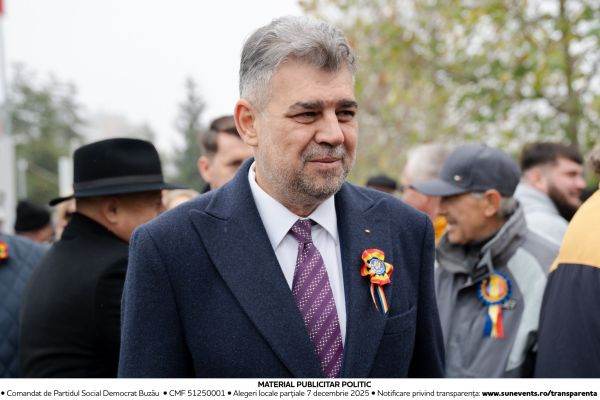
In the case of Marcel Ciolacu, the path is the other way around. After reaching the top of the pyramid, that is, president of the PSD, he became prime minister of Romania, with two successive mandates starting in 2023, until the two resignations caused by the presidential failure in November 2024 and the failure to elect a presidential candidate external to the party, in May 2025. The current social-democratic candidate for the head of the Buzău County Council seems to have suddenly discovered that, from the position of local baron, power is less disturbed by Brussels, but much more direct over county roads, asphalting contracts, hospitals and local interest networks. In the case of Ciolacu, we are no longer talking about a politician who "starts from the bottom", from the county, and dreams of Bucharest, but about a former prime minister who is descending the ladder of power, wants to settle comfortably in Buzău and who explains to us, with the air of a man who has found his vocation, that he is not taking "a step back", but "a huge step forward" by running for the presidency of the Buzău County Council in the partial local elections of December 7, 2025.
The context of these partial elections does not mean a "return home": the position of president of the Buzău County Council remained vacant after Lucian Romaşcanu, elected to that position in 2024, was later sent to the European Court of Auditors, leaving behind a county in which the PSD cannot afford the luxury of losing the institutional buttons even for a few months.
On the ballot, things are a bit more complicated: eight candidates were validated by the County Electoral Office no. 10 for the position of president of the Buzău County Council. The list includes, in order of registration, the following: Ştefăniţă Alin Avrămescu, the AUR envoy in the battle for the County Council, Dragoş Eugen Brânzea from the POT party, Adrian Dogaru from SOS Romania, Silviu Iordache - entrepreneur and former prefect, independent candidate, Mihai Răzvan Moraru - independent officially supported by the PNL-USR alliance, Marcel Ciolacu for PSD, Gheorghe Gabriel Pană from the Conservative Action formation and Mihai Budescu, the PRM candidate.
For almost 363,000 Buzău residents with the right to vote, the offer looks, at least formally, like a generous democratic menu; In reality, everyone knows that the match is between the PSD candidate, a former prime minister with national notoriety, and the PNL-USR tandem that pushed the entrepreneur Mihai Răzvan Moraru to the forefront, used as a showcase for the "united right" in a county where the right has missed, for years, the chance to build a serious opposition to the PSD. AUR is also trying to steal a slice of anti-system discourse through deputy Ştefăniţă Avrămescu, accompanied in Buzău by George Simion, with the promise that, "if the vote is honest", the elections would already be won; the rest of the candidates seem more like extras in a show in which the spotlight is fixed on Ciolacu, and the others have the role of democratic scenery, meant to dress the outcome in an appearance of competition.
And yet, beyond the stage play, the story of these partial local elections in Buzău County is not about "who loves the county more", but about how you transform a failure at the national level into an orderly retreat to local fiefdoms, according to the established model of the PSD: if it doesn't work from Bucharest anymore, you can always start from Buzău, Vrancea or Teleorman, where the party infrastructure, the networks of mayors, the local and county councils are perfect for recycling leaders hit by wear and tear, but still useful for the redistribution of contracts, positions and influence.
Liviu Dragnea made his way from local baron to party leader and strongman at the Victoria Palace, then ended up returning to Teleorman as a mythological character of his own system; Ciolacu reverses the course: he was party leader, led the government, lost the presidential elections and is now descending, methodically, towards the base plate of the "baroniade", where a County Council president has, practically, the last word regarding money, projects and key appointments in a county.
Ironically, while in Bucharest he is presented as the "European, moderate, pro-EU" politician who was to stabilize Romania, in his own public biography Marcel Ciolacu still bears the imprint of a youth in which his name appears in press investigations alongside that of Omar Hayssam, the controversial businessman convicted in terrorism cases, in the story of the famous hunting party from the early 2000s, where, according to journalists' reports, Ciolacu was not at all an extra, but one of the people close to Hayssam's circle, a hunting and business partner, a protege of the local PSD barons of the time. Recently, Marcel Ciolacu has also been linked to the Nordis scandal, after flying the plane provided by the company several times to the Côte d'Azur and to Paris, on the money of those who were damaged by the company. Moreover, the former PSD president and former prime minister has never clarified the scandal related to his high school diploma.
Of course, in Buzău, all of the above aspects are treated rather as unimportant episodes, while the campaign for the County Council is polished with messages about "development", "respect for people" and "returning home". However, in a county where the PSD has led, for years, almost everything, from the city halls to the County Council, the idea that the former close associate of the political-financial networks of the last 10-15 years would be the "solution to reset" the county administration seems more like an internal joke of the party than a fresh offer for voters.
The real stakes of the local by-elections for the presidency of the Buzău County Council are whether the county will accept, without too many questions, that a former prime minister will park his national failure in a local "lord" mandate, following the model of the barons who made history in the PSD, or whether the political scene will at least partially re-establish itself, under the pressure of a real competition. From this point of view, the elections of December 7 are more than a simple administrative exercise to fill a vacant position: they are a test of how deeply the idea that, after falling from Bucharest, you return nicely "home", put on your crown as a county baron and continue to decide, discreetly, who receives works, who gets funds, who prospers and who remains a spectator in Buzău has entered the Romanian political reflex.




















 Euro
Euro Dolar SUA
 Franc elveţian
 Liră sterlină
 Gram de aur