English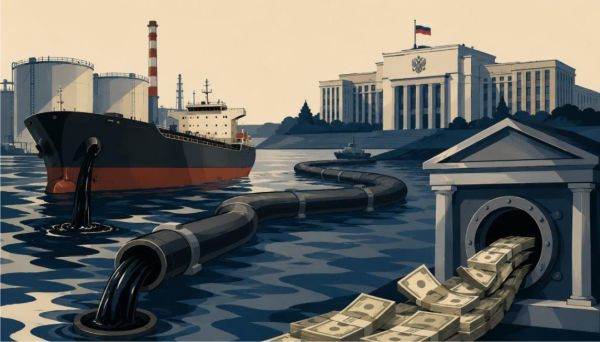
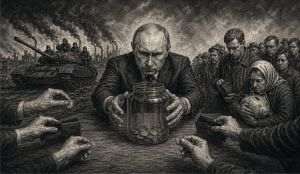
Foreign buyers of oil and gas cover less than half of the cost of Russia's war, and they don't lend it any money at all. There is, in verifiable accounts from 2026, no line of credit opened to the Russian state or Russian banks by a BRICS government or bank. Chinese banks are even restricting trade payments. External support is large, but it is not decisive and it is not financing - and hence the rest must be taken from within.
• How much do foreign buyers actually cover
Russia's military spending for 2026 is 16,000 billion rubles, according to the Stockholm Institute for Peace Research.
Russia's Court of Accounts estimated in June that the federal budget's oil and gas revenues for the year would be 7.8 trillion rubles, a figure reported by The New Voice of Ukraine on June 17.
The amount that foreign buyers pay for Russian oil and gas, when collected and sent to the budget, covers less than half of the year's military spending.
The share has fallen sharply.
In the first seven months of the year, oil and gas revenues were 4.595 trillion rubles, down 16.8% from last year, and other revenues were 17.518 trillion rubles, according to the Russian Finance Ministry, via Interfax, (August 11).
Oil and gas now account for a fifth of the federal budget's revenues.
Before the war, they accounted for more than a third.
• Who's buying
China became the number one customer in 2026.
China's seaborne imports of Russian crude hit a record 1.86 million barrels per day in January, up 46% from January 2025, and Russia overtook Saudi Arabia as China's top supplier, according to data from analyst firm Kpler, cited by OilPrice on February 7.
In August, Chinese imports were estimated by Kpler at 1.25 million barrels per day.
Since the start of the war, China has bought more than $230 billion in Russian energy, according to estimates cited by The Moscow Times on February 4.
India announced it was pulling out and did not pull out.
In early February, US President Donald Trump announced a trade deal that would cut tariffs on Indian goods from 50% to 18% in exchange for halting purchases of Russian oil. Reuters reported on February 8 that Indian Oil, Bharat Petroleum and Reliance Industries were rejecting offers for deliveries in March and April, and Indian imports fell to 1.04 million barrels per day in February, from 1.84 million in November, according to Kpler.
The war over Iran and the blockade of Iranian ports have reversed the trend: the Russian ambassador to Delhi, Denis Alipov, confirmed to the Indian channel NDTV that India is buying a lot of Russian oil again, in an interview reported by CNBC on April 23.
In August, Indian imports were estimated by Kpler at 1.87 million barrels per day, after 2.79 million in July.
• What the same partners don't do
Russia's partners lend it.
Chinese banks are even restricting trade payments. Alexander Vediakhin, first deputy chairman of the board of directors of Sberbank, told the International Economic Forum in St. Petersburg that there are constant disruptions in the payment infrastructure, and the South China Morning Post wrote on June 5 that Chinese banks are constantly weighing the risk of losing access to the dollar financial system. Medium-sized Chinese banks refuse to confirm letters of credit issued by Russian banks. A significant part of the payments go through intermediaries in Hong Kong, Kazakhstan, Kyrgyzstan, the United Arab Emirates and Turkey.
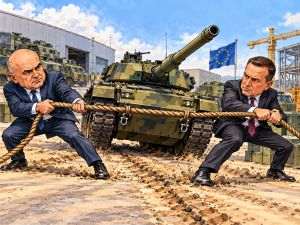
The European Union has taken note of this circuit.
In the 21st package of sanctions, adopted in August, it added 51 entities to Annex IV of Regulation 833, including intermediaries in China and Hong Kong, India, Kazakhstan, Kyrgyzstan, Turkey and the United Arab Emirates, considered to facilitate the circumvention of export controls for microelectronics, numerically controlled machine tools and semiconductor processing equipment; The analysis of the package belongs to the law firm Skadden.
In April, through the 20th package, the Union banned the export of sensitive technologies to Kyrgyzstan.
• Why the client does not become a creditor
The distinction is economic, not political, and therefore does not change through joint statements and photos from summits.
Buying Russian oil at a discount brings an immediate and measurable gain, and the risk is limited to the cargo and the ship in question.
Lending money to a sanctioned state means putting your own access to the dollar payments system at stake, for an uncertain and long-term return.
Russia's partners take the gain and avoid the risk.
Chinese state banks are no exception, and the proof is not in the press releases, but in the refused payments.
For this reason, this support cannot be transformed, by a politically decision, in what Russia lacks: borrowed money.
• What follows from here
The situation described in the main article of the study results (see Russia has exhausted three of the four sources of financing the war).
Because there is no external creditor and because the domestic market for public debt closed in July, the uncovered part of the budget must be taken from domestic savings. And the other half of the cost of the war, the one that foreign buyers do not cover, has always been taken from the Russian taxpayer.
There is also a risk on the part that is currently working.
The US Senate passed by 86 votes to 12 the first procedural hurdle for the law called the Lindsey O. Graham Sanctioning Russia and Iran Act of 2026, which provides for tariffs of up to 100% for the top five buyers of Russian oil and gas. China and India are at the center of the project; the other three have been identified in the press as Slovakia, Hungary and Azerbaijan, according to an analysis by the Atlantic Council.
If the law passes and is implemented, the pressure shifts to revenues.
The effect would be strong, but still not decisive: even if stopped altogether, foreign purchases would cut less than half of the Russian military budget.
The other half comes from Russia's own pocket, and no Western sanctions will suffice.








 Euro
Euro Dolar SUA
 Franc elveţian
 Liră sterlină
 Gram de aur