English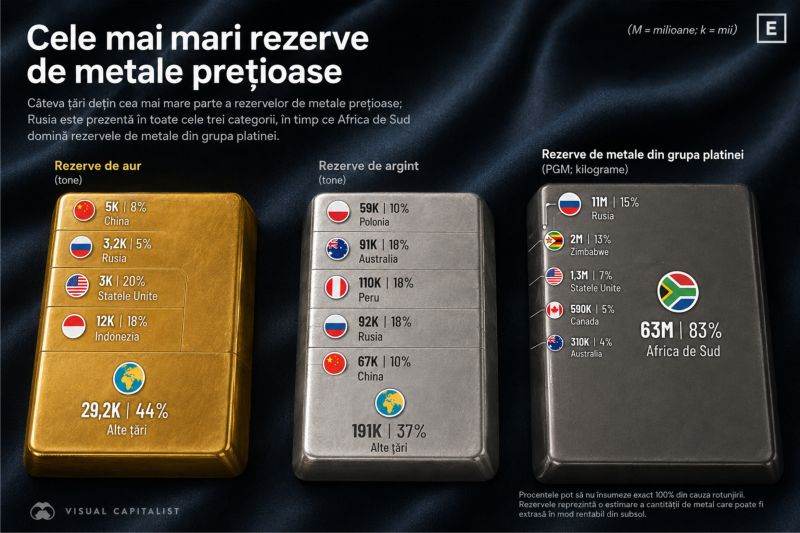
Precious metals are among the world's most valuable natural resources, serving as both financial assets and critical industrial materials. While gold is valued as a store of value, silver and platinum group metals play essential roles in manufacturing, clean energy technologies, and electronics, according to visualcapitalist.com.
The cited source compares the countries with the largest known reserves of these strategically important metals, using U.S. Geological Survey data on economically recoverable deposits.
• Australia and Russia lead in gold reserves
Australia holds the world's largest gold reserves, at 13,000 tonnes, about a fifth of the global total. Russia follows closely with 12,000 tonnes, while South Africa, once the world's leading gold producer, is a distant third with 5,000 tonnes. Indonesia (3,600 tonnes of gold) and Canada (3,200 tonnes) are in fourth and fifth place respectively.
Together, Australia and Russia hold almost two-fifths of the world's known gold reserves. As central banks continue to accumulate gold and mining companies face declining ore grades, these reserves represent an important strategic asset in the long term.
• Silver reserves are more widely distributed
Peru leads the world in silver reserves with 110,000 tonnes, followed by Russia and Australia, with roughly equal shares: 92,000 and 91,000 tonnes respectively.
Unlike gold, no single country dominates global silver reserves. The top five countries account for about two-thirds of the world total, highlighting the broader geographical distribution of silver. The 4th and 5th places go to China (67,000 tonnes) and Poland (59,000 tonnes).
Because silver is widely used in solar panels, electronics and industrial applications, these reserves are becoming increasingly important as demand increases with the energy transition.
• South Africa dominates PGM reserves
The distribution of platinum group metals (PGMs) is much more concentrated than that of gold or silver. South Africa holds about 83% of global reserves, at 63 million kilograms, making it by far the world's largest holder of these critical minerals.
Outside of South Africa and Russia (11 million kg), reserves of the platinum group metals are relatively limited. This concentration means that supplies can be particularly sensitive to disruptions in just a few producing countries.
PGM metals - which include platinum, palladium, rhodium, iridium, osmium and ruthenium - are indispensable in catalytic converters, electronics, jewellery, medical devices and emerging hydrogen fuel cell technologies.
Central banks will step up their gold purchases over the next 12 months, according to a study published last month by the World Gold Council (WGC), cited by Reuters. The analysis, conducted between February 5 and May 19, shows that 45% of public reserve managers surveyed by the WGC, up two percentage points from last year, expect their own institutions to increase their gold holdings in the next 12 months. The majority, 54% of 74 central banks that responded to the WGC survey, say their holdings will remain unchanged, while 1% expect a decline.



























 Euro
Euro Dolar SUA
 Franc elveţian
 Liră sterlină
 Gram de aur