English

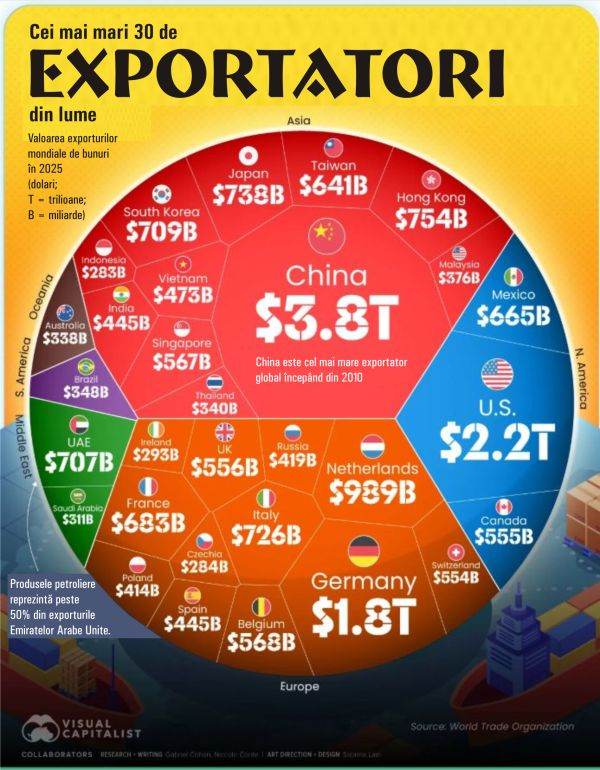
Global trade is dominated by a few large exporters, but the difference in magnitude between them is striking.
China exported goods worth almost $ 3.8 trillion in 2025, maintaining a significant lead over the United States and every other economy, according to visualcapitalist.com. At the same time, Europe has achieved a massive share of global exports, and smaller trading centers, such as the Netherlands and the United Arab Emirates, continue to have a weight far above their caliber in the field.
The cited source ranks the 30 largest exporters in the world, based on 2025 data from the World Trade Organization.
• China's exports boosted by free trade agreements
China's exports, at $3.8 trillion, are almost double those of the United States ($2.18 trillion), underscoring the extent of its dominance in manufacturing and global trade.
Since its gradual liberalization in the late 1970s and 1980s, China has adopted an export-led growth model that has sought to position the country as the "world's factory.” Today, no country ships more goods abroad than China.
China's expanded exports have been boosted by its various free trade agreements, including with Australia, Pakistan, South Korea, and the ASEAN bloc of Southeast Asian markets. The effect is undeniable: China is now the largest trading partner of more than half the world's countries, playing an increasingly important role in developed and emerging markets on every continent.
• US - Diversified Exports, Over $2 Trillion
The United States is known as the world's largest import market, but it is also responsible for more than $2 trillion in diversified exports, including cars, oil, soybeans, and medical products. The US's major trading partners include its North American neighbors, Canada and Mexico, as well as China, Germany, and Japan.
Integrated supply chains in North America show that many US exports actually obtain their inputs from imports across the border. Auto parts, for example, can cross the US border with Mexico or Canada about six to eight times during the vehicle assembly process.
After the US, the 3rd to 10th places in the world exporters ranking are as follows: Germany ($1.764 trillion), Netherlands ($989 billion), Hong Kong ($754 billion), Japan ($738 billion), Italy ($726 billion), South Korea ($709 billion), United Arab Emirates ($707 billion), France ($683 billion).
• Persian Gulf exports, supported by hydrocarbon reserves
Gulf states, such as Saudi Arabia ($311 billion) and the United Arab Emirates ($707 billion), are also well above their caliber as exporters, supported by their extensive hydrocarbon reserves, according to the cited source.
Petroleum products account for almost 75% of Saudi exports and over half of those of the Emirates, in contrast to the share of less than 20% observed in the US, the world's largest oil producer.
The Gulf countries' high dependence on their oil production makes them vulnerable to geopolitical tensions and disruptions to supply chains in the Middle East, with the ongoing conflict involving Iran being a clear example.
• WTO: Global merchandise trade growth to slow in 2026
Global merchandise trade growth will slow significantly to 1.9% this year, from 4.6% last year, and could fall even further if the Middle East war continues to push up energy prices and disrupt global transport, according to a report published last month by the World Trade Organization (WTO), Reuters reports, according to Agerpres.
In 2025, the growth of trade related to artificial intelligence (AI) and the increase in merchandise exports to the US in anticipation of customs duties led to a better-than-expected performance of trade. While world trade has remained resilient, the outlook is under pressure from the escalating Iran war, WTO Director-General Ngozi Okonjo-Iweala said.
If crude oil and liquefied natural gas (LNG) prices remain high this year due to the conflict, growth in world merchandise trade could slow to 1.4%, WTO economists said.
If crude oil and liquefied natural gas (LNG) prices remain high this year, growth in world merchandise trade could slow to 1.4%, WTO economists say.
A prolonged blockade of the Strait of Hormuz by Iran would hit fertilizer imports and crops in countries such as India, Thailand and Brazil, and increase food security risks. High energy prices could shave 0.5 percentage points off growth in world merchandise trade, with Asia and Europe hardest hit, the WTO warns.
And growth in services trade could slow to 4.1% this year, down from a previously forecast 4.8%, as disruptions to maritime and air trade hit services. Last year, growth in services trade was 5.3%.
"The outlook could still improve if the conflict ends quickly and the AI spending boom continues,” the WTO said in a statement.




















 Euro
Euro Dolar SUA
 Franc elveţian
 Liră sterlină
 Gram de aur