English

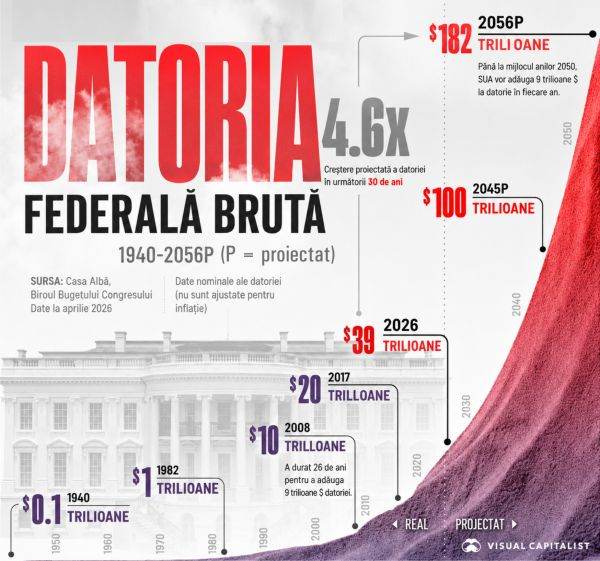
For decades, the US federal debt has increased in long, gradual cycles, but this pace is now accelerating rapidly. A visualcapitalist.com analysis shows, based on data from the Congressional Budget Office and the White House, how the US debt has grown from $51 billion in 1940 to nearly $40 trillion today and how it could climb to $182 trillion by 2056. At that point, the US could add $10 trillion to the federal debt every one or two years.
• How the US federal debt has accelerated
Each additional $10 trillion to the US debt is recorded faster than the previous one, with the accumulation period reduced from several decades to just a few years, according to the cited source. It took nearly 70 years for the US debt to reach its first $10 trillion mark. In the following decades, the same increase could occur in just one or two years.
After World War II, it took more than 60 years for the U.S. debt to reach $10 trillion.
The next $10 trillion came in nine years after the 2008 financial crisis. In the 2020s, pandemic-related spending compressed the gap to just five years.
By the 2050s, each additional $10 trillion could be added in just one to two years.
This scenario doesn't account for new wars, recessions, or unmanageable interest rates. Even so, the U.S. federal debt is projected to reach $182 trillion by 2056.
For context, that's a 4.6-fold increase from the current all-time high of $39 trillion, or nearly three times the current valuation of all companies in the S&P 500 combined.
• Why Debt Matters to America's Future
As the debt rises, an increasing portion of the federal budget is expected to be spent on interest payments, crowding out spending on defense, infrastructure, and public services. As borrowing costs rise, the effects could ripple through the economy, raising interest rates for households and businesses, slowing investment, and hurting long-term growth.
• US Spends More on Interest Payments Than on Defense
The United States is now spending more on interest payments than on national defense for the first time since the late 1920s, marking a turning point in federal priorities, according to visualcapitalist.com. As debt levels and borrowing costs rise, interest payments are taking up an increasing share of the budget and are projected to reach $2.1 trillion by 2036, far exceeding defense spending.
According to data/estimates provided by the White House and the Congressional Budget Office, US interest payments will reach $879.9 billion in 2024, exceeding defense spending, which was $850.7 billion. Projections through 2036 show that interest payments will continue to rise, even as defense spending increases.
According to official data, between 1996 and 2001, U.S. defense spending was, on average, about 30 percent higher than net interest costs, as falling interest rates and budget surpluses kept debt service relatively low. This gap widened sharply after the terrorist attacks of September 11, 2001. Military spending doubled over the next decade, reaching $699 billion in 2011, while interest costs grew more slowly, to $230 billion.
During the low-interest-rate era of the 2010s, borrowing costs remained low even as the federal debt nearly doubled-from $9 trillion in 2010 to $16.8 trillion in 2019-masking the long-term cost of that debt.
After the Covid-19 pandemic, this dynamic has reversed. A sudden increase in borrowing, combined with higher interest rates, has led to a significant increase in debt-servicing costs, with net interest expenses nearly tripling to $970 billion by 2025.
At an estimated $1 trillion in 2026, America's net interest bill is projected to become the largest-growing budget item.
By 2036, net interest spending in the US will double to $2.1 trillion, while defense spending is projected to reach $1.1 trillion.
• Who finances the US debt
The US relies on a wide range of buyers of government securities, such as domestic institutions, foreign governments and its own central bank, to finance its growing deficits.
Visualcapitalist.com shows who finances the US debt of $39 trillion and how much of it is held by domestic and foreign investors, respectively, according to data provided by the Treasury, the US Joint Economic Committee and the Federal Reserve, valid as of March 2026.
Of the $39 trillion that represents the gross debt of the United States, $31.4 trillion (81%) is held by domestic and foreign investors. The remaining $7.6 trillion (19%) is intra-governmental debt, reflecting domestic government transactions. This total is about twice the combined wealth of the world's top 20 billionaires.
Public debt is what the U.S. owes to foreign investors and directly influences interest rates, borrowing costs, and financial markets. In contrast, intra-governmental debt is money the government owes itself, primarily through programs like Social Security.
Mutual funds and pension funds are the largest holders of U.S. public debt ($6.6 trillion), reflecting strong demand for safe, liquid assets. The Federal Reserve holds $4.4 trillion on its balance sheet, more than the top three foreign creditors-Japan, Britain, and China-combined.
Among individuals, Warren Buffett, through his company Berkshire Hathaway, is the largest non-government holder of US Treasuries, with $339 billion in the last quarter of 2025. The top countries that bought US Treasuries from November 2024 to November 2025, both in terms of the value in US dollars and the percentage change in their holdings, are the United Kingdom, Belgium and Japan, each with purchases exceeding $115 billion, according to visualcapitalist.com. The United Kingdom led these purchases, with almost $122 billion (+16% annually) during the period, followed by Belgium ($119.7 billion; +33%) and Japan ($115.5 billion; +11%). Canada and Norway are in fourth and fifth place, with $99.8 billion (+27%) and $56.3 billion (+35%), respectively. Together, these five countries accounted for about 65% of the total purchases of $786 billion.
The cited source notes that, in the case of Belgium, the 33% increase is largely technical: Brussels is home to Euroclear, a clearing house that holds bonds on behalf of investors in Europe. Therefore, the number may indicate where the debt is held, rather than who actually purchased it. The same logic applies to other financial centers, such as the United Kingdom, the Cayman Islands and Luxembourg.
In the aforementioned ranking, places 6-10 look like this: France ($43.5 billion; +13%), United Arab Emirates ($30.3 billion; +41%), Taiwan ($26.5 billion; +9%), Cayman Islands ($22.1 billion; +5%), Israel ($20.2 billion; +23%).
In contrast, China has been steadily reducing its holdings of U.S. government debt, and a post on the X network by analytics provider The Kobeissi Letter shows that the Asian country's share of total foreign holdings of U.S. securities has fallen to 7.3 percent, the lowest level since 2001, according to economictimes.indiatimes.com. This share was much higher before - 28.8 percent in June 2011, for example, which means it has fallen by about 21.5 percentage points since then.
China currently holds about $683 billion in U.S. Treasuries, the lowest level since 2008. That means the Asian country has sold about half of the U.S. bonds it bought between 2000 and 2010.
China's holdings of U.S. debt peaked in 2013, and their continued decline is driven by Beijing's reduced financial dependence on the United States. Industry officials say this also helps reduce risk if markets become volatile.


























 Euro
Euro Dolar SUA
 Franc elveţian
 Liră sterlină
 Gram de aur