English

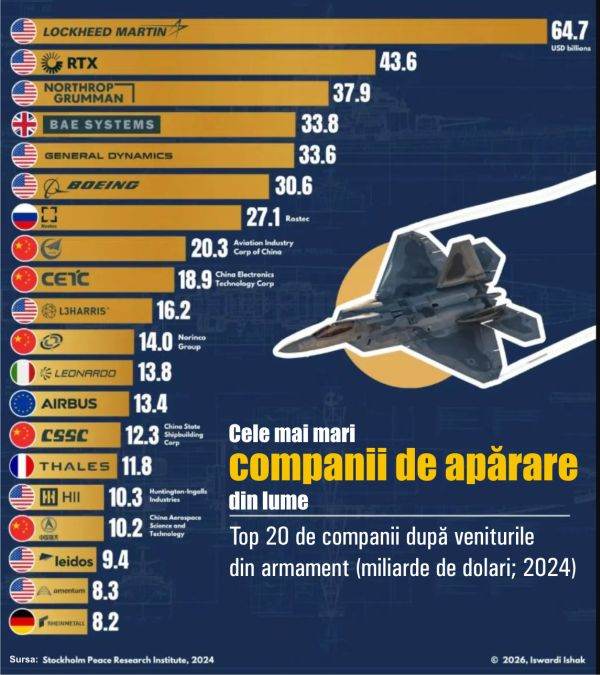
A small group of companies dominate the global arms industry, with a clear leader at the top, according to visualcapitalist.com, which presents a ranking in the field, using data from the International Peace Research Institute (SIPRI). It ranks the top 20 defense companies by arms sales in 2024. US giant Lockheed Martin is well ahead of its competitors, highlighting the industry's concentration among a small number of major contractors.
American companies have an outsized presence at the top of the rankings, but China and Europe continue to expand their presence, indicating a gradually changing global landscape.
• Why the US dominates global arms sales
American companies occupy six of the top ten spots on the rankings by arms revenue, reflecting their dominance in defense programs that have high costs and long life cycles. From fighter jets to missile defense systems, these projects create steady, long-term revenue streams.
Together, these companies generate hundreds of billions of dollars in arms sales, but the revenue is concentrated among the top players.
Lockheed Martin leads the rankings, with nearly $65 billion in arms revenue, well ahead of second- and third-place companies RTX (about $44 billion) and Northrop Grumman (nearly $38 billion).
General Dynamics ($33.63 billion), Boeing ($30.55 billion) and L3Harris Technologies ($16.21 billion) also rank in the top 10.
• Major players in Europe and China
European companies remain major players in the field, although their revenues lag behind the largest US contractors. BAE Systems ranks fourth overall ($33.8 billion), while Leonardo ($13.83 billion), Airbus ($13.37 billion), Thales ($11.80 billion) and Rheinmetall ($8.24 billion) also appear in the top 20.
Chinese state-owned companies are also present in the list, including AVIC ($20.32 billion), CETC ($18.92 billion), NORINCO ($13.97 billion), China State Shipbuilding Corp. ($12.33 billion) and China Aerospace Science & Technology Corp. ($10.23 billion). Together, these reflect the expansion of China's defense industrial base in aerospace, electronics and shipbuilding.
• European arms imports tripled after Ukraine invasion
European arms imports tripled between 2021 and 2025, compared to the previous five-year period (from 2016 to 2020), according to the latest SIPRI report, cited in March by dpa, according to Agerpres.
According to the document, global arms deliveries increased by 9.2% compared to the previous two five-year periods.
SIPRI estimates the volume of arms delivered, not their value, dpa specifies.
Arms quantities fluctuate significantly depending on orders each year, but the institute follows long-term trends, comparing one five-year period to another.
The strongly increasing trend in Europe manifested itself in the context of the Russian invasion of Ukraine, which led European countries to strengthen their defense capabilities. SIPRI expert Katarina Djokic even said that "Russia is solely responsible for the sudden increase in European arms imports.”
Demand for weapons has also increased in European NATO member countries, due to uncertainties about the extent of the defense provided by the United States within the alliance, the researchers show.
Europeans purchase weapons primarily from the United States, and for the first time in the last two decades, the bulk of American arms exports were destined for Europe, not the Middle East, SIPRI finds. Imports from the United States continued in 2021-2025 despite the increase in arms production by European companies and the new European Union defense investment instrument.
This observation is particularly true for fighter jets and long-range anti-aircraft systems, which are considered particularly effective in Europe.
Countries such as Romania and Poland have also purchased American weapons to strengthen their partnerships with the US, Djokic noted, adding: "Also, if you already have US systems - like Germany's Patriot anti-aircraft system, for example - there are many logistical and training reasons to continue using them.”
SIPRI predicts that Europe's demand for arms will continue to grow, including due to tensions and war in the Middle East.
Djokic also anticipates other possible consequences of the US-Israeli attacks on Iran: "If there are bottlenecks in the US, for example in terms of defensive missiles, this may make the country prioritize its own armed forces and restrict deliveries to other states.”
Such a situation could become a problem for European states, given that the Americans provided about 42% of all international arms deliveries in the period 2021-2025 and exported weapons to 99 countries. During the same period, France and Russia ranked second and third in the respective trade, with the observation that Russian exports decreased by 64%.
On the other hand, the largest importer of weapons remains Ukraine, which is defending itself from the Russian invasion, followed by India, Saudi Arabia, Qatar and Pakistan.
• US announces arms sales of over $16 billion in the Gulf
The United States approved, in March, arms sales worth over $16 billion to the United Arab Emirates and Kuwait, countries in the Persian Gulf affected by the consequences of the American-Israeli war against Iran, AFP and Reuters report, according to Agerpres.
After the US and Israel began air strikes on Iranian territory on February 28, Tehran's forces responded by launching missiles and drones, especially against Arab states in the Gulf region where American military bases are located. The State Department in Washington has given the green light to exports of missiles, drones, radar systems, ammunition and upgrades for F-16 fighter jets to the Emirates, which is to pay more than $8.4 billion.
Kuwait could purchase missile defense radars worth $8 billion, and Jordan would benefit from aviation support and ammunition worth $70.5 million.
The main contractors include American corporations RTX, Northrop Grumman and Lockheed Martin, the State Department also said.
• Pierre Vandier: "We must prepare, otherwise we will suffer what the Gulf states are experiencing"
NATO countries must urgently develop new ways of defending themselves against rivals and have not yet understood the scale of the challenge, especially in terms of the volume of their weapons production, a senior official of the North Atlantic Alliance recently warned, AFP reports, according to Agerpres.
"We must prepare, otherwise we will suffer what the Gulf states are currently experiencing", attacked by Iran, warned the Supreme Allied Commander for Transformation (SAC-T), French Admiral Pierre Vandier, at the Strategic Defense Forum in Paris. "These countries were hit by Shahed drones in 2019, they have no problem with money, they can buy anything they want on Earth. It is not a question of money, it is a question of speed, of making the right choices,” said Pierre Vandier, noting: "For NATO, the challenge is not to be able to do more of the same thing we did before, but to find answers to the challenges raised by Russia or Iran in their way of waging war, in terms of the mass of weapons and their speed of evolution.”
"This is a moment of truth,” the quoted official also declared, specifying: "We are witnessing the return of mass production, and our industry has produced systems (weapons - ed.) that cannot be mass-produced. For example, the United States produces one Patriot missile battery for every four ballistic missiles produced by Russia or Iran.”
Faced with these threats and the mass production of drones like the Iranian and Russian Shahed, simply producing more drones leads to a stalemate and "we have to invent something new.”
The other crucial issue is "speed of adaptation,” which the admiral considers far too slow. In joint projects overseen by SAC-T, allies need a period of two to three years just "to define the requirements.” "This is a huge problem because each country says it wants specifications to protect its industry,” Pierre Vandier explained.
Meanwhile, the speed of development is incredible. For example, the Shahed drones have undergone five upgrades since some of them fell in Poland in September 2025. Therefore, Pierre Vandier believes that it is essential to have "newcomers” in the defense industry, whose ability to produce large programs, such as fighter jets or aircraft carriers, remains crucial.

























 Euro
Euro Dolar SUA
 Franc elveţian
 Liră sterlină
 Gram de aur