English

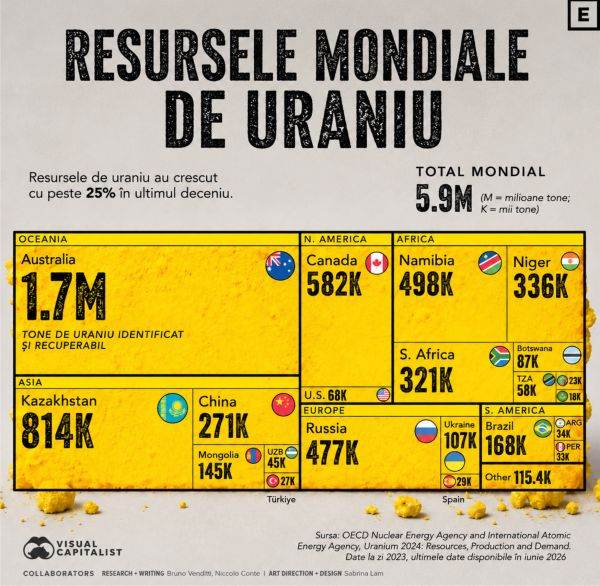
Uranium resources are highly concentrated in a few countries, with Australia alone holding more than a quarter of the world's known reserves.
Visualcapitalist.com presents a ranking of countries by recoverable uranium resources identified in 2023, according to data from the OECD and the International Atomic Energy Agency. The figures include resources that can be recovered at costs of up to $130 per kilogram of uranium.
• Australia - 1.7 million tonnes of uranium
Global identified uranium resources totaled 5.9 million tonnes in 2023. More than half of this amount is concentrated in just three countries: Australia, Kazakhstan and Canada. Australia has the world's largest uranium resource base, with nearly 1.7 million tonnes of contained uranium metal, according to the source cited. This represents 28% of the global total, making Australia the clear leader in the field. Its resources are more than twice those of Kazakhstan, the second largest holder.
A country that has large uranium resources does not necessarily mean that it produces the most uranium. Resource estimates measure what is known to exist and can be economically recovered, while production depends on mine development, investment, permits and government policies.
Despite its large resource base, Australia's uranium mining industry is smaller than reserves might suggest, partly due to political restrictions and project development timelines.
• Kazakhstan and Canada - major producers
Kazakhstan holds 813,900 tonnes of uranium resources, or 14% of the global total. Canada follows with 582,000 tonnes, equivalent to 10% of the world's resources. Together with Australia, these three countries account for 52% of the global identified uranium resources. Both Kazakhstan and Canada are also major uranium producers, with importance in the global nuclear fuel supply chain.
• Broad global resource base
Beyond the top three, uranium resources are spread across Africa, Asia, Europe and the Americas. Namibia (497,900 tonnes; 8% of the total) and Niger (336,000 tonnes; 6%) are notable African holders, while Russia (476,600 tonnes; 8% of the total), China (270,500 tonnes; 5%), Ukraine (106,700 tonnes; 2%) and Uzbekistan (45,000 tonnes; 1%) represent major Eurasian resource bases. Brazil (167,800 tonnes; 3%), Argentina (34,300 tonnes; 1%), Peru (33,400 tonnes; 1%) and the USA (67,800 tonnes; 1%) contribute to the resource picture in the Americas.
As countries seek to expand low-carbon electricity generation, uranium supplies have become increasingly important for energy security planning. Continued exploration has helped increase global identified uranium resources by more than 25% in the past decade, expanding the potential fuel base for future nuclear power growth.
• New nuclear reactors in the US
The US government signed an $80 billion deal with Westinghouse Electric Co. in October 2025. to build new nuclear reactors, an initiative aimed at meeting the growing demand for electricity from Artificial Intelligence, reports Bloomberg, according to Agerpres.
The strategic partnership, which also includes investment fund Brookfield Asset Management and Canadian uranium producer Cameco Corp, aims to implement US President Donald Trump's artificial intelligence ambitions and expand an industry it sees as vital to competing with China.
In a joint press release published at the time, the signatories reported that the strategic partnership will lead to the creation of tens of thousands of jobs in the US.
According to BloombergNEF analysts, US data center electricity consumption will double by 2035, reaching nearly 9% of total demand. This explosion in electricity consumption has driven the construction of new power plants and the provision of grid connection. However, building new nuclear reactors takes several years, and some companies, such as Google, are considering reopening closed nuclear plants in an attempt to get electricity faster.
Much hope for a nuclear renaissance in the U.S. is centered on the development of small modular reactors, but the deal with Westinghouse is for large reactors and aligns with a 2025 announcement by developer Fermi Inc. that it will begin production on four large reactors that would be used for a private data center network campus in the Texas Panhandle.
The announced agreement came amid a slow development of nuclear power in the US: only two reactors have been completed this century - the units at the Vogtle plant in Georgia, which have suffered numerous delays.
Each two-unit Westinghouse AP1000 plant creates or supports 45,000 manufacturing and engineering jobs in 43 states, and a nationwide deployment will create more than 100,000 construction jobs, the signatory companies said. Six AP1000 reactors are currently in operation, and the technology has been selected for programs in Poland, Ukraine and Bulgaria.
"The program will strengthen the United States as one of the world powers in the field of nuclear energy and will increase exports of Westinghouse's nuclear energy production technology globally," the statement added.























 Euro
Euro Dolar SUA
 Franc elveţian
 Liră sterlină
 Gram de aur