English

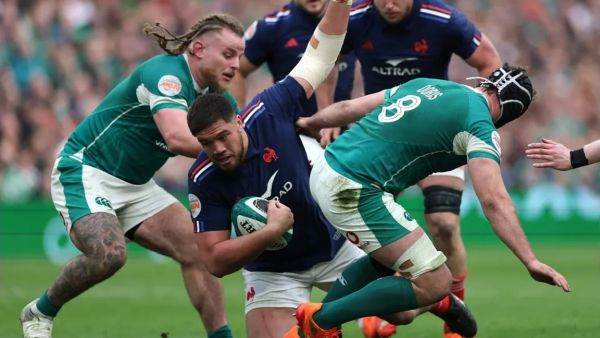
European men's rugby restarts its engines today in the most resounding way possible: the Six Nations 2026 begins with the France-Ireland match at the Stade de France, a duel that, in recent years, has become almost synonymous with the fight for the trophy. It is not just an opening match, but a declaration of intent from both teams: two national teams that have shared the last four titles between them - France won the Six Nations in 2022 and 2025, Ireland was champion in 2023 and 2024 - immediately throw down the gauntlet in an evening that promises intensity, pressure and an emotional stake that matches the reputation of the competition.
The Six Nations remains, every winter, that championship that compresses history, rivalries and identity into 80 minutes, and the 2026 edition assumes a blockbuster rhythm from the start: Paris, a full stadium, two different styles, two huge prides and, very importantly, a special match.
For the first time, the Six Nations tournament begins on a Thursday, a detail that is not just a curiosity, but a sign of the way in which top sport is placing itself on the same map as major global events. The move was not a whim, but a decision to avoid an overlap with the opening ceremony of the Winter Olympics in Milan, scheduled for Friday, February 6, when the artistic moments will be supported by Mariah Carey and Andrea Bocelli. Instead of entering into a direct competition for the public's attention, the Six Nations opens the curtain with France-Ireland, today, February 5, at 22:10 - Romanian time, transforming Thursday evening into a "prime time" of rugby. In a Europe where the audience is divided between sports, platforms and events, a Thursday start may seem like a risk; in reality, with France and Ireland at the start, it is a guarantee of ratings, atmosphere and impact.
The weight of the confrontation lies not only in the present, but also in the numbers that frame it in a long and dense history. France and Ireland have a head-to-head of 104 test matches, starting in 1909, and the overall balance favors the French: 60 wins for Les Bleus, 37 for Ireland and 7 draws. However, if we look strictly at the contemporary area, the differences melt away: both teams have five wins in the last ten direct confrontations, a sign that we are talking about a rivalry that has reached equilibrium, in which the details - a penalty, an interception, a decision at the pile, a bravely played advantage phase - can rewrite the hierarchies. There is also a coincidence that adds salt to the wound and fuel for storytelling: in the era when the tournament was called Five Nations, a France-Ireland match was played on a Thursday (then, January 1, 1948), and the hosts lost in Paris 13-6; Ireland won that edition with victories on the line. It is the kind of memory that fans bring up before a big match, either as a warning or a promise. In 2026, France enters the competition as the title holder, with the aura of the 2025 champion and with Paris ready to press the pedal to the emotion from the first second. At the same time, Ireland comes with the status of the team that has dominated recently, but also with the burden of some absences and occasional turbulence that can change the way the script is written. Bundee Aki, a defining centre in the Irish architecture in recent years, has been suspended for four matches for verbal abuse of an official, a penalty that will see him miss the first three matches of the Six Nations, including the duel with France, which forces Ireland to quickly reinvent themselves in the midfield and in the contact game. On top of that, the problems in the squad are already part of the picture: Mack Hansen is unavailable with a foot injury, and Andrew Porter and Robbie Henshaw are also mentioned as absentees for at least the debut match against France. However, in a duel of the level of France-Ireland, any absence means a series of adaptations: new combinations, communication in defense, synchronization in transition phases, the ability to manage pressure when the Stade de France starts to "flow" over the opponent.
On the other hand, France has at its heart a comeback that alone can push global interest up: Antoine Dupont, considered one of the best players in the world as a scrum midfielder and, for many, an absolute benchmark of current rugby. Dupont suffered a torn ligament in the penultimate match of the last campaign, even against Ireland, but he returned faster than expected, checking his return in Toulouse in November. In an opening match that could set the tone for the entire edition, Dupont's presence is not only good news for French fans, but a change of equation for any opponent: the speed of the service from the ruck, the decision to play with his hand or foot, the way in which the defenders are kept in check inside, all take on a different temperature when he leads the orchestra.
Six Nations 2026 promises, however, more than just a huge match, even if France-Ireland is the initial magnet. The first round continues on Saturday, February 7, with Italy-Scotland in Rome (16:10-Romania time) and England-Wales in London, at Twickenham (18:40 - Romania time), two confrontations that immediately add pressure on the standings and a different dimension of the rivalries.
England, for example, enters the tournament with a squad that sees both big names and the idea of depth, even if the problems in the front line have been accentuated by injuries and surgeries. Added to this is the replacement of captain Maro Itoje - amid an extremely difficult personal period after the death of his mother - with Jamie George designated to lead the team in his debut. Itoje is ready to enter the game at any time from the bench.
Another interesting aspect is the fact that Louis Rees-Zammit, who also went through the NFL, reappears in the Welsh national team, a name capable of reigniting enthusiasm in a Welsh rugby under pressure and, at the same time, in the context of internal turmoil that has generated fan protests and discussions about the future of the professional regions.
The format of the 2026 competition maintains that brutal and spectacular balance: five stages, few breathing spaces, every mistake is punished.
In the second round, the matches Ireland-Italy in Dublin and Scotland-England in Edinburgh are scheduled on February 14, then Wales-France on February 15; in the third round we will have the duels England-Ireland and Wales-Scotland on February 21, followed by France-Italy on February 22, and the fourth round has an evening duel, Ireland-Wales, on March 6, before Scotland-France and Italy-England are played on March 7.
The Six Nations 2026 final will be apotheotic. On March 14, the Ireland-Scotland, Wales-Italy matches are scheduled, and in the evening the France-England confrontation takes place, at the Stade de France, in Paris, a match that, within the England team, has already been talked about as a possible title final, which says everything about how close this edition of the Six Nations in men's rugby is announced.
The Six Nations 2026 matches will be able to be watched by rugby fans in our country on Digisport channels.




















 Euro
Euro Dolar SUA
 Franc elveţian
 Liră sterlină
 Gram de aur