English


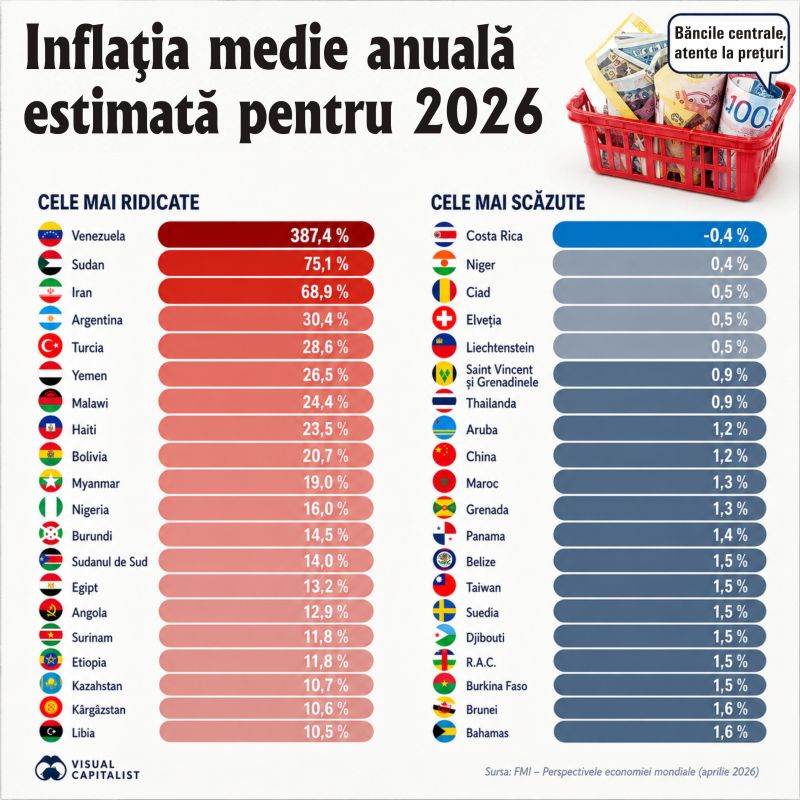
Inflation has eased in many major economies, but many countries still face severe price volatility in 2026. Visualcapitalist.com has compiled a ranking of the countries with the highest and lowest annual average inflation rates projected for 2026, based on the World Economic Outlook released in April by the International Monetary Fund (IMF). At one extreme, Venezuela's inflation rate is expected to reach 387.4%. At the other extreme, Costa Rica is expected to be the only country in deflation, with prices falling by 0.4%.
• Venezuela's Inflationary Nightmare
Venezuela has the world's highest inflation rate. Its economy has been battered over the past decade by political instability, policy mismanagement, and the exodus of millions of people. The country's economic fortunes have long been tied to oil, with Venezuela holding the world's largest reserves. When oil prices collapsed in 2014, Venezuela's economy fell with them. More than a decade later, the country's inflation remains higher than that of any other country.
Given the surge in oil prices over the previous decade, Venezuela's collapse in the mid-2010s was far from inevitable. However, the channeling of oil profits into political projects rather than infrastructure upgrades has left the country in ruins.
Several other unstable, oil-rich countries also struggle with high inflation, including Iran, Libya, and Nigeria.
After Venezuela, the inflation ranking looks like this (ranks 2-10): Sudan (75.1%); Iran (68.9%); Argentina (30.4%); Turkey (28.6%), Yemen (26.5%); Malawi (24.4%); Haiti (23.5%); Bolivia (20.7%); Myanmar (19%).
• Deflation and disinflation in the Caribbean
While Venezuela struggles with the highest inflation rate in the world, in 2026, some of the countries in the Caribbean are doing much better. Aruba, Belize, Grenada, Panama, Saint Vincent and the Grenadines, and the Bahamas are among the countries with the lowest inflation estimates in the world, recording an annual average of around one percent.
Costa Rica stands out as the only country in the ranking with deflation (-0.4%). While falling prices may seem positive for consumers, sustained deflation can weaken demand, reduce business income, and put pressure on wages. Costa Rica's central bank does not expect inflation to return to its target range until mid-2027.
Niger follows, with inflation estimated at +0.4% this year, and Chad, at +0.5%. The rankings, down to 10th place, are as follows: Switzerland (0.5%); Liechtenstein (0.5%); Saint Vincent and the Grenadines (0.9%); Thailand (0.9%); Aruba (1.2%); China (1.2%); Morocco (1.3%).
• Battling high inflation in 2026
Given the damaging impact of skyrocketing prices on households and companies, central banks around the world are focusing on fighting inflation, usually through monetary policies such as raising interest rates.
Governments also play an important role. President Javier Milli was elected to Argentina's presidency in late 2023 with a mandate to address the country's economic woes. His government has cut spending and subsidies to help keep inflation low. Another, more radical approach that Milli campaigned on was to replace the currency with the dollar. By switching to the U.S. dollar, as countries like Ecuador and Panama have done, Milli hoped to avoid the possibility that future governments would resume an inflationary cycle by printing excessive amounts of local currency. However, Argentina continues to use its own currency, the peso, without adopting the dollar.
• Christine Lagarde, ECB: "Long-term inflation expectations remain anchored despite Iran war”
European Central Bank (ECB) President Christine Lagarde said last month that long-term inflation expectations in the euro zone remain broadly anchored, although the energy crisis caused by developments in the Middle East continues to increase inflation and affect the economy, according to Anadolu and Reuters.
Lagarde said the ECB remains firmly committed to price stability, amid high uncertainty caused by the energy shock. This shock has significant direct and indirect effects on EU economies, Lagarde warned, adding that she had briefed the region's finance ministers on inflation developments and the ECB's monetary policy decision in April, Agerpres notes.
Analysts expect the ECB to raise borrowing costs at its policy meeting today after annual eurozone inflation rose to 3% in April from 2.6% in March, well below the ECB's medium-term target of 2%.
"Longer-term inflation expectations in the eurozone remain broadly anchored, despite upward pressures on inflation and downward pressures on economic activity,” Lagarde said, adding: "The implications of the war for medium-term inflation and economic activity depend on the intensity and duration of the energy shock, as well as the magnitude of its spillover effects.” The official said the ECB was committed to setting monetary policy in a way that would ensure inflation remains stable at the institution's medium-term target of 2%.
Asked about the ECB meeting that ends today, Lagarde refused to give any clear indications, saying: "We will continue to follow, at each meeting, a data-driven approach to determine the most appropriate monetary policy so that we reach our medium-term inflation target of 2%.
Lagarde told euro zone finance ministers that if they loosen fiscal policy too much to cushion the impact of energy prices, the ECB would react with higher interest rates. Fiscal policy measures aimed at containing the energy price shock should be temporary, targeted and proportionate. Any deviation from these principles would have negative effects and would lead to a change in monetary policy, Lagarde said.
In April, the European Central Bank kept interest rates unchanged for the seventh consecutive meeting, but signaled its growing concerns about rising inflation, fueling bets that there will be more rate hikes this year, starting in June.




















 Euro
Euro Dolar SUA
 Franc elveţian
 Liră sterlină
 Gram de aur