English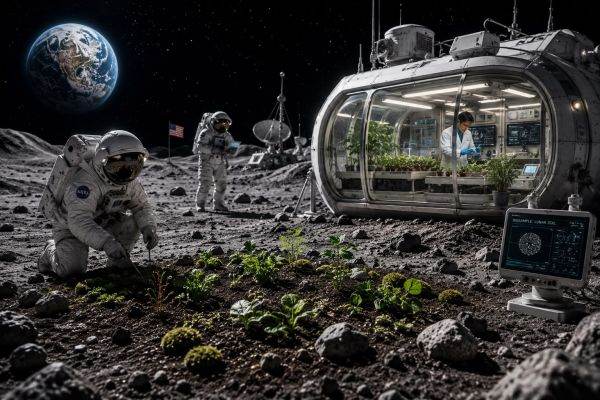
Some microorganisms from Earth could remain alive in certain areas of the Moon, especially in the south pole region, where the relief creates spaces protected from solar radiation, NASA informs. A study coordinated by NASA and published in the journal Science Advances shows that several bacteria and fungi found in human environments can withstand, at least temporarily, the extreme conditions on the lunar surface. However, the researchers emphasize that the results do not represent proof of the existence of life on the Moon and that the microorganisms tested have not been observed multiplying in these conditions.
• The South Pole of the Moon, a Less Hostile Environment Than It Seems
The Moon is one of the most extreme environments known. It has no atmosphere to protect the surface from radiation, temperatures vary greatly, and liquid water cannot exist under normal surface conditions. However, the lunar relief creates surprising situations. Near the poles, craters, ridges, and other features can block sunlight from reaching certain areas. The result is shadowed regions, some of which can remain out of direct sunlight for very long periods. It was these "niches” that were the starting point for the research coordinated by NASA scientists. The team analyzed three regions near the lunar south pole-Nobile Rim, Connecting Ridge, and De Gerlache Rim-using altitude, temperature, and radiation data from the Lunar Reconnaissance Orbiter. The researchers sought to determine where conditions might be favorable enough for microorganisms accidentally brought from Earth to remain viable. The study looked at microorganisms that can be associated with humans or the environments in which they operate, including during space missions. Among them were Aspergillus niger, Bacillus subtilis, Staphylococcus aureus, and Deinococcus radiodurans, as well as several species of Fusarium. The choice was not accidental: some of these organisms are known for their ability to withstand difficult conditions and have even been detected in environments associated with spaceflight. The most resistant of the microorganisms analyzed proved to be Aspergillus niger, a fungus found in humid and warm environments and also known from environments on the International Space Station. Of the bacteria tested, Deinococcus radiodurans showed the greatest resistance. However, the results do not mean that microorganisms could live on the Moon in the same way that they live on Earth.
• Survival does not mean reproduction
This is one of the essential distinctions of the study. By "survival”, the researchers aimed to see if the microorganisms could remain alive for a certain period under the conditions analyzed. The experiment did not prove that they could develop.
Therefore, the conclusion of the research is narrower, but important: certain forms of terrestrial life could temporarily withstand certain micro-circumstances on the Moon. The discovery is important as space programs prepare for a longer human presence on the Moon. Humans do not travel alone. Microorganisms are an inevitable part of the human body and the environment in which they live. NASA estimates that, on average, there are about a million bacteria on a surface of skin the size of a pencil eraser. Some of these can reach space through suits, equipment and habitats. In the case of robotic probes, sterilization procedures can be applied to a much greater extent. For manned missions, however, complete elimination of microorganisms is impossible. This difference becomes important in the context of plans for a permanent human presence on the Moon.
• The risk is one of contamination, not "biological invasion”
One of the concerns of researchers is that terrestrial microorganisms do not compromise future research on the Moon. If a microbe brought by astronauts remains viable in a protected area and is later discovered by another mission, scientists could have difficulty determining the origin of the biological material. The problem is all the more important for research that looks for organic compounds or other chemical clues associated with the geological and, possibly, biological history of celestial bodies. NASA warns that future explorations must take this possibility into account and document the chemical and biological composition of the lunar environment as well as possible before human activity modifies it. It is, in essence, a question of planetary protection: humans must avoid contaminating other celestial bodies with terrestrial organisms, but also be able to identify any materials or organisms that could come from the explored environment.
• Shadowed craters can develop eni "refugees" for microorganisms
The models carried out by the researchers have identified what NASA calls "survival niches", with very different sizes. Some can be the size of a crater, while others can be extremely small, down to the area covered by an astronaut's bootprint. Ultraviolet radiation is one of the main factors limiting the survival of microorganisms on the surface of the Moon. However, shaded areas offer a natural protection. In the case of Aspergillus niger, the high resistance to ultraviolet radiation allowed the identification of areas where the fungus could remain viable even in regions that receive a certain amount of light. These results show that the surface of the Moon should not be viewed as a uniform environment. Even if, on a global scale, the conditions are incompatible with ordinary terrestrial life, the microclimate of some areas may be different.
The importance of the research is also increasing due to the radical change in lunar exploration programs. NASA is developing a program to build a permanent human presence near the Moon's south pole, and the agency is working with commercial partners to develop the necessary infrastructure. Plans include landers, rovers, power systems, and technologies for operating on the lunar surface. At the same time, the south polar region is a prime area of interest for future missions because it is home to permanently shaded regions and ice deposits that scientists believe could be of major importance for long-term exploration.
As the number of missions increases, the problem of biological contamination will become more difficult to ignore. Paradoxically, microorganisms that could pose a problem for lunar research may also become the subject of important experiments. NASA believes that the Moon's extreme environments can provide opportunities to study the limits of biological survival. Understanding how organisms respond to radiation, extreme temperatures, and lack of water could be relevant not only for lunar exploration, but also for future missions to Mars.

























 Euro
Euro Dolar SUA
 Franc elveţian
 Liră sterlină
 Gram de aur