English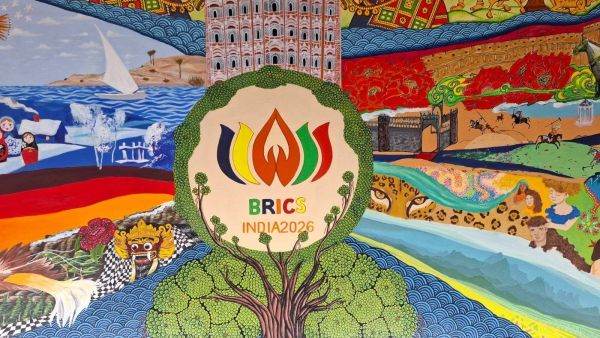
Gathered in New Delhi on September 12 and 13, 2026, BRICS leaders adopted a joint declaration calling for the reform of international institutions, an increase in the influence of the Global South, the elimination of economic sanctions not authorized by the UN Security Council, and the resolution of conflicts through dialogue and diplomacy. The document reaffirms the principles of respect for sovereignty, the equality of states, and international law, while advocating for the transformation of the multilateral system into one that is more representative, equitable, and adapted to new economic and geopolitical realities.
BRICS calls for comprehensive reform of the UN and the Security Council to ensure stronger representation for countries in Africa, Asia, Latin America, and the Caribbean. China and Russia reaffirmed their support for Brazil and India's aspirations to play a more significant role within the UN, including in the Security Council. Regarding the selection of the next UN Secretary-General, the leaders noted that no woman has yet held this position and called for greater geographic diversity and increased female participation in the leadership of international organizations.
The declaration also demands urgent reform of the International Monetary Fund and the World Bank so that the voting rights and quotas of emerging economies more accurately reflect their weight in the global economy. In the realm of trade, BRICS supports strengthening the World Trade Organization and restoring a functional dispute settlement mechanism, while criticizing the proliferation of tariffs, non-tariff barriers, and protectionist measures incompatible with WTO rules. Member states condemn economic and secondary sanctions imposed unilaterally-outside the mandate of the UN Security Council-stating that these measures undermine the right to development, health, and food security, while disproportionately affecting poor and vulnerable populations.
Regarding the conflict in the Middle East, leaders express deep concern over escalating tensions and call for "maximum restraint," the protection of civilians and civilian infrastructure, respect for sovereignty and territorial integrity, and the maintenance of trade flows, energy supplies, and supply chains. The document condemns deliberate attacks on civil nuclear facilities subject to International Atomic Energy Agency safeguards. BRICS condemns all forms of terrorism, including the cross-border movement of terrorists, their financing, and the existence of safe havens. The document also draws attention to cross-border fraud networks, money laundering, human and arms trafficking, terrorist financing, and the illicit use of virtual assets.
In the financial sphere, member states will continue efforts to establish faster, cheaper, more accessible, and secure cross-border payment mechanisms and to utilize national currencies in trade and investment. However, the declaration does not propose the creation of a common BRICS currency; instead, it advocates studying the interoperability of national payment and financial messaging systems, acknowledging that there is no "one-size-fits-all" solution for all members. The group also aims to develop its own insurance ecosystem, strengthen the New Development Bank, and mobilize private capital for projects within BRICS and the Global South. In the energy sector, the declaration promotes a diversified mix comprising renewable, nuclear, and hydroelectric energy, bioenergy, hydrogen, fossil fuels, and storage technologies. BRICS calls for secure supply chains for critical minerals and upholds the right of resource-rich states to control and develop their own deposits.
Artificial intelligence is presented as a major opportunity for economic growth and sustainable development; however, BRICS insists that AI technologies be safe, inclusive, reliable, energy-efficient, and accessible to the Global South. Member states will cooperate on digital public infrastructure, Industry 4.0, cybersecurity, quantum technologies, scientific research, and the protection of intellectual property rights-including during the training of AI models. The declaration also supports expanding the BRICS remote-sensing satellite constellation, establishing a BRICS Space Council, and preventing the deployment of weapons in outer space.
The document further outlines the development of a BRICS grain trading platform; cooperation in agriculture, health, pharmaceutical production, and pandemic preparedness; and the strengthening of social protections for workers in the digital and platform economies.
























 Euro
Euro Dolar SUA
 Franc elveţian
 Liră sterlină
 Gram de aur