English


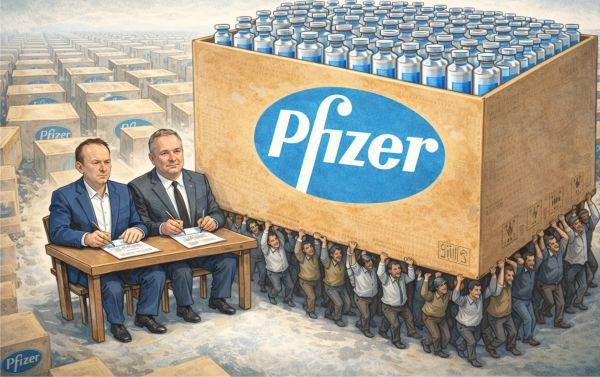
In the scandal of the acquisition of tens of millions of doses of the Pfizer vaccine, our country was not condemned by the French-speaking Court of First Instance in Brussels for being caught in a dead end trap, but because it had the opportunity to exit or modify the initial conditions of the contract and refused to use them, regardless of whether we are talking about the Cîţu or Ciucă governments. This is the brutal conclusion that emerges from the 60 pages of the decision of the French-speaking Court of First Instance in Brussels, a sentence by which the Romanian state is obliged to pay 3,031,128,036.97 lei with VAT to Pfizer Romania, plus the related interest, and to take over the remaining 28,940,613 vaccine doses, after years of confirming, signing, modifying, rescheduling, requesting postponements, but not using either the initial withdrawal mechanism or the major flexibility signed on May 26, 2023 by the European Commission and 24 other European Union member states.
At the heart of this failure is the "opt-out" mechanism, clearly presented both in the Commission's centralized agreement and in the Belgian court's decision. The rules were simple: if the Advance Purchase Agreement (APA) was to contain a purchase obligation, the Member State that did not agree could withdraw by express notification within 5 working days of the communication of the Commission's intention and the detailed terms. If it did not withdraw within that period, it was considered to have authorised the Commission to negotiate and conclude the agreement on its behalf.
The Belgian judgment then translates this abstract rule into concrete liability for Romania. The court notes verbatim that, at the stage of constituting the obligation, "Romania decided not to exercise its right to opt-out and to participate in the purchase contract concluded on 20 May 2021, the terms of which had been presented on 9 April 2021 in the steering committee of which Romania was a member”. Further, the judges note unequivocally: "Romania decided not to use the "opt-out” mechanism and, therefore, to be bound by the Procurement Contract signed by the European Commission (ed. - on behalf of the 27 EU Member States). On this basis, Romania also participated, in agreement with the other participating Member States and the Commission, in the process of distributing the doses contracted by them, thus confirming the number of doses it committed to purchasing, without reservations”.
Here we see the first major political and administrative fault of the political decision-makers in Bucharest. In May 2021, the Government not only did not say "no”, but said "yes” twice: once by not using the opt-out mechanism and the second time by actively participating in the distribution of the doses. And this second stage practically closed the circle. We also note that in May 2021, Vlad Voiculescu was no longer the Minister of Health, having been dismissed by Prime Minister Florin Cîţu as early as April 14, 2021. The position of Minister of Health was held in May, as early as April 21, 2021, by Ioana Mihăilă, so we do not understand, in light of what the Brussels court held and in light of the file investigated by the DNA, what Vlad Voiculescu is looking for as a defendant in the Pfizer case. Just because between April 9 and 14, 2021 he did not express his opt-out option?
• Florin Cîţu, Ioana Mihăilă and Vlad Voiculescu - prosecute in the DNA case regarding Pfizer vaccines, Nicolae Ciucă and Alexandru Rafila "omitted” from the criminal investigation
The Brussels Court of First Instance also noted in the considerations or, better said, in the motivation of the sentence pronounced in the middle of last week that, after accepting the general framework, the government in Bucharest took the decisive step: it signed the firm order. The court records: "On January 7, 2022, Romania signed an order form under which, and in accordance with articles 1.5.2 and 1.6.3 of the Purchase Contract, it purchased 39,099,623 contracted doses and accepted a binding monthly calendar for the delivery between January 2022 and June 2023 of these doses, in a specific monthly quantity.” This quantity fully corresponded to the quota that had been allocated to it.
Who was at the head of the country on November 25, 2021, after the Cîţu government was dismissed by a motion of no confidence in October 2021? The PNL-PSD-UDMR government, led as prime minister by retired general Nicolae Ciucă. And the Minister of Health? Well, after the USR left the government on September 8, 2021, the interim minister was Prime Minister Florin Cîţu himself for eight days, then, from September 16, 2021 until the Ciucă government, it was Cseke Attila from UDMR, and during the Ciucă government (November 25, 2021-June 15, 2023), the Minister of Health was Alexandru Rafila from PSD. If we refer to the order form of January 7, 2022, signed and sent by Romania to Pfizer, we note from the above that only Florin Cîţu appears in the DNA file, but not Cseke Attila, nor Alexandru Rafila, nor the former Prime Minister, General Nicolae Ciucă.
Under these circumstances, in which the Belgian court writes in black and white that Romania ordered the respective doses only on January 7, 2022, the DNA should explain why, on November 23, 2023, when it opened the Pfizer file, it did not include Cseke Attila, Alexandru Rafila and Nicolae Ciucă among the defendants, who did not take any measures regarding the negotiation with those at Pfizer to reduce the quantity of vaccine doses ordered and, implicitly, the reduction of the damage subsequently found by anti-corruption prosecutors.
From now on, the usual political defense from Bucharest, that Romania was pushed into the contract by a European dynamic that it did not control, collapses. Because the decision of the Brussels Court shows something else: Romania was not a spectator, but a participant who accepted the rules, confirmed the quantities and then operated within the contract. More precisely, after the signing, it benefited from favorable adjustments. The court notes: "Romania benefited, twice, from a reduction in the number of contracted doses, formalized by the signing at European level of the additional acts of January 10 and February 10, 2022. The total number of doses purchased by Romania thus amounted to 32,599,623 doses”. The judges also note that Romania benefited from the second rescheduling mechanism agreed between the Commission and Pfizer in May 2022 and then from the extended suspension of deliveries between December 1, 2022 and May 26, 2023. In other words, the Ciucă government was not allowed by the European Commission to hit the wall of the contract head-on, but received reductions, rescheduling and a period of almost six months in which the contract was suspended. However, the Belgian court finds that the Ciucă government did not take the step that really mattered: an orderly exit from the overcommitment when the most important political and contractual window opened.
That window opened on May 26, 2023, when the European Commission and Pfizer agreed on the fifth addendum to the contract. From the official public documents retained by the Belgian court, it follows that the amendment aimed to respond to the changing needs of the member states, by reducing the volumes and pushing the deliveries until 2026. Pfizer and BioNTech officially announced that the agreement "includes the annual rescheduling of the delivery of doses until 2026” and "includes a reduction in the aggregate volume, providing additional flexibility to the EU member states”. In fact, the European Commission, in the Q&A related to the presentation of the new addendum, summarized the objective as being to reduce the number of doses and extend the delivery schedule in the following years. Neither the Commission nor Pfizer published in the official documents found the exact percentage of the reduction nor the breakdown by Member State.
• Ciucă and Rafila, without reaction at a delicate moment
However, what last week's ruling says about the option that Bucharest refused is devastating. The Brussels court states in full: "On 26 May 2023, Pfizer and the Commission concluded an Additional Act No. 5 to the Procurement Contract, which allowed the participating Member States that wished to do so to reduce the number of contracted and/or additional doses purchased and to stagger the delivery of these reduced volumes, as well as their payment, until 2026. Romania chose not to reduce the number of doses it ordered and not to participate in Additional Act No. 5, accepted, moreover, by 24 participating Member States."
This is the second major strategic error, after not exercising the opt-out. In May 2023, the pandemic was already receding, the WHO had just announced, on May 5, 2023, that COVID-19 no longer represents a public health emergency of international concern, and member states were seeking to get out of overstocks and obligations that had become burdensome. At that time, 24 states chose to enter the new flexibility formula. Romania remained outside. Not because it was prohibited, not because the mechanism did not exist, but because it "chose not to reduce” and "chose not to participate”. This formulation of the court is legally deadly and politically devastating. It cuts off at the root any subsequent attempt by the state to pose as a victim of the contract.
Who was in power in May 2023? The PNL-PSD-UDMR coalition. Or rather, the Ciucă government, with Minister of Health Alexandru Rafila, who remained in office until June 15, 2023, when the Ciolacu government took office. The DNA, through the act of November 2023, did not indict either Nicolae Ciucă or Alexandru Rafila. Why?
• Romania's lawyers invoked the nullity of the contract to which the Ciuca government agreed
Regarding the claims it made before the Brussels Court, Romania attempted a maximalist defense in court: it wanted to declare the May 2021 contract concluded by the European Commission with Pfizer null and void. The government argued that the procedure for award was flawed, that the principles of public order in the field of public procurement were violated, that the negotiated procedure without publication was chosen irregularly and that the negotiation process was, in essence, illegal. That is, it wanted the annulment of a contract with which the Cîţu government had agreed and based on which it benefited, at a favorable price, from millions of doses of the Pfizer anti-COVID vaccine. The court, however, responded dryly and severely. First, it found that Romania had not challenged the award decision in time at the level of European jurisdictions and that it was, therefore, deprived of the right to challenge the validity of the Commission's decision in this way. Then, in the context of the procedure, the court held that Romania "does not seriously dispute the urgency of the situation at the beginning of 2021", and "this exceptional circumstance alone authorizes the Commission to resort to the negotiated procedure without prior publication, so that the irregularity of the choice of this award method is not demonstrated."
More brutally than that, the court turned against Romania precisely its post-contractual conduct. The judges put together the non-exercise of the opt-out, the participation in the distribution of doses, the signing of the firm order, the acceptance of the additional reduction and rescheduling acts, the benefit of the suspension of deliveries and the refusal to enter into the amendment of May 26, 2023. And from this sequence they concluded that there was neither abuse, nor impossibility, nor reason for exoneration. The key formula is relentless: "Romania is solely responsible for this choice, which cannot release it from its contractual obligations towards Pfizer.”
This means, in political terms, that three distinct government stages contributed to the same disaster. In 2021, the Government missed the initial exit, although it knew or could have known that the deadline for the opt-out was 5 working days from the communication of the intention and the terms. In 2022, the Executive confirmed and operated the contract, partially reducing the volumes, but without changing its fundamental logic. In the first half of 2023, when there was already a negotiated solution of reduction and rescheduling until 2026, Bucharest refused exactly the mechanism that 24 states had accepted. From then on, all the subsequent discourse about "useless doses”, "unjustified costs” and "burdensome contract” became almost useless before the court, because the court did not judge the pandemic in the abstract, but specifically Romania's successive decisions.
And the bill is clear. The court granted the request and ordered Romania to pay 3,031,128,036.97 lei with VAT to Pfizer Romania, with legal interest from December 8, 2023, plus capitalization of interest due on June 19, 2025, and to take over the remaining 28,940,613 doses, within a period of three years.
• Instead of reducing the damage, we are obliged to pay it in full
The only area where public transparency remains incomplete is precisely the one that Bucharest should have clarified before refusing the May 2023 amendment: by how much exactly the volumes for the states that entered that mechanism were reduced. The exact percentage does not appear in the official Commission documents and in the Pfizer/BioNTech communication. These public sources limit themselves to "reducing the aggregate volume” and rescheduling deliveries until 2026. Press reports at the time spoke of a reduction of approximately one-third of the remaining doses, and other information from March 2023 put forward the figure of 40% as the offer discussed in the negotiations, but these could not be confirmed from the identified official public documents.
Beyond this still opaque detail, the political conclusion is already written in black and white in the ruling: Romania did not lose because it would have had no alternatives. It lost because it ignored them all. First it missed the opt-out, then it signed the order, then it operated the contract, received reductions and postponements, and finally it refused the only major restructuring accepted by 24 states. By the time it got to the court and requested the nullity of the initial agreement, it was too late, and its own subsequent behavior had already demolished its defense. What remains is not just a conviction of over 3 billion lei, but a judicial indictment against the improvisation, passivity and incompetence with which the governments of 2021, 2022 and the first half of 2023 administered one of the most expensive public decisions in recent years.






















 Euro
Euro Dolar SUA
 Franc elveţian
 Liră sterlină
 Gram de aur