English

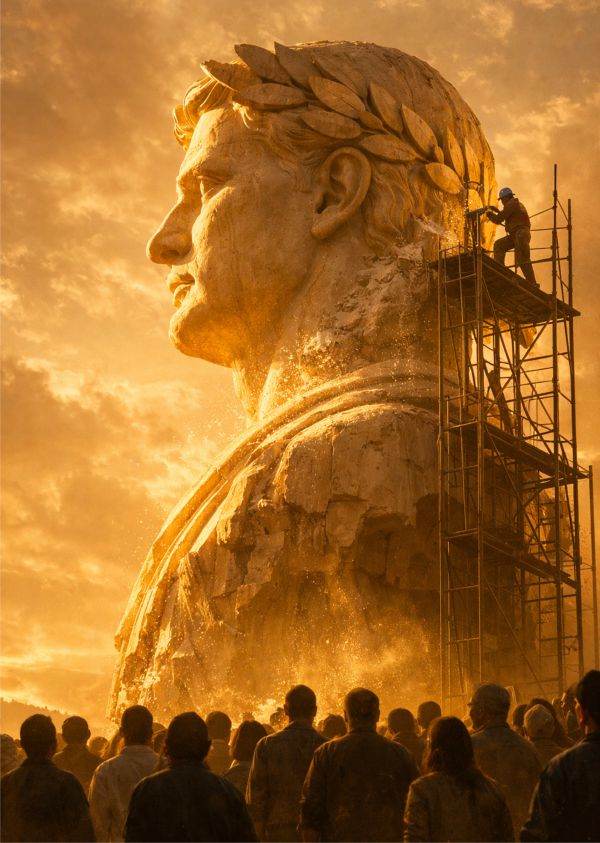
We are increasingly finding ourselves in a period in which the personality cult, long considered a relic of totalitarian regimes, is returning to the forefront of global political life, in a form adapted to the digital age. We are no longer talking about statues and parades, but about speeches, television, social networks and, above all, about an essential mechanism: the leader attributes exceptional merits to himself, and the circle around him confirms and amplifies them until they become political reality.
The definitions established by the dictionaries edited by the universities of Cambridge and Oxford describe the personality cult as the exaggerated promotion of a leader and the attribution of extraordinary, almost superhuman qualities. The difference from the past is that today this process is simultaneously domestic and international, and leaders validate each other.
The most emblematic case is that of Russian President Vladimir Putin. At the 2018 Valdai Forum, the Russian leader himself set the framework: "Russia does not need a world without Russia,” adding that "Russia will either be sovereign or not exist at all.” But the chorus around him is essential. After Putin announced that he would run again for the highest office in the state, military officer Artyom Joga declared, according to Reuters, on December 8, 2023, that "all of Russia will support this decision.” Earlier, in March 2018, Margarita Simonyan, the head of Russia Today, went further, stating of Vladimir Putin: "He was our president; now he is our leader.” Later, in February 2026, Reuters reported that Dmitry Medvedev had sanctioned this total concentration of power, stating that "President Vladimir Putin remains the final voice in Russian politics.” The Minister of Foreign Affairs of the Russian Federation, Sergei Lavrov, reinforced the same idea, stating that "Russia's position has been clearly formulated by President Vladimir Putin.” In this system, the leader is no longer just the head of state, but the sole source of political direction.
• Donald Trump's ego, the basis of the personality cult at the top of the US
In the United States, the phenomenon takes on a different, but equally visible, form around Donald Trump. "I, alone, can solve” (ed. - the problems facing the US), Trump stated at the 2016 Republican Convention, a statement that remains one of the clearest expressions of the personalization of power. In the same logic of thinking, Donald Trump has attributed special merits to himself in his second presidential term, declaring that the US is experiencing a Golden Age under his leadership, he has stated that he deserves the Nobel Peace Prize because he has contributed to the end of several conflicts, although reality contradicts this, and even that he will soon be the first American president who, after a period of 165 years, will have his own signature on the 100 US dollar banknotes that will be issued by the US Treasury in June, on the occasion of the celebration of the 250th anniversary of the War of Independence. But what transforms this rhetoric into a cult mechanism is the validation of those around him. Stephen Miller, the deputy chief of staff at the White House, told Donald Trump on July 11, 2025, according to Reuters: "Looking at what you've done, sir, has been the greatest honor of my life." Karoline Leavitt, the White House press secretary, stated on March 2, 2026, that Donald Trump had done what "no president has had the courage to do,” later stating on April 7 that the US president "got Iran to accept a ceasefire.” Steven Cheung, the White House communications director, took the speech to the extreme: "there will be no one like him (ed. - Donald Trump), able to move mountains by the sheer force of his will.” Here, the cult is not imposed, but built through political loyalty and communication.
And to top it all, Donald Trump's image as a messianic leader was also visually outlined, through the posts on his page on the Truth Social network, in which he appeared either as the Pope, or as the president of Venezuela - after the removal of Maduro, or as Jesus - in the most recent post that the American president withdrew following criticism received, including from his own camp.
• Viktor Orban and Recep Erdogan, two autocrats seeking validation
In Europe, the case of former Hungarian Prime Minister Viktor Orban shows the transnational dimension of the phenomenon. Donald Trump described him as "a really strong leader” and said that bilateral achievements were "largely due to Orban,” according to Reuters. In turn, Slovak Prime Minister Robert Fico declared, according to the same source: "I have never met such a warrior for sovereignty as Viktor Orban,” while Andrej Babi¹, the Prime Minister of the Czech Republic, added: "he has always fought for a stronger Europe” and "electing a leadership that has proven through deeds matters more than ever.” In fact, Viktor Orban was not only presented as a national leader, but was presented as a model and defender of a whole European vision.
In Turkey, the mechanism is equally evident around President Recep Tayyip Erdoğan. The Turkish leader said at the UN General Assembly that "the world is bigger than the five” - referring to the five members of the Security Council, suggesting that Turkey wants to assume a global role. A global role that Erdoğan wants especially in the Middle East, especially against the state of Israel, which he recently described as a "bloodstained genocide network”. The way the Turkish president is supported is essential. Devlet Bahçeli, a former deputy prime minister of Turkey and member of the Grand National Assembly, said, according to Reuters, before the presidential elections in 2025, that it would be "a natural choice” for Erdoğan to remain in power for the stability of the country. In the media area close to power, the discourse becomes even more intense: Erdoğan was described by the media close to power, according to a report prepared by the Stockholm Center for Freedom, as the "leader of the century” and even as "a blessing from Allah”. These formulations go beyond politics and enter the symbolic area.
• The Călin Georgescu case - the cult of personality in its incipient phase
In Romania, the case of Călin Georgescu is still in formation, but the pattern is visible. Georgescu speaks of Romania's "historical mission”, and his political supporters validate his role. Călin Georgescu appeals to historical, national values, which were brought to the forefront by the nationalist policy of the communist regime, such as the Romanian voivodes Ştefan cel Mare, Mihai Viteazul, but also other heroes, and combines in his discourse the national feelings of the citizens with appeals to divinity and with his ideas about a Romania as the main power factor in the world, which represents a utopia.
For example, on December 1, 2025, in Alba Iulia, Călin Georgescu declared: "The year 1918 is a natural consequence of what November 1, 1599 was, when the great voivode Michael the Brave entered Alba Iulia victorious, on horseback, with sword in hand. It proved that our history is not a succession of voivodes, but the sum of the consciences of a people, the breath of every Romanian peasant who, with his plow, turned the furrow of the earth and the furrow of the sky, asking for the blessing of his labor. So December 1, 1918 is the reunification of our being and not just a simple administrative rectification of a historical injustice. Romania must not be just simple geography, but become, once again, a living history. (...) Today, December 1, 2025, I do not feel joy, but pain. I am shaken to see that people are waiting to tick off a certain day, when every day, in fact, should be be the national day. The Romanian soul and spirit, especially, are not for sale! We are obliged to keep alive the moment when the Romanian nation stood tall in the face of history. We must take our fate into our hands and understand once and for all that without Jesus Christ we can do nothing. Fight to become aware, let hope burn in you every day, not just on National Day. Today, Romania has reached its lowest point. People have become of two kinds: people who have value and people who have value. Today, now, is the time for each of us to decide what kind of life and what kind of Romania we want. It is time to say no to everything that distances us from Romania and to say yes to the millennial values that have kept us together and strong: God, homeland, family, honor. Let's be honest with ourselves. The ship Romania is sinking, and many today don't care, those of yesterday did cared. They cared about their homeland, they cared about God. They cried for this land, and their tears kept the Romanian soul afloat. Today, the tears are missing and the Romanian soul is sinking into the swamp of humiliation and despair”.
Moreover, in order to consolidate his role as a messianic leader, Călin Georgescu recently stated in a podcast that forces in Western Europe want his physical elimination and pointed out, saying that "you can eliminate a body, you can eliminate a person, but you cannot eliminate a movement for freedom”.
The image of Călin Georgescu as a providential leader was contributed by AUR and its president, George Simion, who declared that there are "several ways” by which Georgescu can reach the leadership and that these will be used if "the Romanian people want it”, even by building a majority to install him in key positions. Even if the mechanism is less consolidated, the logic is the same: the leader is presented as necessary, and the system must be adapted for him. This is constantly contributed to by the close media, which claims to be of the people, a people about whom Călin Georgescu speaks at every appearance on the steps of the courts that handle the criminal cases in which he is accused of legionary propaganda and instigation of an attempt to change the constitutional order through violence. Thus, on March 31, Călin Georgescu said: "We want a political class loyal to the country, not to foreign interests. And we want a secure future where young people build in our country and do not run away. And we raise this word out of love, not out of hatred, out of loyalty and nostalgia. Because we are not subject to anyone, we are free and good people, descendants of a great history, we are a valiant people of a nation that was made whole by the sword of Michael the Brave, and Romania is alive through us and through the words of the Holy Great Voivode Neagoe Basarab, who said this: let us stand, brothers, in the fear of God and not be saddened in battles”.
Later, on April 14, on the steps of the High Court of Cassation and Justice, Georgescu said: "The Romanian people understood that (...) the Resurrection of our Savior Jesus Christ means the Resurrection of the Romanian people, it means the Great Renaissance”. He immediately added that the current government is "without a trace of dignity and without fear of God”, so that "the country looks like a concentration universe” in which "freedom of expression has been annulled” and "we are forbidden to call them thieves”, referring to the rulers.
"However, the Romanian people, awakened in conscience, are more anchored than ever in conservative values, in nationalism, in Christian moral values, which have kept us united and made us strong: God, Fatherland, Family, Honor”, concluded Călin Georgescu.
Taken together, these examples show that we are not just witnessing a change in political style, but a structural transformation. Leaders attribute exceptional merits to themselves, and those around them - ministers, spokespeople, political allies and even leaders from other countries - confirm and amplify these statements. This creates a closed circuit: the leader proclaims himself indispensable, and his entourage transforms this statement into a repeated truth.
This is the essence of the personality cult in its modern form. It is no longer imposed from the top down, but built through a combination of discourse, loyalty and mutual validation. And when the leader simultaneously becomes the solution, the explanation and the direction of a nation and when those around him repeat this until it becomes an accepted reality, we are no longer talking about simple political statements, but about the return of a phenomenon that the world thought was outdated.












 Euro
Euro Dolar SUA
 Franc elveţian
 Liră sterlină
 Gram de aur