English

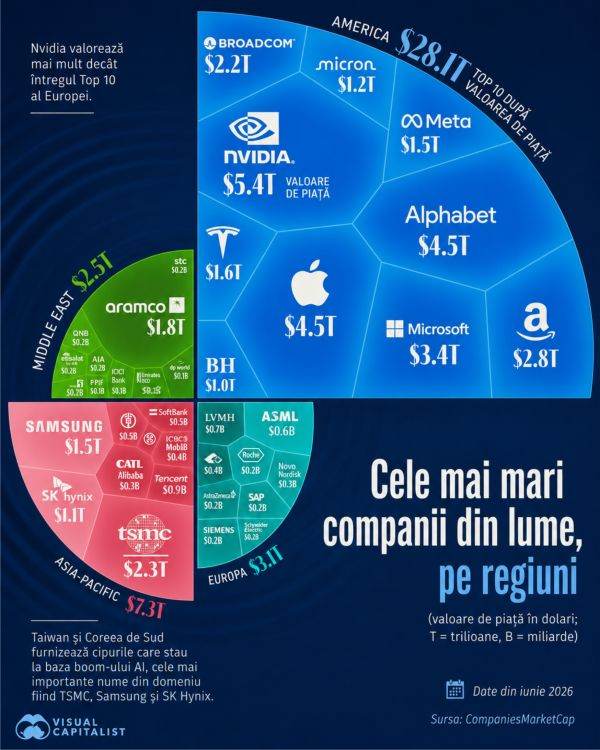
The global corporate landscape has become increasingly concentrated in a handful of American companies with mega-capitalizations. Visualcapitalist.com ranks the ten largest listed companies in the Americas, Europe, Asia-Pacific and the Middle East, according to capitalization data provided by CompaniesMarketCap (valid as of June 2026), showing that the scale of the largest American companies is difficult to match.
Chip giant Nvidia alone is worth $5.4 trillion, exceeding the combined value of the ten largest European companies. Together, the top ten listed companies in America are worth $28.1 trillion, more than the combined value of the top ten companies in Europe, Asia-Pacific and the Middle East, according to the cited source.
• American technology giants - leaders
The top ten positions in the aforementioned ranking look like this: Nvidia (US, $5.4 trillion); Alphabet (Google's parent company, US, $4.5 trillion); Apple (US, $4.5 trillion); Microsoft (US, $3.4 trillion); Amazon (US, $2.8 trillion); TSMC (Taiwan, $2.3 trillion); Broadcom (US, $2.2 trillion); (Saudi Aramco, Saudi Arabia, $1.8 trillion); Tesla (US, $1.6 trillion); Meta Platforms (US, $1.5 trillion). The next ten places are occupied as follows: Samsung (South Korea, $1.5 trillion), Micron Technology (US, $1.2 trillion), SK Hynix (South Korea, $1.1 trillion), Berkshire Hathaway (US, $1 trillion); ASML (Netherlands, $628 billion); Tencent (China, $499 billion); China Construction Bank (China, $390 billion); Agricultural Bank of China (China, $336 billion); Roche (Switzerland, $328 billion); HSBC (United Kingdom, $320 billion).
• Europe's largest companies are more diversified
The largest company in Europe is ASML, valued at $628 billion. The Dutch company is the world's only manufacturer of extreme ultraviolet lithography machines, which are essential for manufacturing the most advanced semiconductors.
Beyond ASML, the European Top 10 includes pharmaceutical companies such as Roche, AstraZeneca and Novartis, along with luxury giant LVMH and consumer goods leader Nestle. This combination shows Europe's strength in established global industries, while also highlighting the region's smaller scale compared to the mega-cap tech giants in the US.
• Asia-Pacific - anchored by semiconductors
TSMC is the only company from Asia-Pacific to be ranked among the world's six most valuable companies. Together with Samsung and SK Hynix, the region's semiconductor leaders account for a market value of nearly $4.9 trillion, underscoring the industry's growing importance to the global economy, the source said.
China also has a strong presence on the list, with names like Tencent, Alibaba, CATL and several major banks. In total, the region's top ten companies are worth $7.3 trillion.
• Saudi Aramco dominates the Middle East
Saudi Aramco is by far the largest company in the Middle East, with a market capitalization of $1.8 trillion. The oil giant's valuation is more than double that of the other nine companies in the regional top combined. The rest of the list is led by banks, utilities, energy and telecommunications companies from Saudi Arabia and the United Arab Emirates.
As the region works to diversify beyond oil, Aramco's size shows that energy remains essential to Middle Eastern capital markets.
• TSMC management confident in growth prospects amid AI boom
Taiwan Semiconductor Manufacturing Company (TSMC) is confident in its growth prospects in the coming years, thanks to robust demand for its next-generation semiconductors amid the artificial intelligence (AI) boom, Chief Executive Officer C.C. Wei told shareholders last week, according to Reuters, Agerpres reports.
Customers are still optimistic about the prospects for AI, although the company continues to closely monitor the impact of rising component costs, the head of the world's largest contract semiconductor manufacturer said.
"We continue to see an increase in the adoption of AI models in consumer, enterprise and AI applications. This trend is increasing the demand for supercomputers and high-end semiconductors,” Wei explained. Asked if TSMC could raise prices for customers, Wei said: "I would like to do that ... we still need to make money. We don't want to suddenly raise prices like memory chip makers do. It's not sustainable. TSMC is focused on sustainable, long-term operations.”
TSMC is making major efforts to meet all customer demands, although it will take "a very long time” to fully meet the needs of US customers. TSMC is investing $165 billion to build new facilities in the US state of Arizona.
TSMC, whose customers include Apple and Nvidia, will build new production facilities this year to meet demand and will expand or upgrade facilities in the US, Japan and Germany. The company said last month that it expects the global semiconductor market to exceed $1.5 trillion by 2030, up from its previous estimate of $1 trillion. Artificial intelligence (AI) and supercomputer use are expected to account for 55 percent of the $1.5 trillion market, followed by smartphones at 20 percent and automotive applications at 10 percent, according to TSMC.
• SK Hynix invests to meet global demand for AI memory chips
SK Hynix said in April it planned to invest 19 trillion won ($12.85 billion) in a new manufacturing facility in South Korea to meet growing global demand for AI memory chips, according to The Korea Herald and Reuters. Construction will begin this month, said SK Hynix, which supplies Nvidia with its latest-generation memory chips.
The South Korean chipmaker is benefiting from strong demand for its products from companies building AI data centers and investing trillions of dollars. The company is one of the biggest global beneficiaries of the surge in demand for memory chips.
Earlier this year, SK Hynix said it was accelerating capacity expansion and would open a new memory chip factory in South Korea to meet the strong demand.
In April, industry sources said SK Hynix was hiring to expand production at its key facilities in Icheon and Yongin in Gyeonggi Province, as well as in Cheongju in Chungcheong Province.
Analysts expect SK Hynix to report an operating profit of up to 250 trillion won this year, driven by strong demand from AI technology.
























 Euro
Euro Dolar SUA
 Franc elveţian
 Liră sterlină
 Gram de aur