English


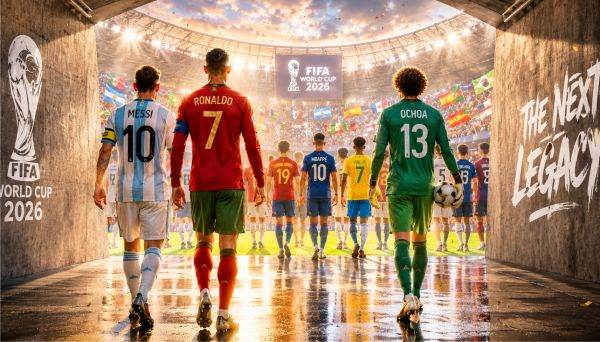

The United States, Mexico and Canada will host the largest World Cup in history from June 11 to July 19, 2026. For the first time, the tournament will bring together 48 teams, which will play 104 matches in 16 host cities, in a competition that will last almost 40 days, according to data provided by FIFA.. Mexico makes history as the first country to organize three editions of the World Championship, after those in 1970 and 1986, and the final is scheduled for MetLife Stadium in New Jersey. However, the huge dimensions of the competition turn the tournament into an unprecedented logistical experiment.
• Spain, the favorite of the bookmakers
According to the odds published by international operators, Spain is considered the main favorite to win the trophy. The European champion has one of the youngest and most spectacular generations. The favorites also include: England; France; Brazil; Argentina; Germany. Bookmakers are giving close odds for the top three favorites, a sign that the 2026 edition could be one of the most balanced in recent decades. Portugal, the Netherlands, Morocco, and the USA could be included in the big surprises category. Even if they do not start among the top three favorites, Portugal has an impressive squad. Many analysts believe that this could be Cristiano Ronaldo's last major competition and, at the same time, the moment of definitive affirmation for the generation of Rafael Leao, Joao Neves, or Goncalo Ramos. A statistical model developed by economist Joachim Klement, who claims to have anticipated the last three world champions, indicates a Netherlands-Portugal final and even a success for the "Clockwork Orange".
Morocco - the semi-finalist in Qatar 2022 is no longer an unknown. The African team has experience and could produce surprises again. Benefiting from the advantage of their own field, the Americans could exceed expectations. The new generation formed in Europe is considered the most valuable in the history of "classic" American football.
• High temperatures cause concerns
One of the major problems of the tournament is the excessive heat. Researchers and specialists have warned that 14 of the 16 stadiums may be affected by dangerous temperatures for players and fans. FIFA has introduced hydration breaks, but scientists are calling for additional measures. Against this background, just a few days before the debut, FIFA decided to ban reusable containers in stadiums, citing security reasons. The decision caused protests from fan organizations, who warn of the risk of dehydration in high temperatures.
• Climate cost of the largest World Cup
Another controversy concerns the impact on the environment. Experts estimate that the 2026 edition will generate approximately 7.8 million tons of carbon dioxide emissions, more than double the level recorded at Qatar 2022. Most of the pollution will come from air transport between the host cities, located thousands of kilometers apart. Critics accuse FIFA of not having sufficiently defined climate neutrality objectives.
• Curiosities of this edition
The tournament is doing well in terms of records and novelties: 104 matches will be played, an absolute record; Mexico becomes the first country to host three World Championships;
Canada is organizing matches at a men's World Cup for the first time; the distance between Vancouver and Miami, two of the host cities, exceeds 4,500 km;
the tournament will last 39 days, the longest in recent history; 48 national teams will participate, compared to 32 in previous editions.
• Messi, Ronaldo and Ochoa make history
Three giant names in world football will reach an unprecedented milestone: Lionel Messi, Cristiano Ronaldo and Guillermo Ochoa will participate in the sixth World Cup of their careers.
It is an absolute record in the history of the competition, and Messi and Ronaldo become the first players in history to play in six editions of the final tournament. Guillermo Ochoa, the symbol of Mexico, also achieves the same performance, but with a peculiarity: he did not actually play in the 2006 and 2010 editions, although he was called up. This triple presence confirms not only longevity, but also the profound change in modern football, where top careers exceed the threshold of two decades.
• Absolute leader of active goal scorers
Lionel Messi enters this tournament with a historic advantage: he is the active player with the most goals scored in the World Cup - 13 successes. Behind him are: Kylian Mbappe -12 goals, Harry Kane - 8 goals, Neymar - 8 goals, Cristiano Ronaldo - 8 goals. The absolute record, however, has stood for over a decade: Miroslav Klose - 16 goals.
The small differences between the active stars suggest that the 2026 edition could even rewrite the all-time scoring hierarchy.
• World Cup veterans
Po Scottish striker Craig Gordon, at 43, becomes the third oldest player in recent World Cup history. The absolute record remains with Egyptian Essam El Hadary, who played at 45 in 2018, followed by Faryd Mondragon (Colombia) - 43 years and 3 days (he played in 2014). In the same longevity register, Cristiano Ronaldo will be 41 years and 126 days old, becoming one of the oldest outfield players ever to appear at the tournament. The 2026 World Cup thus also becomes a competition of extreme sports longevity.
• Manchester City, the world superpower of clubs
One of the most spectacular records comes from club football: Manchester City sends 19 players to the World Cup. Their distribution is global, covering national teams from:
Algeria, Belgium, Croatia, Egypt, England, France, Ghana, Netherlands, Norway, Portugal, Spain and Uzbekistan. It is a confirmation of the structural dominance of the club built in the Guardiola era, but also a signal of the extreme globalization of elite football. Following the "citizens" are: Bayern Munich - 18 players, Arsenal - 16 players, PSG - 16 players, Barcelona - 15 players.
• Domination of the English championship
The Premier League confirms its absolute hegemony in world football: 200 players from the English championship participate in the World Cup. The top is completed by: Germany - 109 players, France - 86, Spain - 86, Italy - 71. These five championships concentrate the overwhelming majority of footballers at the final tournament, confirming the economic and sporting imbalance of global football.
• The paradox of national clubs
A less discussed detail, but relevant to the global structure of football: Qatar and Saudi Arabia each have 25 players who play in their domestic championships. At the opposite end, nations such as: Cape Verde, DR Congo, Ivory Coast, Curaçao, Senegal,
Uruguay do not have any active players in their domestic championships. This rupture confirms the profound imbalance between European football and the rest of the world.
• 22 world champions, still active
The North American tournament will feature 22 players who have already won the World Cup. Of these: 17 Argentines, members of the champion team in Qatar 2022,
Manuel Neuer - world champion with Germany (2014), Ousmane Dembele, Lucas Hernandez, N'Golo Kante and Kylian Mbappe - France (2018). This density of active champions makes experience a decisive factor in the competition.
The 2026 World Cup is no longer just a tournament. It is a show of force for globalized football, where legends refuse to retreat, clubs become transnational superpowers,
and records seem more like starting points than limits. The question that remains open is no longer just who wins the trophy, but whether this type of football - hyper-globalized, hyper-mediatized and hyper-statistical - still preserves the classic essence of the World Cup.



















 Euro
Euro Dolar SUA
 Franc elveţian
 Liră sterlină
 Gram de aur