English

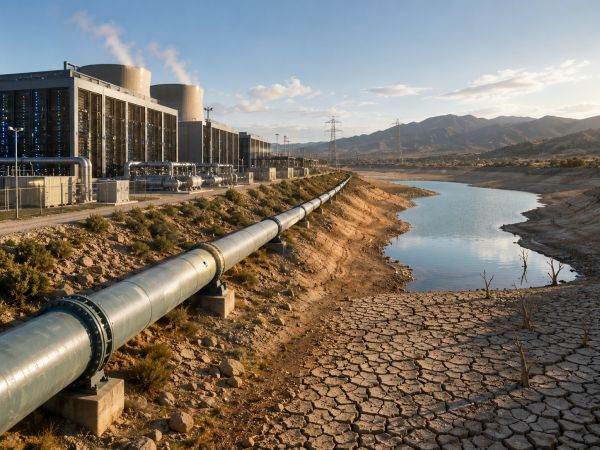
Global demand associated with artificial intelligence could cause a water consumption of 4.2-6.6 billion cubic meters in 2027, including both direct cooling of servers and water used to produce electricity consumed by data centers, according to the study "Making AI less thirsty: uncovering and addressing the secret water footprint of AI models”, by researchers Pengfei Li, Jianyi Yang, Mohammad Islam, and Shaolei Ren, from the University of California, Riverside, and the University of Texas at Arlington.
According to the study cited, of this huge amount, the actual consumption, represented mainly by evaporated water that does not immediately return to the source from which it was taken, could reach about 380-600 million cubic meters. To understand the order of magnitude, the volume withdrawn in a single year to support artificial intelligence could exceed the cumulative annual consumption of several countries the size of Denmark and would be close to half of the annual water consumption of Great Britain.
This almost invisible thirst of artificial intelligence appears in a world where about half the population already faces severe water shortages at least at some time of the year, where a quarter of humanity lives in areas of extreme water stress, and where 2.1 billion people still do not benefit from safely managed drinking water supply services. Between 2002 and 2021, droughts affected more than 1.4 billion people, and climate change threatens to increase their frequency, duration and intensity. Yet governments, technology companies and investors are rushing to build a digital infrastructure that requires ever-increasing amounts of water and electricity, often in the very regions where these resources are becoming more fragile. Data on water scarcity, droughts and access to water are presented by UNESCO in the UN World Water Development Report and in the 2026 edition dedicated to inequalities in access.
The above shows that the artificial intelligence revolution is not taking place in an immaterial cloud, as the industry's seductive vocabulary suggests. The "cloud” is made up of huge industrial halls, chips, servers, transformers, generators, pipelines, cooling towers and high-voltage power lines. Behind every response a chatbot makes, every image it generates, and every model it trains is a physical infrastructure that generates heat and must be constantly cooled. The larger, more complex, and used by more people, the more computing power, electricity consumption, and water demands increase.
• Data Center protests in the U.S.
For the first time, opposition to this expansion has taken on the dimensions of a national movement. On Saturday, July 18, 2026, opponents of the uncontrolled development of data centers organized 142 protests in 42 American states, from Wasilla, Alaska, to Naples, Florida, according to an article published by Zerohedge. The cited source claims that the mobilization was coordinated by Humans First, an organization co-founded and led by Amy Kremer, one of the founding figures of the Tea Party movement. The demonstrations brought together conservatives, progressives, environmentalists and first-time protesters, a sign that the issue has transcended old ideological boundaries. The turnout was uneven, and in some places attendance remained modest, but the simultaneous actions across much of the United States show that the revolt against AI infrastructure can no longer be reduced to a few local conflicts over urban planning. The scale of the demonstrations and the demands for energy, water, transparency and community control were confirmed by Reuters. In Kenilworth, New Jersey, a town of about 8,500 people, people protested against a $1.8 billion CoreWeave artificial intelligence data center approved on the site of a former Merck campus. A petition against the project has garnered more than 12,000 signatures, several thousand more than the town's population. Protesters continued to march even after heavy rain began, and one of the signs summed up the community's fears: "Do you think this is pressure? We? Wait until the water pressure is gone". In Imperial Valley, California, where a proposed center could take nearly 250 million gallons of water from the Colorado River system each year, people took to the streets in the heat of the day. "It's dystopian to use so much freshwater for artificial intelligence," Ivan DelSol, one of the participants, told Reuters. The fear is not unfounded: Colorado has been under enormous pressure for more than two decades from overuse, drought and rising temperatures, and its resources are being contested by states, cities, farmers and ecosystems. Bringing a new industrial powerhouse into such a region is not simply an investment decision, but one about the distribution of a vital resource. Data centers use water in two ways. Direct consumption occurs in cooling facilities, where heat generated by servers is removed through evaporation or other thermal systems. Indirect consumption occurs in power plants that generate the electricity needed by the facility, especially in thermal and nuclear power plants that use water for cooling. For this reason, a facility that reports low on-site consumption may have a much larger water footprint if it is powered by energy produced in a water-dependent system.
A distinction must also be made between withdrawn water and consumed water. According to the World Resources Institute, the Environmental and Energy Study Institute, and the MOST Policy Initiative, withdrawal is the amount taken from a river, lake, aquifer, or municipal system, even if some of it is later returned, and Consumption is the part that does not quickly return to the same source, mainly because it evaporates. The sources cited show that the returned water may have a different temperature, may contain substances used to treat the facilities, and does not always return to the same watershed. Furthermore, in evaporative cooling systems, up to 80%-85% of the withdrawn water may actually be consumed.
According to the cited sources, data centers in the United States directly consumed approximately 66 billion liters of water in 2023, and by 2028, their annual direct consumption could rise, depending on the pace of construction of new facilities and the cooling technologies used, to 144-276 billion liters. To this amount must be added the water consumed for electricity production, which in some regions can exceed the direct use within the center several times. The estimates are included in the Lawrence Berkeley National Laboratory report on the consumption of data centers in the United States, prepared for the US Department of Energy.
• An medium data center can consume 1.14 million liters of water per day
The size of the facility and the location where it is built radically changes the impact. According to the World Resources Institute, an medium data center can use nearly 1.14 million liters of water, and a very large facility can use up to five million gallons, or nearly 19 million liters, per day, which is comparable to the needs of a small city. These figures cannot be automatically applied to every project, as the needs depend on climate, server type, building efficiency, cooling system, electricity source, and degree of reuse. However, they do show that authorizing such a center without publishing a complete and verifiable water balance is equivalent to assuming a risk on behalf of the entire community.
The estimate that artificial intelligence could withdraw 4.2-6.6 billion cubic meters of water by 2027 should be interpreted with caution. It does not come from direct measurements of all centers or from complete company reporting, but from modeling computing needs, server consumption, cooling technologies, and energy mix. The study authors also estimated that training the GPT-3 model in state-of-the-art American data centers could have directly evaporated about 700,000 liters of fresh water. This value does not mean that every model automatically consumes the same amount, nor that every question asked to a chatbot has an identical footprint. The impact depends on where and when it is processed, the external temperature, the efficiency of the chip, and the source of electricity. It is precisely this variability that demonstrates that the answer cannot be a global and undifferentiated condemnation of artificial intelligence. The same computing task can have a low water footprint if it is executed in a region with sufficient water, moderate temperatures, and electricity produced without intensive water consumption, or it can become burdensome if it is processed during a heat wave, in a dried-up basin, with energy from thermal power plants. Not every interaction with AI represents an ecological catastrophe, but the billions of interactions, multiplied by ever-larger models, can have a major regional impact.
The problem is compounded by a lack of transparency. Large companies publish global targets for efficiency, renewable energy and water restoration, but rarely disclose each facility's consumption of drinking water, industrial water, recycled water and indirect footprint. Meta reported an increase in water use for its owned sites from 3,726 megaliters in 2020 to 5,637 megaliters in 2024, a 51% increase, but that did not include all leased or under-construction facilities. Microsoft published total consumption without a full breakdown for each location, and Amazon reported its energy intensity, not an absolute comparable total. Investors concerned about financial and climate risks have called on Amazon, Microsoft and Google to publish more detailed data, according to a Reuters investigation.
This opacity also affects promises to become "water positive.” A company can claim to restore more water than it uses by funding the restoration of a wetland, reforestation, or upgrading a municipal water system hundreds or thousands of miles away. The project may have ecological value, but it does not automatically return the water to the aquifer from which the data center draws it. Water is not a perfectly fungible commodity on a global scale: saving a million liters in a wetland does not necessarily compensate for the consumption of the same volume in a drought-stricken community.
• Drinking water shortage, a global problem
Around the world, 25 countries are exposed to extreme water stress every year, meaning they use more than 80% of their available renewable water resources. In the Middle East and North Africa, 83% of the population lives in such conditions, and in South Asia, the proportion reaches 74%. Bahrain, Cyprus, Kuwait, Lebanon, Oman, and Qatar are among the countries most affected. A short drought can be enough to cause restrictions, resource depletion and conflicts between agriculture, industry and people, according to WRI Aqueduct data.
Climate change is spreading the pressure beyond traditional arid regions. Southern Europe, the western United States, Mexico, Chile and parts of Brazil are facing longer droughts, extreme temperatures, reduced river flows and dwindling groundwater reserves. By 2050, an estimated 2.4 billion urban people could face water shortages, up to half of the world's urban population, according to UNESCO. In these circumstances, using drinking water to cool servers cannot be justified simply by having a commercial contract and paying a bill.
• Immense energy consumption, from data centers
Energy is the other dimension of the revolution. Data centers consumed an estimated 485 terawatt hours (TWh) of electricity in 2025, and their global demand is expected to reach nearly 950 TWh by 2030, roughly the equivalent of Japan's current consumption and nearly 3% of global electricity demand. The consumption of data centers dedicated to artificial intelligence is expected to triple in just five years. In 2025, the electricity demand of the entire sector increased by 17%, compared with a mere 3% increase in global consumption, according to the International Energy Agency.
A share of 3% of global demand may seem bearable, but the global average hides the concentration of facilities. Almost half of the capacity of US data centers is clustered in just five areas, and a large AI center can require as much energy as an energy-hungry aluminum factory. In the United States, data centers are expected to account for nearly half of the growth in electricity demand by 2030. Lawrence Berkeley National Laboratory estimates that they could account for 6.7% to 12% of total U.S. consumption by the end of the decade, depending on the speed of expansion and the efficiency of the equipment.
The pressure is already being felt in Ireland, where data centers are expected to consume an estimated 7,663 gigawatt hours (GWh) in 2025, accounting for 23% of the country's metered electricity, almost as much as all of the homes combined. In 2015, their consumption was just 291 GWh. The growth has forced authorities to restrict new connections in the Dublin area and impose stricter requirements on large consumers. Ireland is not representative of the world, with a relatively small electricity system and an exceptionally high concentration of digital industries, but its case shows how quickly a marginal sector can become a dominant consumer.
Renewables will cover almost half of the additional energy needed by the centers by 2030, but natural gas and coal will provide a significant share, and nuclear power will start to play a larger role towards the end of the decade. According to estimates by the International Energy Agency , global data center electricity generation could exceed 1,000 TWh in 2030 and reach around 1,300 TWh in 2035. This means that the AI revolution risks prolonging the life of polluting power plants, spurring the construction of new gas-fired plants and making it harder to meet climate goals if clean infrastructure is not developed quickly enough. The industry argues that developers can build their own energy capacity and avoid direct competition with households. The solution can partially protect the grid, but it does not automatically solve the climate or water problem. A gas-fired power plant located behind the meter continues to emit carbon dioxide and pollutants, and diesel generators on standby can affect air quality. A self-powered power plant can shift the burden from the consumer's bill to the air the same community breathes.
But there are technologies that can substantially reduce the impact. Closed-loop liquid cooling systems can recirculate water without a continuous supply, air cooling can limit consumption in the right climates, and treated wastewater can replace potable water. Non-critical IT workloads can be moved to times and regions with abundant renewable energy, cooler temperatures, and reduced water stress. Microsoft claims that its new closed-loop data centers can eliminate annual water consumption for cooling, demonstrating that industry's thirst is not a technological fatality.
These solutions have their own limitations. Air-only cooling uses more energy during very hot periods, desalination is energy-intensive, and wastewater must be transported and treated. Reducing water use can lead to increased electricity consumption, and choosing a low-emission energy source can have its own water requirements. There is no one-size-fits-all technology that is perfect for every site. Each project must be evaluated through a simultaneous assessment of water, energy, emissions, land, and social impacts.
Data centers also bring undeniable benefits. They support communications, healthcare, research, industry, government, cybersecurity, and almost the entire digital economy. Artificial intelligence can improve weather forecasts, identify water leaks, optimize energy distribution, speed up the discovery of materials, and reduce consumption in buildings or factories. The centers can bring significant tax revenues and many jobs during the construction period, although the number of permanent positions is often small in relation to the investment, the area occupied, and the infrastructure required. The tax benefits are real, but secret negotiations and competition between authorities to attract investors can diminish the advantages obtained by communities, warns the Brookings Institution.
The cited sources mention that not all centers consume millions of liters of water per day, not all use drinking water, and not all are powered by polluting sources. A center built in a resource-rich region, cooled in a closed loop, powered by additional clean energy, and required to pay for its infrastructure cannot be put on the same level as a facility located in a drought-stricken area and dependent on municipal water.
The AI revolution can continue without turning communities into sacrifice zones, but only if developers are required to publish water and electricity consumption for each site, present cumulative balances at the watershed level, use recycled water in stressed regions, bring in additional clean energy, reduce the load at critical times, and finance the necessary infrastructure. Where these conditions cannot be met, temporary moratoriums are justified.

























 Euro
Euro Dolar SUA
 Franc elveţian
 Liră sterlină
 Gram de aur