English


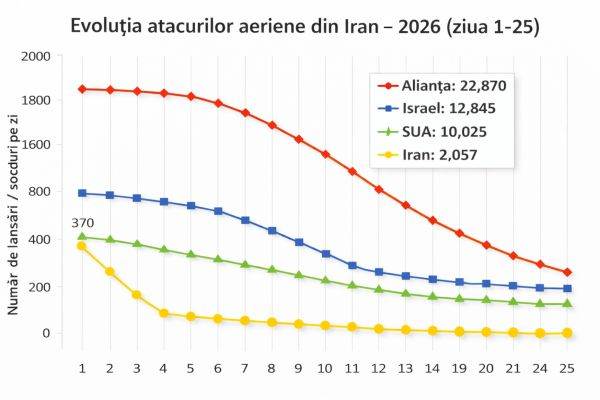
Iran has launched, to date, approximately 1,089 ballistic and cruise missiles plus 968 attack drones, according to aggregated estimates by JINSA, Atlantic Council and IDF.
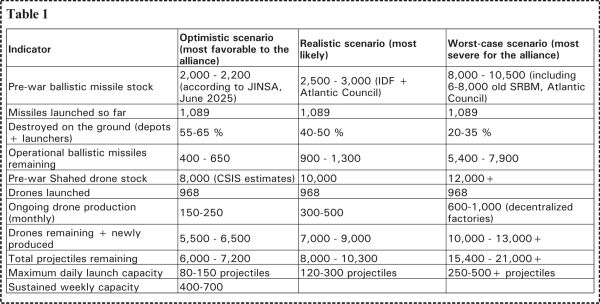
The analysis below compares three possible scenarios regarding authentic initial stockpiles and remaining capacity, taking into account ground destruction and production rates.
• 1. Optimistic scenario for the US/Israel Alliance (estimated probability of 25%):
According to JINSA (estimates from June 16 and 26, 2025, updated in March 2026), Iran started the war with approximately 2,000 medium-range ballistic missiles. Alliance strikes destroyed over 55% of the stock and launchers. According to Atlantic Council, drone production remains limited to 150-250 units monthly. Iran can only launch sporadic strikes and is close to operational exhaustion.
According to Admiral Brad Cooper (CENTCOM) and IDF reports from March 23, the daily fire volume of Iran has decreased by over 90% compared to the first week.
The source estimates that only 100-120 functional mobile launchers remain (from over 470 initially); most are hidden in deep bunkers, but their emergence to the surface is almost impossible without being detected by the alliance's air dominance.
• 2. Realistic scenario (estimated probability of 55-60%):
According to assessments by IDF and Alma Center (March 2026), the initial stock was about 2,500-3,000 ballistic missiles, of which approximately 40-50% have been destroyed or launched. Drone production continues at 300-500 units monthly, according to CSIS and Bloomberg reports. Iran can sustain a war of attrition with waves of 700-1,500 projectiles per week, but no longer has the capacity for massive coordinated barrages.
• 3. Worst-case scenario for the US/Israel Alliance (estimated probability of 15%):
According to older estimates by the Atlantic Council and some US officials (2025), Iran could have retained 6,000-8,000 short-range missiles (SRBM) in hard-to-hit underground depots. Ground destruction remains below 35%, and drone production reaches 600-1,000 units monthly (Bloomberg and War on the Rocks reports, March 2026). In this case, Tehran could maintain intense attrition pressure (over 1,500-3,000 projectiles weekly) for many months, turning the conflict into an extremely costly war for the alliance.
Even in the most pessimistic variant, mobile launchers and command infrastructure remain the main limiting factor, according to all analyzed sources. Iran can no longer repeat the massive Day 1 attack, but the difference between scenarios determines the duration and cost of the war for the United States and Israel.
• Maximum daily Iranian launch capacity
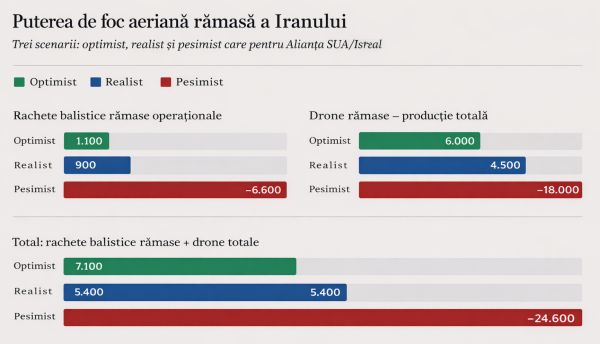
1.Optimistic
80-150 projectiles/day
2.Realistic
120-300 projectiles/day
3.Worst-case
250-500+ projectiles/day
Aggregated sources: JINSA, Atlantic Council, IDF/Alma Center, CSIS, Bloomberg, ISW - updated estimates March 2026. Average values of ranges are used for graphical representation.
NOTE
Aggregated reports (Alma Center, JPost) indicate that Iran has already consumed or lost approximately 2,410 ballistic missiles from the estimated stock of 2,500, suggesting that Iran may be on the verge of operational exhaustion of medium-range ballistic missiles (MRBM). What remains, sources say, are mainly short-range missiles (SRBM) and museum pieces that cannot change the course of the war.
• Imports help prolong Iranian resilience
Iran appears to receive external support from the "Axis of Resistance”, but according to Western views, its ability to rapidly multiply its firepower through imports remains very limited.
According to reports from February-March 2026, Iran mainly benefits from technical support, components and intelligence information, not from massive deliveries of ballistic missiles or ready-to-use combat drones.
• Direct support from allies
China has delivered Iran attack drones (loitering munitions / kamikaze drones) in small quantities, chemical components for solid rocket fuel (sodium perchlorate), as well as access to the BeiDou satellite navigation system for improved drone and missile accuracy. According to Middle East Eye, US-China Economic and Security Review Commission and Reuters (February-March 2026), Beijing is in advanced negotiations for CM-302 supersonic anti-ship missiles (export version of YJ-12). However, China avoids massive deliveries of direct lethal weapons to avoid severe US sanctions and to protect massive oil imports through the Strait of Hormuz. Beijing prefers indirect support (dual-use technology, components, intelligence) instead of large shipments of ballistic missiles.
Russia has provided Iran satellite imagery and targeting data for strikes on US bases, as well as improved technology and components for Shahed drones (navigation and accuracy). According to Wall Street Journal, Financial Times, CNN and statements by President Zelensky (March 2026), Moscow signed in December 2025 an agreement to deliver Verba portable air defense systems (500 launchers + 2,500 missiles), but deliveries are scheduled only for 2027-2029. Russia prioritizes its own war effort in Ukraine and cannot (or does not wish to) divert large quantities of weapons to Iran at this time.
North Korea maintains a long-standing historical cooperation in ballistic missile technology (North Korean designs underpin many Iranian missiles). However, there are no confirmed public reports of recent massive deliveries of missiles or drones to Iran after the outbreak of the February 2026 conflict.
Other actors in the "Global South” or within the "Axis of Resistance” (Hezbollah, Houthis, Iraqi/Syrian militias) receive weapons from Iran, not the other way around. There is no credible evidence of significant imports from other states (Venezuela, Cuba, etc.).
• Limitations of land and rail routes
Even if Iran attempted to import weapons via land or rail routes, these options remain extremely difficult, slow and risky for significant military transport. Reports from 2025-2026 (Financial Times, Reuters, The Cradle) show:
1.Route from Russia (INSTC corridor - International North-South Transport Corridor)
Includes rail and road segments through Azerbaijan (Rasht-Astara route) or via the Caspian Sea (ferries). The key Rasht-Astara segment is not fully operational at maximum capacity. Transporting massive weapons would require crossing Azerbaijan or other Caucasus states, which are sensitive to US and Israeli pressure. Any visible military convoy would be easily monitored by satellites and Western intelligence. According to analysts, real deliveries of heavy weapons (ballistic missiles) via this route are minimal or nonexistent in 2026.
2.Route from China (China-Iran Railway Corridor)
There is a direct rail connection China-Kazakhstan-Turkmenistan-Iran (part of the Belt and Road Initiative), tested with freight trains in 2025. However, Central Asian states (Kazakhstan, Turkmenistan, Uzbekistan) do not want to allow weapons transport to Iran to avoid tensions with the US and secondary sanctions. Trains can be stopped, inspected or diplomatically blocked, and capacity is small for heavy and sensitive cargo (entire ballistic missiles are bulky and difficult to conceal).
3.Route through Iraq and Syria ("Axis of Resistance” land corridor)
This is the traditional route for supplying Hezbollah and Shiite militias. In 2026, Israeli and US strikes have seriously degraded infrastructure in eastern Syria and Iraq-Syria border areas. According to ISW and Alma Center reports (March 2026), the land corridor through Syria is subject to repeated attacks. Transport is possible only in small quantities, with camouflaged civilian trucks, but not at industrial scale (thousands of missiles).
• Iran remains mainly dependent on remaining internal stockpiles and its own drone production
Even via land or rail, large weapon shipments remain highly vulnerable and inefficient due to intensive monitoring by satellites, drones and Western intelligence, dependence on third countries that avoid escalation risks, long transit times (weeks or months) and limited capacity. According to JINSA, Chatham House and CNBC assessments (March 2026), the main limitation is not only allies' willingness, but logistics and high risks.
The net result is that support from Russia, China or North Korea remains mainly technical and in components (navigation, solid fuel, electronics), not in massive deliveries of complete missiles. Iran cannot rapidly multiply its firepower through imports. These routes help prolong resilience (through drones and spare parts), but cannot reverse the current attrition trend. Iran remains mainly dependent on its remaining internal stockpiles and its own drone production, which continues at reduced scale due to alliance strikes on factories. This indirect support prolongs the conflict as a war of attrition, but, in the view of Western analysts, does not change the fundamental strategic balance in Iran's favor.
• Degradation of alliance interception systems - estimate March 24, 2026
Iran's remaining firepower capacity must always be read in relation to the state of active defense systems. A stock of 9,000 projectiles against a fully functional system is fundamentally different from the same stock against an already compressed system.
• Estimated state of main systems
Iron Dome has handled the largest volume of engagements. The declared interception rate remains above 90%, but Tamir interceptor reserves are carefully managed - production cannot fully compensate for consumption in massive waves, and batteries undergoing reload create windows of vulnerability.
Arrow-2/3, the critical layer against ballistic missiles, operates at an estimated 60-75% of the initial interceptor stock in the realistic scenario (BESA Center, March 2026). Production is slow and expensive - each Arrow-3 interceptor costs 2-3 million dollars.
US THAAD can be resupplied from continental stocks, but logistics take weeks - not days.
Key implication
Active defense systems do not fail linearly - they function almost perfectly up to a threshold, after which the interception rate collapses rapidly. Iran deliberately launches ballistic missiles and drones in simultaneous waves precisely to force this saturation. In the realistic scenario, if Iran sustains 700-1,500 projectiles weekly for 6-8 weeks, interceptor reserves become the alliance's limiting factor - not Iranian firepower itself.
If the estimate is correct, then the alliance wins in the long term through air superiority and ground destruction, but pays a very high price in the short term.
Iran cannot win, but can turn the alliance's victory into a "Pyrrhic” one - expensive, long and political. The decisive difference will be made by the alliance's ability to continue strikes on remaining launchers and factories versus interceptor reserves.
It is unlikely that the war will end with a "knockout”, but rather with a slow exhaustion - and that, paradoxically, favors the side with greater political will to bear the costs.





















 Euro
Euro Dolar SUA
 Franc elveţian
 Liră sterlină
 Gram de aur