 English


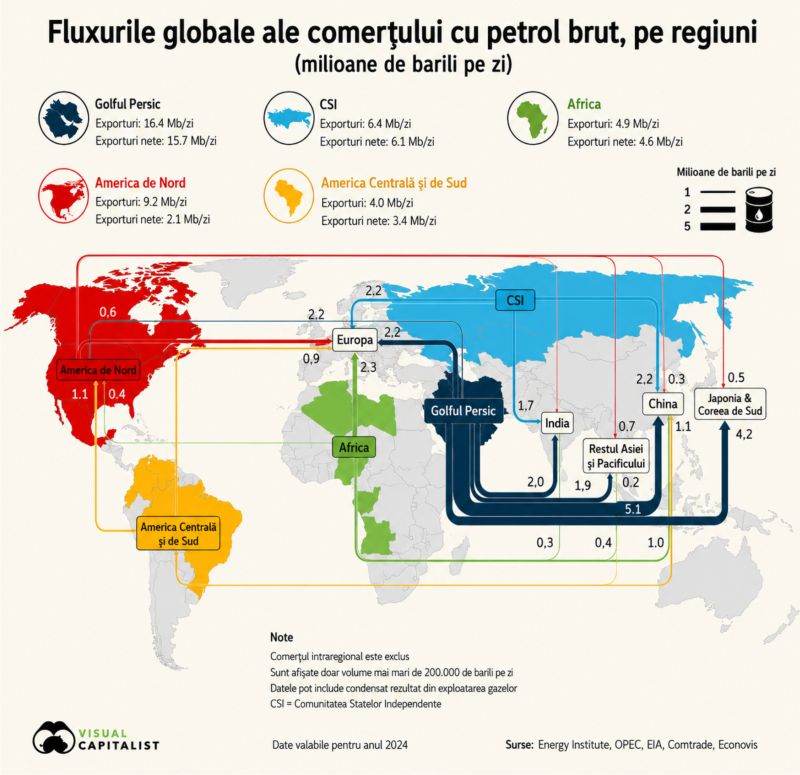
Crude oil is the most traded commodity globally, and the routes it travels reveal the true map of global energy power: a handful of exporting regions supplying a demand center decisively shifted to Asia, according to an analysis by visualcapitalist.com.
The cited source presents the map of crude oil trade between the main regions of the world in 2024, according to statistical data from the Energy Institute and the UN Comtrade.
Only flows greater than 200,000 barrels per day were taken into account, and intra-regional trade is excluded.
• Persian Gulf - the world's leading oil exporting power
The Persian Gulf remains the world's leading oil exporting power, and in 2024, the region transported 16.4 million barrels/day of crude oil, more than the Commonwealth of Independent States (CIS) and Africa combined. Its dominance is significant because most of these barrels of oil are headed to Asia, making Gulf production one of the most important pillars of the global energy system. Shipments from the Persian Gulf are largely oriented eastward. Of the Gulf's exports, about 13.2 million barrels/day went to Asia in 2024: 5.1 million to China, 4.2 million to Japan and South Korea, 2 million barrels/day to India, and 1.9 million to the rest of the Asia-Pacific region. Europe took 2.2 million barrels/day, while only 0.6 million went to North America.
In addition to the Persian Gulf, Europe was supplied mainly by three other regions: 2.3 million barrels/day from Africa, 2.2 million from North America and 2.2 million from the CIS. South and Central America added another 0.9 million barrels/day to Europe in 2024.
• Asia - the center of gravity of demand
The map cited reveals a clear trend: the world's largest crude oil flows are now heading towards Asia. China alone imported 5.1 million barrels/day from the Persian Gulf, 2.2 million from the CIS and 1 million/day from Africa in 2024, making it the largest destination for internationally traded crude oil.
India presents a similar story, having benefited from 2 million barrels/day from the Persian Gulf and 1.7 million from the CIS, a flow that has increased as Russian crude has been redirected east. Japan and South Korea, with fewer domestic options, have relied almost entirely on the Gulf to buy, together, 4.2 million barrels/day in 2024.
• Orders for supertankers at record high
Shipowners around the world have placed orders for a record number of new supertankers, surpassing the previous all-time high set in 2008 that ultimately led to a glut and a collapse in prices, Bloomberg reports, according to Agerpres.
According to analysts at the consulting firm Clarkson Research Services, shipyards around the world currently have 262 supertankers on order, each capable of carrying two million barrels of oil. Such a number of supertankers, which could handle all of the US's crude exports, means exceeding the previous all-time high reached in October 2008.
The supertanker market was disrupted, and ultimately benefited, by the Iran war. Prices have doubled from pre-conflict levels and have sometimes reached record highs of several hundred thousand dollars a day due to disruptions. However, the blockade of the Strait of Hormuz has sharply reduced oil supplies, which could hurt earnings over time if the situation persists, especially if the conflict ultimately leads to a decline in oil demand in the long term.
"It is temporarily better than in 2004-2008, when the market exploded,” George Economou, a Greek billionaire founder of TMS Group, said at the Posidonia forum in Athens last week. "But if it continues, it will be bad for oil companies,” Economou warned.
The market capitalization of 15 of the largest oil tanker companies has exceeded $60 billion since the start of the Iran war. By comparison, at the start of the year, it was barely half that, a measure of growth for this vital component of global oil trade.
Prices for second-hand tankers have also risen. Clarkson data shows that a 10-year-old tanker now costs around $115 million, the highest price since 2008.
Some owners point to the large number of tankers targeted by sanctions as a reason for such high orders for new tankers. Clarkson data shows that the average age of the supertanker fleet has reached its highest level since 1998, increasing the need for fleet renewal.
The picture is similar beyond the tanker fleet. Across the shipping industry, orders are at a 14-year high.
"The biggest risk facing shipping right now is wealthy shipowners,” said George Youroukos, executive chairman of container shipping firm Global Ship Lease.
One example is an enigmatic South Korean shipowner who, with the support of MSC Mediterranean Shipping Company SA, has been buying tankers at exorbitant prices in recent months. The purchases have given many of the companies that sold their tankers to Sinokor smaller fleets, but also more money, some of which has been reinvested in new ships.
• EU energy bill rises by 47 billion euros since Iran war began
The European Union's fossil fuel import costs have risen by 47 billion euros ($54.3 billion) since the start of the Middle East conflict 100 days ago, DPA reports, according to Agerpres.
"This is the price we pay without a single molecule of extra energy,” a European Commission spokesman said on Monday, adding: "But it is important to say that we have not suffered any disruption. Security of supply is assured and that is the most important thing.”
This was possible because the EU has diversified its energy sources, increased the share of domestic energy and improved energy efficiency, the spokesman explained, adding: "The EU executive is ready to take further action if necessary.”
Sources who wished to remain anonymous said the European Union was working on a series of plans aimed at reducing taxes on renewable energy and making electricity systems more flexible, as high electricity costs continue to weigh on the region's economy.























 Euro
Euro Dolar SUA
 Franc elveţian
 Liră sterlină
 Gram de aur





























