 English


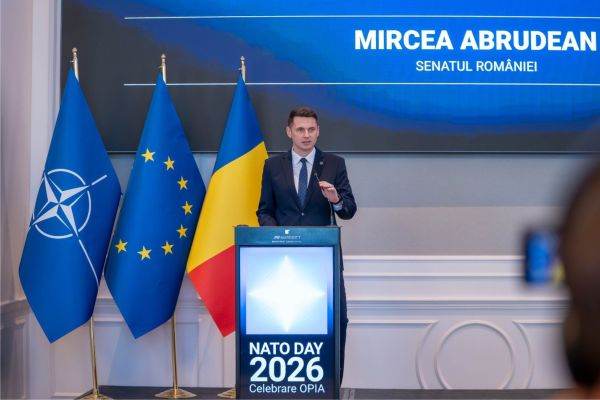
The defense industry can no longer function on the logic of improvisation or small steps, but needs a coherent strategy, consistent investments and real collaboration between the state and the private sector, to transform this sector into a central pillar of national security and the economy, said the participants at the NATO Day 2026 event, organized yesterday by the Defense Industry Employers' Organization.
At the opening of the event, Răzvan Pîrcălăbescu, President of OPIA and General Director of Romarm, stated that our country has over 150 accredited companies in the defense industry, of which 85 are members of the employers' organization he leads. He said that Romarm and the companies in OPIA will develop new production capacities, in addition to drone production.
Răzvan Pîrcălăbescu stated: "We are ready to offer the Ministry of National Defense and all the force structures in Romania everything they need, but we must be consulted and know a period of time in advance that purchases will be made.” He indicated that OPIA member companies produce "small-caliber, medium-caliber, large-caliber ammunition, drones, tanks, combat vehicles, 4x4s, etc.”.
In turn, Radu Oprea, the Secretary General of the Government, said: "When you have benefits and are a member of an alliance, you must also have a share of contribution. And the best contribution that we, as Romania, can make is our capacity to deter conflicts in the area. This means that the Romanian army must be prepared, the law enforcement institutions must be prepared, but, of course, also the national defense industry, with private capital and state capital. And this can be done during this period, because the Strategy for the National Defense Industry and the law on industrial cooperation have moved the decision from any of the ministries to the CSAT. We are talking about the decision in areas where, in accordance with the law on industrial cooperation, the public procurement and the industrial cooperation agreement must be signed at the same time. That is, to say clearly, very well argued, what we want to do in Romania, how much we can produce in Romania in the interest of Romania's security, in accordance with Article 346 of the Treaty on the Functioning of the Union European. We have a chance, we have an opportunity, it is called SAFE, and we must take advantage of it, because time does not forgive us in this period and, as you can see, neither are times on our side”.
• Political decision-makers: SAFE allocations for the benefit of the national defense industry
The participants in the debate showed that, in a context dominated by complex threats, from conventional conflicts to hybrid, cyber and information risks, defense capacity depends directly on the strength of the industry, technology and the speed of decisions taken by political factors. They also said that, in this context, the opportunity offered by European funds for the period 2026-2030 becomes essential for Romania's repositioning in the defense industry. Directing these resources to companies with domestic capital and stimulating strategic partnerships can transform the sector into a pole of excellence, capable of supporting both domestic needs and integration into European production chains.
Mircea Abrudean, President of the Senate, stated: "Apart from the political and military component, of course we need to talk more about the economic component, about the defense industry, which is talked about a lot, but, unfortunately, I think that it is not done as much, and we see this in practice. We have almost 17 billion euros in the European SAFE mechanism, which represents the second largest amount allocated to a member state for the consolidation of defense and dual infrastructure between 2026 and 2030. It is important to ensure that this money goes to companies with domestic capital, because companies in this area demonstrate that the development of the defense industry is not concentrated in a single point built regionally, but represents a pole of excellence capable of supporting both national needs and integration into the European value chain. I, at least, and my colleagues, certainly, in all the meetings we have in the country and abroad, in foreign delegations, we try to support the Romanian defense industry as much as we can. defense, because we have extraordinary capabilities here, in addition to the tradition we have in the field. We have qualified human resources, we have many IT companies that have reprofiled themselves towards the Defense Tech area and that manage on their own in this jungle, let's call it, in which they operate, they already work with multinationals, with the big players in the industry and I think they need to be encouraged more. I think that's what we need to do. 22 years after joining NATO, Romania are at a moment of strategic maturity. We have the obligation to actively contribute to collective security, to strengthen our defense capabilities and to develop a national technical industry, supported politically, legislatively and economically. It was and I believe it still is a matter related to legislation and here we have shown our full willingness to accelerate any legislative initiative that streamlines the implementation of the defense industry in Romania”.
He specified that, following the reform of state-owned companies, we should see an increase in the efficiency of the management activity of these commercial companies, which until now have been in a crisis due to non-compliance with the provisions on corporate governance.
"I very much want, I repeat, Romanian companies to benefit from a large part of these amounts from SAFE. This means that Romanian companies must also be more oriented, let's say, and try to be efficient, to find solutions where solutions are needed and I know that we are capable of doing this in order not to lose this very big opportunity for Romania. Of course, many criticize the fact that we are talking about SAFE, but SAFE is a loan. It is a loan at extraordinarily good interest rates. It would be ideal if Romania could borrow at these interest rates and in the current activity of the Government”, said Mircea Abrudean.
• Defense companies, evaluated by members of the parliamentary defense committees
In turn, Nicoleta Pauliuc, president of the Senate Defense, Public Order and National Security Committee, mentioned that, after the Easter holidays, the committee members will begin an evaluation of the defense industry, an evaluation that also includes visits to public and private companies in the territory, in order to determine which companies this sector of activity can rely on.
"During this period, we are working on the National Defense Law. There is an article that we introduced through an amendment that talks about the defense industry as a strategic area of Romania. Because when we talk about security, we are not just talking about capabilities, we are not just talking about a prepared army, we are also talking about a strong defense industry. (...) We live in an era in which the security of states is no longer threatened unidimensionally. We see conventional military threats, but also hybrid attacks, informational, cyber, economic pressures and attempts to undermine democratic politics. Faced with this reality, NATO has remained what it has always been in the decisive moments of history: a space of strategic unity, credible deterrence and collective defense. (...) But NATO also means an obligation of maturity for Romania. Being a member of the Alliance does not only mean benefiting from protection, but also means contributing, investing, being prepared and understanding your role in a region essential for Euro-Atlantic security. So, Romania is not just a beneficiary of collective security. Romania is and must be a security provider. And in a context in which the eastern flank has major strategic importance, this role becomes even more important. (...) In the field of defense, we can no longer afford hesitations, oscillations or short-term visions. Security is built over time, through continuity, through intelligent investments and through consensus on the national interest. Therefore, we must strengthen our real defense capacity. Today, credible deterrence does not just mean political will. It means capabilities, infrastructure, interoperability, technology, industry and resilience. It means the state's ability to collaborate with industry, the research environment and strategic partners to transform the decision into real power. Then we need to invest in people. No alliance is stronger than the people who serve it. No strategy is worth more than the competence of those who put it into practice. From the military and security experts, to engineers, researchers and professionals in the defense industry, we need a new generation of leaders who understand the complexity of this era and respond with professionalism, character and vision”, stated Nicoleta Pauliuc.
• Ambitious goals for 2030
In the long term, the stake is for Romania to no longer be just a security beneficiary, but a relevant actor in the Euro-Atlantic architecture, including through a globally competitive and interconnected defense industry. Without accelerating reforms, streamlining legislation and increasing production capacity, there is a risk of missing a strategic opportunity at a time when regional competition is increasingly intense.
In this regard, Irineu Darău, Minister of Economy, Digitalization, Entrepreneurship and Tourism, said: "First of all, I state the principle of complementarity: it is not about private versus public, it is not about internal versus external, it is not about import versus export. We are in a period in which, as we face threats, we have multiple opportunities for solid development of the defense industry and we must know how to combine all these elements. It is not a zero-sum game. We must know how to attract partners from Romania, partners from abroad, to carry out both imports and exports and to encourage real partnerships between the private sector and the state. The second principle would be interdependence.
Of course, we want to produce as much as possible in Romania, if it is even possible to produce from one end to the other. We know as well that it will not be possible in all cases, but the essential principle is that, after these years, the defense industry in Romania should be an essential link in the global and European production chains. Romanian production, the Romanian defense industry, should, after 2030, no longer be bypassed in almost any global production chain regarding the military industry, especially, of course, within the European Union and NATO.”
What is happening now, both in the military industry and in research, in innovation, means a speed that companies in our country do not have, but that they must gain, said MEP Vasile Dîncu, former Minister of National Defense.
Vasile Dîncu specified: "Through the SAFE program and through other programs, we are trying to build what Romania also wants, which is to be part of an important, strategic, autonomous pillar within NATO. It is not an idea that is very well targeted everywhere, but I believe that it is an idea that Romania must seriously adhere to. Given the complementarity with the partnership with the United States, I believe that we can be the most interesting bridge in the reconstruction of a Euro-Atlantic spirit.”
• Vasile Dîncu: Without responsibility and competence, civilian control of defense can become dangerous, can lead the army into hasty or poorly thought-out projects
The former Minister of National Defense also referred to the current state of NATO, an alliance weakened due to its political core. Vasile Dîncu said: "NATO is a very important subject of international political strategies and a project of concern for many. For decades, NATO was a promise that was born after World War II, after a disaster. It was a promise that was based on two pillars: on an incredible military capacity and on a political core that is based on values and was based on common values. Today, one of these two pillars has weakened a lot and that should worry us. Today, it is not the military structures that bring weakness to NATO, but the political core or this level of politics. We see a fragmentation; while NATO remains solid militarily, it is losing political cohesion. And I think that NATO, if it has a danger at the moment, it is not a danger from outside NATO, but a danger from within NATO. That is why I think that today we are experiencing a very strong contrast and I would like to pay tribute today to those who are the basis of this alliance: the military. The military lives the reality of security. Politicians discuss it. We, the politicians, discuss it. The military knows what risk means. Politicians formulate, talk about risk in speeches. The military goes on missions and does not know if they will return. (...) NATO, in the last 20 years, has sacrificed over 4,000 lives. Dozens of families have been left in difficulty. So, this means that, for the military, war is not an idea. The military values life and we need, at this moment, the lucidity of the military, because, in the end, there is an aspect that we, the politicians, must recognize and must discuss. That of civilian control over defense. Civilian control over defense was thought of on the need for balance between the military and the civilian. But let's look a little: without responsibility and competence, this civilian control can become dangerous, it can transform the army into a project, it can lead it into hasty or stupid projects thought and which sometimes do not have general acceptance. That is why I believe that, for NATO to remain strong, we need to know where we are going and what we are defending, we need decision-making coherence, respect for the institutions that ensure stability, respect for the military”.
MEP Maria Grapini stated, after the interventions of the state representatives, that although over the years the Romanian defense industry has become insignificant in terms of the size of its capacities, there is an urgent need for investments in current production capacities, but also in the opening of new capacities and added that "the European funds made available must be invested in our own industry and infrastructure, and not in imports”.
According to the representatives of the companies present at the event, the participation of Romanian technology companies in NATO initiatives is no longer just an opportunity, but a strategic responsibility. For example, the DIANA (Defense Innovation Accelerator for the North Atlantic) opens the door to financing, testing, validation and scaling for technological solutions with real impact on the security and resilience of the Alliance and allows companies in our country to accelerate innovation and deliver NATO-level technology.



















 Euro
Euro Dolar SUA
 Franc elveţian
 Liră sterlină
 Gram de aur





























