 English


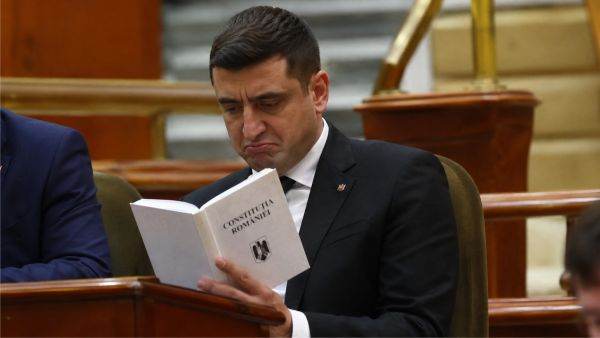
The initiative launched yesterday by George Simion, the leader of the AUR, regarding the suspension of President Nicuşor Dan from office, because he preferred to designate MEP Eugen Tomac as prime minister in charge of forming the new government, seems doomed to failure, because it does not fall within the situations provided for by the Romanian Constitution.
The idea of suspending the country's president was thrown into the air yesterday by the unelected president, Călin Georgescu, on the steps of the Bucharest 1st District Court, where he is being tried in a case in which he is accused of legionary propaganda. Upon leaving the courtroom, after delivering an apocalyptic speech in which he described Romania as a "neo-Phanariot state,” talked about huge debts, closed factories, and young people leaving the country, Călin Georgescu stated that "the illegal occupant of the Cotroceni Palace hammered the last nail into the coffin of Romanian democracy” with the appointment of Eugen Tomac as prime minister. Furthermore, Georgescu explicitly asked parliamentarians to "immediately” initiate the procedure for suspending the president.
The appeal did not go unanswered. Immediately, the leader of AUR, George Simion, went public with his own message: "Nicuşor Dan - suspended!” In the same vein, Simion also took up the topic of early elections, presenting it as "the solution to get out of the crisis.” Dan Dungaciu, the first vice-president of AUR, was no less outspoken, stating that Romania would need early elections to obtain political majorities capable of managing the current situation.
The problem is that between the political spectacle and the real possibility of suspension there is a stubborn obstacle: the Constitution. And the Constitution does not work based on TikTok views, Facebook polls or momentary political indignation.
Article 95 is clear. The suspension of the president can only be triggered "in the event of serious acts that violate the provisions of the Constitution”. Political dissatisfaction is not enough. Opposition to a particular prime minister is not enough. Even the sincere conviction that the head of state has made a wrong decision is not enough.
The Constitution requires the existence of serious acts of violation of the Fundamental Law. And here begins the major problem of the initiative launched by Simion. The entire argument built in recent days is based on the idea that Nicuşor Dan would have annulled the will of the electorate by designating the candidate for the position of prime minister. However, the constitutional texts invoked by the president's critics themselves say exactly the opposite.
Article 103, paragraph 1, establishes unequivocally that the president designates a candidate for the position of prime minister after consulting the party that has the absolute majority in Parliament or, if there is no such majority, the parties represented in Parliament.
The wording is essential. The Constitution does not say that the president is obliged to designate the candidate of a particular party. It does not say that he must choose the leader of the party with the most mandates. It does not say that he must follow the preferences of the opposition. It does not even say that he must designate a parliamentarian. The only situation in which his margin of appreciation is drastically limited is the existence of a clear and assumed absolute majority in Parliament. In the absence of such a majority, the head of state has the constitutional freedom to appoint the person he considers capable of obtaining the necessary parliamentary support. This actually represents the constitutional architecture of the Romanian political regime.
In other words, to affirm and declare that the president of the country should be suspended for not appointing the prime minister preferred by a certain party is the legal equivalent of a complaint against an arbitrator for applying the regulation exactly as it is written.
Moreover, Nicuşor Dan does not appoint the Government on his own. Article 85 of the Constitution is equally clear: the president appoints the Government based on the vote of confidence granted by Parliament. In other words, the head of state proposes the prime minister, but Parliament decides. The Government does not reach the Victoria Palace by presidential decree, but by the vote of the majority of deputies and senators.
Here appears the paradox of the entire political offensive. Those who accuse the president of ignoring the will of Parliament are simultaneously asking the Legislature to sanction a decision that the Constitution explicitly allows it to make.
In fact, the suspension of Nicuşor Dan is not a new idea. In the last six months, the theme has been recurring in the discourse of some political parties. At the end of last year, AUR was already demanding the initiation of suspension procedures, accusing the president of involvement in the judicial system after announcing the intention to organize a referendum among magistrates. Later, after the fall of the Bologna Government through a motion of censure, S.O.S. Romania followed the same logic, requesting the suspension of the head of state and launching public consultations on this issue. However, none of these initiatives managed to go beyond the level of political declarations. The reason is simple: the suspension of a president cannot be built exclusively on political grievances or differences of vision. It requires demonstrating serious violations of the Constitution.
And here the offensive launched by George Simion seems to encounter the same difficulty that affected previous attempts. It is relatively easy to formulate political accusations. It is much more difficult to prove that the president violated a constitutional article when the constitutional text itself grants him the contested competence. Under these conditions, Călin Georgescu's appeal and the rapid reaction of AUR seem to have more the value of a political message addressed to his own electorate than the prospect of a constitutional procedure with a real chance of success.
In essence, there is a fundamental difference between what can be presented as a political scandal and what can be qualified as a violation of the Constitution. And in the case of the appointment of the prime minister, the Constitution speaks so clearly that it leaves very little room for convenient interpretations.
Therefore, just one day after its launch, the suspension initiative seems to face an impossible problem to avoid: the main opponent is not Nicuşor Dan, but the very text of the Romanian Constitution. And this cannot be avoided by press statements, posts on Facebook, Telegram or TikTok or emotional appeals before a court of law.





















 Euro
Euro Dolar SUA
 Franc elveţian
 Liră sterlină
 Gram de aur





























