English

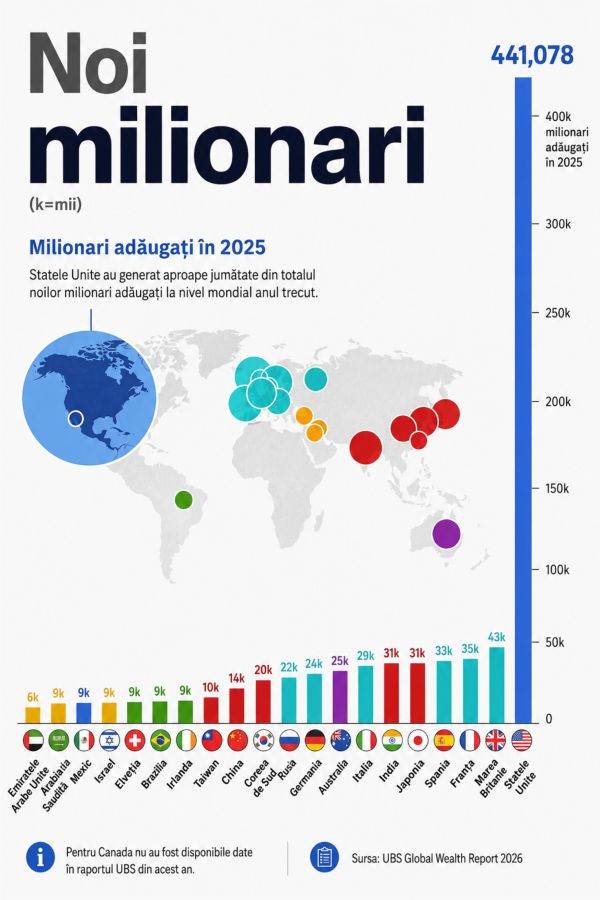
While almost a million people surpassed the $1 million wealth threshold in 2025, this growth is far from evenly distributed across countries.
Visualcapitalist.com presents the top 31 countries that added the most new dollar millionaires between 2024 and 2025, showing where personal wealth grew the fastest over the past year. The data used in the ranking comes from the UBS Global Wealth Report 2026, which tracks individuals with net worths exceeding $1 million.
• The U.S. dominates global wealth creation
The United States added 441,078 new millionaires in a year, more than ten times the total recorded by the United Kingdom, which ranked second. U.S. households accounted for almost half of all people worldwide who surpassed the $1 million mark in 2025, underscoring the country's outsized role in global wealth creation.
Strong capital market performance, broad household investment participation and economic growth have all contributed to the rise in personal wealth in the U.S.
Canada was not included in this year's UBS report, according to the source cited.
• Europe holds many of the top spots
Europe is well represented in the rankings, with the UK (43,139 new billionaires), France (34,604), Spain (32,707), Italy (28,596), Germany (24,263), Ireland (9,491), Switzerland (8,907), Poland (3,888), Greece (2,762), Hungary (1,349), Latvia (1,131) and Lithuania (921) all appearing in the top 31.
France and Spain, each with over 30,000 new millionaires in 2025, occupy the 3rd and 4th spots in the rankings.
While no European country came close to matching the US total, six of the top 10 countries in the rankings are in Europe. This suggests a general increase in wealth across several major economies, rather than a dominant regional market.
• New millionaires in major Asian markets
Japan and India each added more than 31,000 new millionaires last year, followed by South Korea with more than 20,000, and China with more than 14,000. Japan ranks fifth, while India ranks sixth.
Smaller financial centers such as Taiwan, Singapore and Hong Kong also made the list, despite their relatively small populations.
The Asian results highlight two paths to wealth creation. India continued to add millionaires as its economy grew rapidly, while mature markets such as Japan, South Korea, Hong Kong and Singapore generated new wealth through existing household assets and growing financial markets.
• The world's ultra-rich population is expanding rapidly; US and China lead the way
The world's ultra-rich population is expanding rapidly, but the growth is happening in very different ways across countries.
While the US is expected to have far more ultra-high net worth individuals (UHNWIs) than any other nation, estimates show that many smaller economies will see a faster percentage increase in their population with at least $30 million in wealth, according to Knight Frank's 2026 World Wealth Report. The report highlights which countries are expected to have the most ultra-rich between 2021 and 2026.
The US is expected to add nearly 67,000 people with at least $30 million in wealth between 2021 and 2026, nearly three times the growth recorded in China over the same period.
No other country comes close to the US in absolute terms. America's expansive capital markets, technology sector and concentration of fast-growing private companies continue to generate wealth on a scale unmatched by other economies.
China ranks second, with over 22,000 new ultra-high net worth individuals, cementing its position as one of the largest wealth creation markets globally.
The following countries rank 3-10 on the list: Germany (+9,273 ultra-high net worth individuals), India (+7,716), Switzerland (+4,968), Australia (+4,036), France (+3,781), UK (+3,005), Italy (+2,886), Spain (+2,708).
While the US dominates in terms of the total number of new ultra-high net worth individuals, the fastest growth is occurring elsewhere. Poland is the world leader, with a projected growth of its ultra-rich population of 109%, followed by Qatar - with 107% and Turkey - with 94%. These gains suggest that wealth generation is accelerating beyond traditional financial centers and expanding into a broader group of emerging and rapidly developing economies.
























 Euro
Euro Dolar SUA
 Franc elveţian
 Liră sterlină
 Gram de aur