English

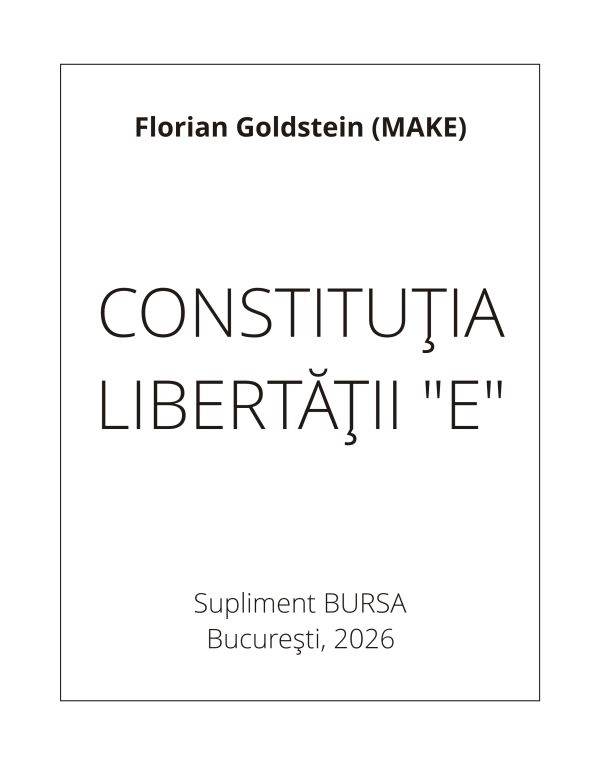

Today we publish "The Constitution of Effective Freedom E”, a description in normative language of the desirable society, which provides the occasion for the launch of ILEB - the BURSA Effective Freedom Index, which establishes, in 188 states, the distance from the state of freedom, that state which would be desirable.
But on this occasion, we discover that the document published today is, in fact, a conclusion to two other books - "The Kingdom of God on Earth” (which I published in 2024) and "The Theory of Interest” (which I published this year) -, all three being united by one and the same search for the configuration of the desired world.
These three books of mine, although completely different in subject and treatment, express the same concern and belong to the same universe of ideas, in the vicinity of the Apocalypse (understood as the revelation of the desirable world).
This means that "The Kingdom of God on Earth”, "The Theory of Interest” and "The Constitution of Effective Freedom E” are united in a trilogy.
Which I did not anticipate.
The idea that this is a trilogy could be called a "surprise”, because I did not intend it, but, in fact, it is something more subtle.
Writing each of these books absorbed me, and I had no way of thinking about an external architecture for them.
Today, however, alongside my other books, I place "The Constitution of Effective Freedom E” on the shelf, tracing an ascent from the part to the whole of the trilogy:
1. I researched the concern for the desirable world in some of the wisest texts of antiquity;
2. I found a plausible interpretation for the mechanism that keeps us in a society whose organization we reproach;
3. based on these studies, I developed the text I publish today, as a proposal for what we would wish for.
The ascent is both intellectual and experiential, and in what follows I will try to transfer this feeling to you.

• 1. The Kingdom of God on Earth
a. The Gospel of Jesus is absent
Where is the Gospel of Jesus?
Before any Gospel, before Mark, Matthew, Luke and John, there existed the Gospel of Jesus (or the Gospel of the Kingdom of God), which Matthew, Mark and Luke explicitly mention:
- "And Jesus went about all Galilee, teaching in their synagogues and preaching the Gospel of the Kingdom, and healing every disease and every infirmity among the people.” (Matthew 4:23)
- "And this Gospel of the Kingdom will be preached in all the world as a testimony to all nations; and then the end will come.” (Matthew 24:14)
- "Now after John was arrested, Jesus came into Galilee, preaching the Gospel of the Kingdom of God and saying: The time is fulfilled, and the Kingdom of God is at hand. Repent and believe in the Gospel.” (Mark 1:14-15)
- "And He said to them: I must preach the Kingdom of God to other cities also, because for this I was sent.” (Luke 4:43)
- "And afterward Jesus went through cities and villages, preaching and proclaiming the Kingdom of God, and the twelve were with Him.” (Luke 8:1)
"Annunciation” is a translation of the Greek word euangelion.
It is therefore indubitable that the Synoptic Gospels speak of the existence of another Gospel - that of Jesus - about the Kingdom of God, which, as they record, must have existed before them (not necessarily as a written book, but certainly as an oral discourse).
Where is the Gospel of Jesus?!
That is, the four detailed accounts of Jesus' final days speak of everything He did before being crucified and do not record His Gospel?!
The Gospel which Jesus declares is precisely His mission to proclaim?!
Do the canonical Gospels not give us Jesus' message as such?!
It is quite shocking.
"Repent and believe in the Gospel,” says Jesus. (Mark 1:14-15)
Which Gospel are we to believe in, if none had yet been written?!
Let us record this shocking absence from biblical literature.
It is an absence more substantial than the presence of Paul's Epistles, than the canonical Gospels, than the Acts of the Apostles, than the entire New Testament.
It is an immeasurable absence.
The mission of Jesus is absent.
Jesus is present, but without a mission.
b. Was Jesus censored?
The Gospel of the Kingdom of God does not appear among the 47 Gospels known today (43 apocryphal, apart from the four canonical ones).
It is nowhere.
At a first search in the New Testament, the expression "Kingdom of God” appears 72 times.
The equivalent expression "Kingdom of Heaven” appears 29 times.
What does the expression mean?
There is no explanation.
An omission made by one evangelist can be explained by selection.
The consistent omission by all evangelists, in all the places where Jesus preaches, cannot.
Four authors, writing in different decades, in different communities, do not accidentally omit exactly the same thing - the content of what their main character preached.
Was Jesus censored?
There is an alternative explanation: the Kingdom of God is described by the Divine Commandments - it is said that the Torah (Pentateuch) sets out 613 Commandments, numerous enough to encompass the organizational aspects of a society.
Since this organization is commanded by God, then it follows as evidence - this is the Kingdom of God.
Recording it in the New Testament would have made no sense, because it would have been nothing more than a repetition of the Old Testament.
c. The Commandments are the main subject
It follows from this that the main subject of any restoration of the concept of the Kingdom of God is the Commandments.
This is what my book does:
1. establishes what the Commandments are;
2. how they were transmitted through the ages and throughout history from one generation to another;
3. how they are assembled into a normative body of divine society.
The book ends with this hierarchical assembly of the biblical Commandments, describing the Kingdom of God as a human social organization.
• 2. The Theory of Interest
a. The civilization of interest - the revolution in Shakespeare's century
In 2017 I published, with BURSA Publishing House, a book preparing the trilogy: "The Golden Calf / The Meaning of Interest”, the result of a systematic effort to document the nature and role of interest.
The historiographical bibliography concerning interest, as well as the conceptual considerations surrounding it, are relatively poor.
The 2017 book showed that the organization I called the "civilization of interest” - the one in which we and our great-grandparents were born - has its origins in the 16th century, when a revolution took place generated by three historical processes:
1. The Great Geographical Discoveries;
2. The Protestant Reformation;
3. The legalization of interest.
Humanity had the incredible good fortune to have a brilliant observer of the transformations of the age - William Shakespeare -, who left us the play "The Merchant of Venice”, a testimony that literary exegesis still does not understand today.
The Great Geographical Discoveries triggered globalization - Christian expeditions, financed with Jewish loans bearing substantial interest, engaged in trade between distant territories, leading to fabulous profits (this is the process of territorial arbitrage).
The profits exerted pressure:
- on the religious dogma that prohibited interest-bearing credit as a sin - and the Reformation was willing to accept that the sinful nature of man is inevitable;
- on the law that prohibited interest - England, with its vocation derived from its insular isolation, was the first to legalize it.
These observations, as well as the entire exegetical effort concerning Shmita, in "The Kingdom of God on Earth”, led to "The Theory of Interest”, which I published this year (2026).
b. Interest orders the economic (and social) space
Standard analysis treats interest as a variable dependent on time preference, inflation and risk.
The model in "The Theory of Interest” treats interest as an architectural variable.
It selects feasible arbitrages, directs capital and shapes the degree of economic integration or fragmentation, influencing social organization.
i. Differentials
The modern economy needs differentials (imbalances) to function efficiently.
These may be:
- very different prices for the same product (for example: a phone manufactured cheaply in Asia and sold expensively in Europe);
- or very different profits between sectors (technology brings high returns, while traditional industry or agriculture brings low returns).
ii. Arbitrage
Companies and investors borrow money from banks in order to buy cheaply where prices are low and sell expensively where prices are high (this type of speculation is called "arbitrage”).
If the price difference is large enough to cover interest and expenses, the operation generates profit.
iii. Globalization
Globalization (integration) means free trade, the easy movement of capital, international investment and global competition.
Under these conditions, money and goods move rapidly toward areas where large price differences exist. This movement flattens the differences: prices gradually converge, profit margins shrink, and arbitrage opportunities become increasingly rare and less profitable.
The more integrated the global economy, the more differentials disappear, credit becomes less profitable, and the entire financial system becomes fragile.
iv. Fragmentation
Fragmentation (trade barriers, customs duties, sanctions, protectionism, separate economic blocs) does exactly the opposite: it creates or enlarges these differences again.
Profitable arbitrage opportunities appear again, credit becomes attractive once more, and the economy recovers.
Integration and fragmentation are not accidental or opposite processes.
They represent two phases of the same structural cycle.
A credit-based economy periodically needs fragmentation - thus shaping a social system based on competition, tension and conflict - in order to recreate the differences on which its survival depends.
c. Theory, empirical validation and measurement
The study contains three distinct layers.
- The first layer is the theoretical document - The Theory of Interest. It formulates the model, definitions and mechanisms. Its internal appendices belong exclusively to the theory and develop the necessary formalizations and axiomatization.
- The second layer is the empirical validation document. It maps economic blocs, operational barriers, payment infrastructures and divergences in the cost of capital. Its role is evidentiary. It does not modify the model. It confronts it with observable reality.
- The third layer is the methodological document of the composite indicator - the BURSA Globalization Index (IBG). It transforms structural concepts into replicable metrics. The indicator allows measurement, comparison and periodic updating.
The methodology is explicit and based on public institutional sources.
• 3. The Constitution of Effective Freedom E
a. The secularization of the Kingdom
In "The Kingdom of God on Earth” I constructed, in the concluding section, a Conceptual Outline of the Kingdom, based on the thesis that "man has the status of a spiritual being”.
From this derives: freedom, as a condition, which is ensured by eliminating economic servitude (the mechanism described in The Theory of Interest), from which the reduction of disparities and social harmony follow.
Translating the concept of the Kingdom of God from the religious register into a secular register seems impossible, because the notion is attributed to Jesus, with a strictly divine provenance.
The solution is offered, in the Bible, by God Himself, quoted in Genesis 1:26 as follows: "And God said, "Let Us make man in Our image, according to Our likeness [...]'”
What pertains to man - including the project of the desirable world - is, by the very logic of the biblical text, transmissible along human lines.
b. Normative description of the desirable society
Summarized in a single sentence, the Constitution of Effective Freedom E states:
A society is legitimate only if it offers every person the effective freedom to pursue their purpose, without being captured by economic, political or institutional constraints.
The Constitution of Effective Freedom E is not conceived as a legal text intended for immediate adoption, but as a description of a desirable society and as a normative model derived from two fundamental premises:
- man has the status of a spiritual being;
- effective freedom is the condition for realizing this status.
In this conception, the purpose conferred upon society is not the maximization of production, consumption or political power, but the creation of conditions in which each person can pursue their own purpose.
i. Man and his purpose
The Constitution starts from the idea that every person has a purpose of their own, which cannot legitimately be replaced by economic, political or administrative interests.
Society is considered legitimate only insofar as it allows people to pursue this purpose.
Consequently:
- the person precedes the institution;
- institutions exist for the person;
- economic utility cannot become the supreme criterion.
ii. Effective freedom
The text distinguishes between:
- formal freedom (the right);
- effective freedom (reality).
iii. Structural constraint
The Constitution introduces the central concept of structural constraint through:
- economic dependence;
- debt;
- monopoly;
- institutional capture;
- lack of real alternatives.
iv. The right of exit
One of the dominant ideas is the right of exit.
No social relationship should be:
- irreversible;
- entrapping;
- impossible to leave.
This rule is applied to:
- labor;
- credit;
- property;
- education;
- public services;
- economic organization.
An institution becomes suspect when people can no longer leave it without disproportionate costs.
v. Critique of the debt system
Under the influence of The Theory of Interest, the Constitution considers that systems based on the permanent accumulation of debt tend to generate dependence and structural constraint.
The text seeks to:
- limit capture through indebtedness;
- prevent debt from becoming a mechanism of subordination;
- maintain the reversibility of economic relationships.
It is not a criticism of economic exchange, but of relationships that turn the person into an appendage of debt.
c. ILEB - the BURSA Effective Freedom Index
ILEB is an indicator designed to measure the effective freedom of the person, not formal freedom.
Its premise is that the existence of legal rights does not guarantee that a person is actually free.
A person may have all constitutional rights and yet be constrained by debts, economic dependencies, monopolies, lack of alternatives or institutional capture.
Therefore, ILEB answers the question:
"How free is a person in reality?”
What does it measure?
In summary form, ILEB tracks five major categories:
1. Effective economic freedom:
- level of indebtedness;
- dependence on a single income;
- access to capital;
- ability to change occupation;
- ability to save.
The question is: Can a person say "no” without being economically destroyed?
2. Professional freedom
- ability to change jobs;
- professional mobility;
- access to retraining;
- dependence on a single employer.
3. Institutional freedom
- ability to leave systems and organizations;
- competition among service providers;
- level of bureaucratic capture.
4. Political and civic freedom
- political rights;
- freedom of expression;
- freedom of association;
- access to justice.
These components also exist in the classic freedom indices, but in ILEB they are not sufficient on their own.
5. Existential freedom
This is the original component.
It seeks to capture whether the person has:
- time;
- autonomy;
- resources;
- minimum stability to pursue their own purpose.
Scale< .u >
ILEB is expressed on a scale from 0 (no effective freedom) to 100 (maximum effective freedom).
The score does not measure the perfection of a society.
ILEB measures proximity to the model described in the Constitution of Effective Freedom E.
• The Trilogy: three books, two indices, a single construction
The two indices (IBG and ILEB) are complementary:
- IBG measures the mechanism that undermines the desirable world (degree of integration/fragmentation);
- ILEB measures the distance from the desirable world (degree of effective freedom).
Cause - effect.
This is what, in the book "The Kingdom of God on Earth”, is revealed under the title "Improvement Suppresses the Ideal”.
In the book that preceded all the others - "Terminus a quo / The Solution to the Crisis” (2015) - I found that I wrote toward the end:
"Through articles published in BURSA and through presentations at conferences organized by BURSA, over the past four or five years, I have put forward three kinds of suggestions about what I believe would constitute solutions to the financial crisis specifically, but also to the other contemporary crises (the food crisis, the water crisis, the energy crisis and the spiritual crisis), among which the financial one is merely the most visible.
I. A solution of a spiritual nature, with political implications - Revelation (we have the rare opportunity, of necessity, to dream of Utopia, the world we desire), leading to a "Charter” of man's spiritual stature (the fundamental thesis: "Man has the status of a spiritual being” can underpin a Constitution).
II. A solution of a political nature, with social implications - the transition to direct democracy [...]
III. A solution of a social nature, with economic implications - polycentric organization, based on the principle of self-management, creating conditions for complementing competition with cooperation, redefining management to maximize profits, but without wasting natural resources and degrading the planet; it is an alternative path to globalization [...]”
The trilogy fulfills the first solution mentioned eleven years ago - it has sought and precisely and in detail designed the world we desire.
The transition to direct democracy and polycentric organization would deserve the same attention.
• The Ascent
At the opening of this presentation I said that I would try to transfer to you the feeling of ascent that runs through the trilogy.
I can transfer the argument through an essay.
The experience - no.
Now this can be seen.
The experience requires the ascent itself, traveled at one's own pace.
For those who wish to experience it: the trilogy is available.
















 Euro
Euro Dolar SUA
 Franc elveţian
 Liră sterlină
 Gram de aur