English


• Chapter 1 - The Object of the Theory and the Paradigm Shift
• 1.1. The Object of the Theory
This work formulates a structural theory of global economic architecture, with interest as the central variable. Interest is understood not merely as the price of capital, but as a mechanism for organizing economic space.
The theory applies exclusively to monetary economies based on interest-bearing credit, regardless of political regime, level of development, or institutional form.
Its object is the operating conditions of interest-bearing credit civilization, analyzed as a coherent system with emergent properties and its own structural constraints.
Interest is not treated as a derived variable stemming solely from time preference or short-term monetary equilibria, but as an architectural variable capable of shaping the degree of integration or disintegration of economic space at any scale (spatial, sectoral, institutional, productivity-related, etc.).
• 1.1.a. Historical Delimitation: The Emergence of Interest-Bearing Credit Civilization
The theory does not apply to all historical forms of economic organization. It describes the specific architecture of a historically determined civilization: interest-bearing credit civilization.
This civilization became possible following a double historical threshold:
1. Religious acceptance of interest within the Protestant Reformation;
2. Legalization of interest-bearing credit, particularly in the English sphere.
The Great Geographical Discoveries created unprecedented opportunities for intercontinental arbitrage between goods from the Old World and the New World.
Exploiting these differentials was not merely a commercial opportunity but generated a systemic constraint on traditional financing forms. The volume of capital required, the risk of expeditions, and the length of commercial cycles far exceeded the possibilities of individual saving or local partnerships. In this context, the religious prohibition of interest became a functional limit to economic expansion. The pressure exerted by emerging global arbitrage forced an institutional adaptation: interest was not accepted because it was morally reconsidered, but because it became indispensable to the functioning of a new type of economy. This led, subsequently, to the explicit legalization of interest-bearing credit. Protestant acceptance and English legalization of interest must be understood as structural responses to this constraint, not as mere doctrinal mutations.
The functional pressure exerted by these opportunities on pre-existing moral and legal prohibitions led to the institutionalization of interest as a legitimate principle of financing. Interest-bearing credit thus became the necessary condition for global arbitrage and, implicitly, for the incipient process of integration.
From this historical moment onward, interest no longer functions as a mere financial instrument but as an architectural principle of global economic space organization. This theory analyzes exclusively this architecture and its internal dynamics.
Henceforth, the expression "interest civilization” will be used as a conventional shorthand for "interest-bearing credit civilization.”
• 1.2. Paradigm Shift: Interest as an Architectural Variable
In standard economic theory, interest is treated predominantly as a dependent variable, determined by time preference, expected inflation, credit risk, and monetary policy.
This work proposes an explicit reversal of perspective: interest is not only the result of existing economic architecture but one of the factors that produce and structure this architecture.
The structure of interest directly influences:
- the feasibility of arbitrage;
- capital mobility;
- the degree of market integration;
- the emergence or disappearance of price differentials.
In this sense, interest acts as a command variable of economic space, determining the alternation between phases of integration and disintegration. It has architectural status through its role as a selection threshold and coordinator of arbitrage feasibility, even if its level is parametrically influenced by the institutional and legal environment.
• 1.3. Integration and Disintegration: A Poorly Posed Problem
Dominant literature treats integration and disintegration as results of political decisions, geopolitical conflicts, or changes in commercial strategy. These approaches are descriptive but insufficiently explanatory.
They usually confuse:
- political triggers of the phenomena,
with:
- the structural mechanisms that make them possible and recurrent.
This theory formulates a different hypothesis: integration and disintegration are not antagonistic processes but alternative phases of the same structural mechanism specific to interest-bearing credit civilization.
Politics is not the primary cause of these transitions but the vector through which a pre-existing financial constraint manifests itself.
• 1.4. Central Hypothesis of the Theory
An economic system based on interest-bearing credit requires the existence of exploitable differentials (of any nature: spatial, sectoral, institutional, productivity-related, etc.) in order to generate sustainable financial margins.
The integration process tends to compress these differentials through the equalization of returns, costs, and conditions of access to capital. In the absence of differentials, generalized arbitrage becomes unfeasible, and the financial structure of the system comes under pressure.
Disintegration re-emerges endogenously as a mechanism for recreating the differentials necessary for the system's functioning. Integration and disintegration are thus alternative expressions of the same architectural logic.
• 1.5. Dialogue with Relevant Economic Literature
Literature on the global financial cycle, financial instability, and international financial fragmentation identifies robust links between market integration, yield compression, and the reappearance of risk and financing differentials. This theory engages in dialogue with these research directions but extends them by explicitly introducing the arbitrage component (α) into the structure of interest and by treating the alternation between integration and disintegration as a structural mechanism. Bibliographic references and empirical series will be gathered in a distinct section dedicated to documentation and validation, separate from the theoretical body. A selective bibliography of works and data sources used is presented at the end of the document.
• Chapter 2 - Interest: Complete Structure and Limits of Standard Theory
• 2.1. Interest in Standard Economic Theory
In standard economic theory, interest is defined as the price of capital, resulting from the interaction between saving and investment, time preference, and monetary policy. In this perspective, interest appears as a dependent, adjustable variable meant to ensure equilibrium between the demand for and supply of funds.
Neoclassical approaches treat interest as a mechanism for efficient capital allocation, assuming:
- functional markets;
- sufficient information;
- relatively high capital mobility;
- absence of persistent structural constraints.
Under these conditions, interest is considered a price signal, not a determinant of economic architecture.
• 2.2. Limits of the Standard Approach
This interpretation becomes insufficient when the economy is analyzed at a global scale and over long time horizons.
Standard theory does not explain:
- the persistence of interest differentials between economic spaces;
- the reappearance of financial disintegration after episodes of integration;
- the accumulation of systemic imbalances in periods of low interest rates;
- the relationship between interest compression and increased systemic fragility.
Interest is treated as an adjustment variable, although in practice it often acts as a constraining factor, limiting or forcing certain economic configurations.
2.3. Complete Structure of Interest
To capture the architectural role of interest, a decomposition into distinct components is required, each reflecting a specific constraint.
The nominal interest rate can be expressed as follows:
i = r + πᵉ + ρ + α
where:
- i is the nominal interest rate;
- r is the temporal component, associated with time preference;
- πᵉ is expected inflation;
- ρ is the economic and financial risk premium;
- α is the arbitrage component, determined by exploitable differentials.
The first three components are well documented in economic literature. The fourth component, α, is generally omitted or implicitly absorbed in other categories, although it plays an essential role in the global architecture of the system.
• 2.4. Temporal Component (r)
The temporal component reflects the irreducible difference between present and future value. It expresses the cost of deferring consumption or recovering capital and is present in any credit relationship, regardless of institutional form.
This component is relatively stable over the long term and does not explain the structural variations of interest observed between distinct economic spaces.
• 2.5. Expected Inflation (πᵉ)
Expected inflation represents the nominal adjustment necessary to preserve the real value of loaned capital. In economies with monetary stability, this component can be reduced but not completely eliminated.
Expected inflation depends on the credibility of monetary institutions and the monetary policy regime, but does not explain the persistence of interest differentials in the absence of significant inflation differences.
• 2.6. Risk Premium (ρ)
The risk premium compensates for uncertainties related to capital repayment, income volatility, and institutional stability. This component varies according to economic, legal, and political context.
Although relevant, the risk premium does not fully explain the additional cost of capital in situations where economic risks are comparable but interest differentials persist.
• 2.7. Arbitrage Component (α)
The component α reflects the additional cost of capital generated by exploitable differentials. It includes:
- legal barriers;
- institutional constraints;
- differences in tax regimes;
- geopolitical risks;
- operational costs associated with crossing economic or sectoral boundaries.
This component is not the result of individual preference or pure economic risk but of the architecture of global economic space.
α varies according to the degree of integration or disintegration and is the main determinant of the feasibility of generalized arbitrage on a large scale.
Structural Decomposition of Component α
The arbitrage component α admits a structural decomposition into two distinct causal sub-components:
α = α_struct + α_env
where:
- α_struct represents the residual structural component, generated endogenously by productive heterogeneity, real transaction frictions, information costs, non-political economic risks, and balance sheet asymmetries. This component does not disappear even under conditions of complete institutional integration, as it derives from the internal non-homogeneity of the real economy.
- α_env represents the environmental component, determined by legal, institutional, and geopolitical conditions that affect arbitrage feasibility through barriers, constraints, or differential privileges. This component is exogenous to the strict economic mechanism but acts through it, amplifying or compressing the effective level of α.
In the rest of the work, the symbol α without subscript denotes the total arbitrage component. When variation is determined by institutional and geopolitical factors, the notation α_env is used explicitly.
The arbitrage mechanism remains endogenous. Environmental factors modify the level and distribution of arbitrage feasibility, not the existence of the mechanism. Consequently, the architectural character of interest derives from its role as a selection threshold, not from independence from environmental parameters.
For empirical operationalization, α can be approximated by adjusted sovereign yield spreads between comparable economies, which capture institutional and geopolitical differences.
In practice, these spreads tend to narrow in integration phases and widen in disintegration phases. Empirical series and detailed quantifications are presented in Annex A - Structural Empirical Validation.
• 2.8. Why Component α Is Ignored in Classical Theories
Standard economic theories assume, explicitly or implicitly, a homogeneous economic space. In such a framework, component α tends toward zero and becomes analytically invisible.
In reality, economic space is profoundly heterogeneous, and this heterogeneity is structural, not accidental. Ignoring component α leads to:
- underestimation of the real cost of capital;
- overestimation of the degree of economic integration;
- erroneous interpretation of cycles of integration and disintegration.
• 2.9. Structural Implications
Explicit recognition of component α radically modifies the interpretation of interest:
- interest is no longer just a price;
- it becomes an indicator of the architecture of economic space;
- it reflects systemic constraints, not only individual decisions.
This reinterpretation enables the formulation of a coherent theory of the alternation between integration and disintegration, treated as endogenous phases of interest-bearing credit civilization.
• 2.10. Transmission of Hegemonic Pressure in the Interest Rate System
In Interest Rate Theory, interest is not only an endogenous price of capital but also a transmission channel for dominant institutional influence in global financial space.
Component α is generated endogenously by the existence of exploitable differentials, and its effective level is influenced by exogenous factors-political, legal, and geopolitical-that modify arbitrage feasibility. This influence is transmitted structurally through markets, legal regimes, and risk conditions, not only through the role of a dominant currency but through global networks of financing and risk assessment, including in multipolar or partially uncorrelated monetary spaces.
• Review of Interest Species and Endogenous Components
- Nominal vs. real interest: nominal interest includes the expected inflation component (πᵉ). Real interest is determined endogenously by time preference (r) and internal productivity. An increase in component α, through higher transaction and external financing costs, can amplify expected inflation and pressure the nominal level of interest.
- Short-term vs. long-term interest (yield curve): short-term interest reflects immediate liquidity conditions, while long-term interest integrates growth expectations and term premium. An increase in component α can modify the structure of the yield curve through higher risk and term premiums.
- Risk premium (ρ): determined endogenously by internal volatility and uncertainty. Exogenous factors that increase α can be incorporated into risk premiums, amplifying the cost of capital even in otherwise stable economies.
- Liquidity premium: determined by the depth and functionality of the local market. An increase in component α can reduce capital flows and liquidity, raising the liquidity premium required by investors.
- Sovereign vs. corporate interest: sovereign interest reflects fiscal position and institutional credibility, while corporate interest reflects firm profitability and risk. An increase in component α is transmitted to both through widening spreads and tightening financing conditions.
• Structural Transmission Mechanisms
Pressure associated with component α propagates through the blocking or increased cost of arbitrage, through risk transmission, and through the reconfiguration of term and risk premiums. In a multipolar system, transmission becomes bidirectional, as institutional and financial shocks in one pole can be reflected in the interest rate structure of other economic spaces.
Comparative empirical analyses show that tightening financial conditions in a major monetary center are transmitted globally through risk, financing, and arbitrage channels, including to economies that do not belong directly to that monetary area.
• Chapter 3 - Arbitrage as a Structural Mechanism
• 3.1. Arbitrage in Standard Economic Theory
In standard economic theory, arbitrage is defined as an operation that exploits price differences for the same good, asset, or financial instrument across different markets, for the purpose of obtaining a risk-free or minimum-risk profit.
In this theoretical framework, arbitrage is considered:
- a market-correcting mechanism;
- a transitory process;
- an activity that tends to self-eliminate by removing price differentials.
Consequently, arbitrage is not treated as a structural phenomenon but as a temporary exception in an assumed homogeneous economic space.
• 3.2. Limits of This Interpretation
This interpretation becomes insufficient when analysis shifts from local or sectoral markets to global economic space.
In practice:
- price differentials persist over the long term;
- arbitrage does not disappear but reorganizes;
- capital mobility is institutionally constrained;
- the costs of crossing economic space are not negligible.
Under these conditions, arbitrage is not a market accident but a necessary function of a system based on interest-bearing credit.
• 3.3. Operational Definition of Arbitrage
In the framework of this theory, arbitrage is defined as follows:
Arbitrage is a financial operation that exploits price differences for the same good, asset, or financial flow between distinct economic spaces, using capital financed through interest-bearing credit.
This definition introduces two elements explicitly absent from standard approaches:
- the financed character of arbitrage;
- its dependence on the structure of interest.
Arbitrage is inconceivable at a systemic scale in the absence of interest-bearing credit.
3.4. Condition of Arbitrage Feasibility
Arbitrage is feasible only if the exploited price difference exceeds the total cost of capital and the operation.
Formally, the condition can be expressed as:
ΔP > i + c
where:
- ΔP represents the price differential;
- i is the nominal interest rate applicable to the financed capital;
- c represents the totality of operational and institutional costs.
This relationship highlights the fact that interest functions as a selection threshold for possible arbitrages.
• 3.4.a. Arbitrage under Conditions of Extreme Asymmetry: The Foundational Case
The first forms of global arbitrage took place under conditions of extreme asymmetry, in which price differentials were not marginal but of multiplicative order. Goods of low or symbolic value in the Old World were exchanged, in the new territories, for precious metals and rare resources.
Under these conditions, arbitrage generated almost certain profits, and the cost of capital became secondary to the size of the exploited differential. This type of arbitrage is not generalizable but explains the historical genesis of interest-bearing credit civilization and the initial attractiveness of debt financing.
As integration reduced these asymmetries, the feasibility of arbitrage became increasingly strictly dependent on the structure of interest and the costs of disintegrating economic space.
• 3.5. Relationship between Arbitrage and the Structuring of Economic Space
For arbitrage to be possible on a large scale, economic space must simultaneously satisfy two conditions:
1. to be sufficiently integrated to allow capital circulation;
2. to be sufficiently disintegrated to generate exploitable price differentials.
This structural tension lies at the center of the dynamics of interest-bearing credit civilization. Excessive integration eliminates differentials, while excessive disintegration blocks capital circulation.
• 3.6. Arbitrage as a Systemic Selection Mechanism
Arbitrage does not distribute capital randomly but directs it toward those configurations of economic space that allow:
- capital recovery;
- coverage of financing costs;
- obtaining a positive margin.
In this sense, arbitrage acts as a systemic selection mechanism, favoring certain institutional, legal, and political structures over others.
• 3.7. Arbitrage and the Dynamics of Integration
In phases of accelerated integration, price differentials tend to decrease, compressing arbitrage margins. Interest falls, and capital seeks ever smaller returns.
As the feasibility of arbitrage deteriorates, the system becomes fragile, and pressures for disintegration increase. Disintegration recreates the differentials necessary for the resumption of the arbitrage process.
Integration and disintegration are thus alternative expressions of the same structural dynamic.
• 3.8. Arbitrage and Interest-Bearing Credit Civilization
In interest-bearing credit civilization, arbitrage is not a marginal activity but the functional engine of capital mobilization.
Interest establishes:
-which arbitrages are possible;
-where capital can move;
-which economic spaces are integrated or excluded.
Through arbitrage, interest effectively structures the architecture of the economic world.
• 3.9. Generalized Arbitrage: Beyond Spatial Differentials
Arbitrage in Interest Rate Theory is not limited to spatial differentials (between regions/countries) but exploits "any dysfunctional differential” that generates opportunities for financial rent through interest-bearing credit. These include:
- spatial differentials (classic, between distinct economies);
- sectoral differentials / between activities (within the same economic space): e.g., disproportionate returns between sectors with rapid technological dynamics and sectors with slow dynamics.
When a dysfunctional sectoral discrepancy appears (e.g., IT rewards > > agriculture due to major technological waves), arbitrage migrates financed capital between sectors: banks grant credits for sectoral reconversion (e.g., modernization technologies) exploiting the return differential. This generates financial rents and temporarily equalizes rewards, maintaining the functionality of the economy.
Sectoral arbitrage acts as an internal buffer: redistributes capital, stimulates cross-sectoral innovation, and recreates new differentials at the local scale. However, it is slower, less scalable, and dependent on institutional stability. When it too is exhausted (e.g., all sectors reach similar marginal returns), systemic pressure returns to broader disintegration (spatial or institutional) to recreate external differentials.
This generalization does not invalidate Interest Rate Theory: the core remains the exhaustion of differentials → rent crisis → survival reaction (disintegration). But it shows that arbitrage is a universal adaptive mechanism, and disintegration appears when all types (spatial + sectoral) are exhausted.
• 3.10. Structural Thresholds of Arbitrage and the Flux-Reflux Integration-Fragmentation Mechanism
Previous subsections defined financed arbitrage, its feasibility condition, and the role of interest as a selection threshold for possible operations. Arbitrage uses capital obtained through credit and is feasible only if the exploitable differential exceeds the total cost of capital and operational costs.
This section introduces a formulation of thresholds that links exploitable differentials, capital cost, and the structural alternation between integration and disintegration.
• 3.10.1. Condition of Arbitrage Feasibility
The operational condition of financed arbitrage is:
ΔP > i + c
where:
-ΔP = exploitable differential
-i = interest rate applicable to financed capital
-c = total operational and institutional cost
Net unit profit of arbitrage:
π = ΔP − (i + c)
Arbitrage is active when π > 0. In this domain, capital moves and compresses differentials.
• 3.10.2. Systemic Minimum Margin
Stable functioning of the interest-bearing credit system requires a sufficiently positive margin. We introduce the systemic minimum margin m ≥ 0.
Upper threshold:
θ_H = i + c + m
If ΔP ≥ θ_H, arbitrage is robust, and the integrative mechanism functions at systemic scale. The system has sufficient exploitable differentials for reproduction.
• 3.10.3. Lower Threshold and Exhaustion of Arbitrage
Lower threshold:
θ_L = i + c
If ΔP ≤ θ_L, arbitrage profit tends toward zero or becomes negative. Financed arbitrage stops. Capital mobility decreases. The selection mechanism deteriorates.
In this zone, structural pressure appears for recreating differentials through institutional and geopolitical barriers. Disintegration functions as an endogenous mechanism for recreating exploitable differentials.
• 3.10.4. Regimes and Transition Rule
We define regime S ∈ {I, F}:
- I = integration
- F = fragmentation
Transition rule:
- if ΔP_t ≥ θ_H → S_{t+1} = I
- if ΔP_t ≤ θ_L → S_{t+1} = F
- if θ_L < ΔP_t < θ_H → S_{t+1} = S_t
The interval (θ_L, θ_H) introduces regime inertia. Transition is not mechanically cyclical. It is governed by structural thresholds.
• 3.10.5. Dynamics of Differentials
In integration:
ΔP_{t+1} = ΔP_t − λ ∙ max{0, ΔP_t − (i + c)}
In fragmentation:
ΔP_{t+1} = ΔP_t + μ ∙ B_t
where B_t is the intensity of structural barriers.
• 3.10.6. Link with Interest Structure
i = r + πᵉ + ρ + α
Fragmentation increases component α_env and raises thresholds θ_L and θ_H. Integration compresses them.
• 3.10.7. Status of Structural Self-Regeneration
The threshold model shows that the interest-bearing credit system contains an internal mechanism of self-regeneration. Integration compresses exploitable differentials. Exhaustion of differentials reduces arbitrage feasibility. The structural reaction is the recreation of differentials through institutional and geopolitical fragmentation.
Fragmentation is not a deviation but a mechanism of operational restoration. The alternation between integration and disintegration is structurally recurrent because it is governed by the feasibility thresholds of financed arbitrage. The system reproduces itself through the endogenous recreation of the differentials on which it depends.
On the basis of this threshold model, integration can be described as a phase of systematic compression of exploitable differentials.
• 3.10.8. Formal Criterion of Endogenous Blockage of the Interest-Bearing Credit System
This section extends the arbitrage threshold model and introduces the conditions under which the system's self-regeneration mechanism can become blocked for endogenous reasons.
We start from the feasibility condition of financed arbitrage:
π_t = ΔP_t − (i_t + c_t)
Arbitrage is feasible if and only if:
π_t > 0
The previously defined thresholds are:
θ_L(t) = i_t + c_t
θ_H(t) = i_t + c_t + m
where m ≥ 0 is the systemic minimum margin necessary for robust functioning.
Self-regeneration presupposes that, when integration compresses differentials ΔP, fragmentation can recreate exploitable differentials. Endogenous blockage appears when this recreation capacity becomes insufficient.
• (1) Endogenous Differential Potential
We define the maximum endogenous exploitable differential:
ΔP_max(t) = ΔP_t + μ ∙ B_max(t)
where:
-B_max(t) = maximum feasible intensity of endogenous regime barriers
-μ > 0 = efficiency of barriers in generating differentials
This magnitude expresses the system's internal capacity to recreate differentials through fragmentation.
• (2) Minimal Criterion of Endogenous Blockage
Endogenous blockage at moment t if:
ΔP_max(t) ≤ θ_L(t) = i_t + c_t
i.e.:
ΔP_t + μ ∙ B_max(t) ≤ i_t + c_t
Interpretation: even at the maximum level of endogenous fragmentation, the generated differentials do not exceed the cost of capital and operational costs. Arbitrage remains unfeasible. The selection mechanism stops.
• (3) Criterion with Systemic Margin
In robust version, blockage appears if:
ΔP_max(t) ≤ θ_H(t) = i_t + c_t + m
Interpretation: arbitrage may become marginally positive again, but does not reach the systemic minimum margin necessary for stable reproduction. The system enters a subcritical regime.
• (4) Blockage through the Paradox of Component α
Interest structure:
i_t = r_t + πᵉ_t + ρ_t + α_t
α_t = α_struct,t + α_env,t
In fragmentation regime, the environmental component increases with barriers:
α_env,t = κ ∙ B_t, with κ > 0
Lower threshold becomes:
θ_L(t) = r_t + πᵉ_t + ρ_t + α_struct,t + κ∙B_t + c_t
Fragmentation produces simultaneously:
- increase in differentials: + μ∙B_t
- increase in threshold: + κ∙B_t
Critical condition:
- if μ > κ → differentials grow faster than the threshold → self-regeneration possible
- if μ ≤ κ → threshold grows as fast or faster → self-regeneration self-suffocates
Formal criterion of self-suffocation:
μ ≤ κ ⇒ fragmentation can no longer restore arbitrage feasibility.
(5) Endogenous Financing Blockage
Arbitrage requires financed capital. Sustainability condition of financing:
DS_t ≤ φ ∙ CF_t, with φ ∈ (0,1)
where:
- DS_t = debt service
- CF_t = cash flow eligible for service
If:
DS_t > φ ∙ CF_t
incremental credit can no longer finance arbitrage. Differentials may exist, but cannot be exploited. Blockage is endogenously financial.
• (6) Structural Interpretation
Self-regeneration through the integration-fragmentation alternation does not guarantee functional perpetuity. The system can become endogenously blocked if:
-maximum endogenous differentials do not exceed the capital cost threshold;
-growth of component α_env cancels the effect of differentials;
-internal financing capacity is saturated.
These conditions define the internal structural limits of the interest-bearing credit system. It follows that self-regeneration is conditional, not structurally guaranteed.
• (6.A) Maximum Endogenous Differentials Do Not Exceed the Capital Cost Threshold
Formal condition:
ΔP_max(t) ≤ i_t + c_t
Economic interpretation: even if the system introduces barriers, segments markets, and creates institutional non-homogeneity, the resulting differentials remain too small to cover the cost of capital and operational costs.
Compatible real conditions: technological convergence between major economies, compressed industrial margins on standardized global chains, near-uniform global cost competition, persistent real returns of capital below financing cost, dominant sectors with regulated or capped profitability.
Observable signal: gross spreads exist, but net spreads after financing become systematically negative.
• (6.B) Growth of Component α_env Cancels the Effect of Differentials
Derived formal condition:
differential created = + μ∙B_t
threshold increased through interest = + κ∙B_t
blockage if μ ≤ κ
Economic interpretation: barriers create differentials but simultaneously raise interest through the environmental component α_env: legal risk, geopolitical risk, convertibility risk, sanctions risk, payment blockage risk, politically induced currency volatility.
Observable signal: interest spreads and risk premiums grow faster than commercial or price differentials.
• (6.C) Internal Financing Capacity Is Saturated
Formal condition:
DS_t > φ ∙ CF_t
Economic interpretation: financed arbitrage needs balance sheets and liquidity. If balance sheets are overloaded with debt, new credit can no longer support arbitrage operations. The mechanism stops for lack of financial fuel.
Observable signal: projects with positive spreads no longer obtain financing.
Endogenous blockage does not result from an external shock but from the internal interaction between differential compression, risk threshold growth, and financing capacity saturation.
Operational indicators corresponding to the criteria of endogenous blockage and the methodology of empirical measurement are presented in Annex A - Structural Empirical Validation.
• Chapter 4 - Integration as a Phase of Differential Compression
The arbitrage threshold model shows the conditions under which differential compression becomes incompatible with the functioning of the capital selection mechanism. The following chapter describes the integration phase as the actual process of compressing exploitable differentials.
• 4.1. Integration: Structural Definition
Integration designates the general process by which exploitable differentials (of any nature: spatial, sectoral, institutional, etc.) are compressed:
-price differences between distinct economic spaces are reduced;
-relative costs of capital tend to equalize;
- access to financing becomes more uniform;
- institutional and legal barriers are diminished or harmonized.
In this sense, integration is a process of economic homogenization, not an ideological project or a political goal in itself.
Globalization is the particular case in which spatial differential compression (between countries, regional blocs, continents) predominates.
• 4.2. Compression of Differentials and Feasibility of Generalized Arbitrage
Generalized arbitrage depends on the existence of exploitable differentials. As integration advances, these differentials are reduced and arbitrage margins are compressed.
The reduction of differentials has several cumulative effects:
- decrease in available returns;
- increase in the volume of capital necessary to obtain the same profits;
- intensification of competition between arbitrage operators;
- downward pressure on interest.
Integration does not eliminate arbitrage instantaneously but gradually erodes its functional base.
• 4.3. Low Interest as Symptom, Not Solution
In advanced phases of integration, differential compression is accompanied by a generalized decline in interest rates. This decline is often interpreted as success of monetary policies or as an expression of economic stability.
In the framework of this theory, low interest is interpreted differently: it is a symptom of the exhaustion of generalized arbitrage differentials, not the solution to a conjunctural problem.
The decline in interest artificially extends the area of still feasible arbitrages but does not recreate the structural differentials necessary in the long term.
Historical empirical evidence shows that very low interest rates reduce the capacity for project selection and can amplify systemic fragility.
• 4.4. Credit Expansion and System Fragilization
As price differentials are compressed, maintaining the volume of economic activity requires:
- credit expansion;
- assumption of higher risks;
- reduction of safety margins.
Interest-bearing credit becomes cheaper but also more omnipresent. Capital is pushed toward:
- investments with marginal returns;
- arbitrages with increased risk;
- complex financial structures designed to extract profit from ever finer differences.
This dynamic leads to structural fragilization of the economic system.
In advanced phases of integration, credit expansion in emerging economies can lead to rapid growth in indebtedness and amplification of refinancing risks.
• 4.4.a. Distribution of Integration Effects: Producer and Creditor
From the mechanism of compression of component α follows logically a structural redistribution of margins between the two poles of the credit relationship: economic integration modifies not only the level of interest and arbitrage feasibility but also the distribution of margins between producer and creditor. Effects are not symmetric and are not transmitted uniformly along the credit-production chain.
In integration phases, market opening and barrier reduction determine expansion of sales area, increase in capital turnover speed, and reduction of unit costs. Productive projects can generate larger cash flows for the same technology and workforce structure. Operational return on capital increases through volume, not through unit margin.
At the same time, financial integration intensifies competition among capital providers. Increased fund mobility and convergence of risk regimes compress risk premiums and interest spreads. Component α tends to decrease. Equilibrium interest falls.
The result is a structural redistribution of margin: the producer is advantaged through increased aggregate operational return, while the creditor is disadvantaged through compression of the percentage return on loaned capital.
Compression of the creditor's percentage return does not automatically imply a reduction in total interest income. In integration phases, the volume of credit and rotation frequency can increase sufficiently to compensate for the decline in unit margin. The creditor's income model shifts from high margin on low volume to low margin on high volume.
In fragmentation phases, the mechanism is reversed. Institutional and geopolitical barriers increase, component α rises, differentials widen, and interest rates rise. Financing becomes more selective. Creditor percentage margins increase, but the area of feasible projects narrows. The producer is disadvantaged through market reduction and higher capital cost.
This alternation confirms the architectural character of interest. Integration favors the productive debtor and compresses the creditor's percentage return. Fragmentation favors the selective creditor and restricts the feasibility of productive investment.
Consequently, the economic feasibility of an enterprise does not depend exclusively on its internal operational parameters but also on the structural level of capital cost determined by the environment of integration or fragmentation.
The same productive structure can be profitable in a regime of compressed α and unfeasible in a regime of high α.
Symmetrically, the financial intermediary's income model shifts inversely, from reduced margin on high volume to high margin on restricted volume.
• 4.5. Integration and the Illusion of Stability
Advanced integration phases are characterized, paradoxically, by a heightened perception of stability. Prices are relatively uniform, access to capital is easy, and apparent volatility is reduced.
This stability is, however, latent instability. Excessive homogenization reduces the system's capacity to absorb shocks and redistribute risk.
In the absence of functional differentials, any local perturbation tends to propagate rapidly on a global scale.
• 4.6. Integration as an Internal Limit of the System
Integration does not fail due to external causes but reaches its own internal limit. By eliminating the differentials that make generalized arbitrage possible, the interest-bearing credit system undermines its fundamental functional mechanism.
This limit is not political nor accidental. It is structural and derives from the internal logic of interest-bearing credit civilization.
• 4.7. Consequences of Differential Compression
Differential compression inevitably leads to:
-reduction of real returns;
-accumulation of debt;
-increase in systemic interdependence;
-amplification of global fragility.
At this stage, the system can no longer continue the integration process without endangering its own functioning.
• 4.8. Integration as a Transitory Phase
In the framework of this theory, integration is not a permanent state but a transitory phase in the structural cycle of interest-bearing credit civilization.
It prepares the conditions for its own reversal through the exhaustion of price differentials and generalized arbitrage margins.
• Chapter 5 - Internal Limit of Integration and Loss of Structural Stability
• 5.1. Object of the Chapter
This chapter analyzes the structural conditions under which the advanced integration phase loses functional stability and becomes incompatible with its own systemic reproduction.
The theory formulated here not only describes the functioning of interest-bearing credit civilization but also allows identification of the structural conditions under which this architecture loses functional stability and becomes incompatible with its own reproduction. The chapter explicitly treats the structural zone in which this loss of stability becomes dominant and produces the transition toward a different configuration of economic space.
The analyzed transition does not represent a cyclical phase and does not presuppose historical periodicity. It expresses the loss of stability of a structural regime under conditions of exhaustion of the constraints that made it functional.
• 5.2. Integration as a Self-Consuming Process
Integration progressively compresses the exploitable differentials that allow generalized arbitrage to function.
As integration advances:
- returns tend to homogenize;
- capital cost tends to equalize;
- access to financing becomes relatively homogeneous;
- institutional and risk differentials are reduced.
This process temporarily extends the area of feasible arbitrages but simultaneously reduces their structural base. Integration thus contains the mechanism of its own limitation: by eliminating exploitable differentials, it erodes the operating conditions of the interest-bearing credit system.
• 5.3. Separation of Physical Productivity from Financial Productivity
In advanced phases of integration, a structural separation appears between:
- technological productivity;
- operational economic productivity;
- financial productivity of capital.
Technological progress can continue, and the physical efficiency of production can increase. However, the system's capacity to transform this progress into repayment flows compatible with credit expansion decreases.
This separation is not accidental but results from the compression of marginal returns on capital under conditions of advanced integration.
• 5.4. Transformation of the Credit Function
In the early phases of integration, credit functions predominantly as a mechanism for mobilizing productive capital.
In advanced phases, the credit function is structurally modified and becomes predominantly:
- a mechanism for stabilizing aggregate demand;
- a mechanism for refinancing existing debt;
- a mechanism for supporting asset values;
- a mechanism for fiscal and social stabilization.
This transformation does not result from policy errors but from the modification of the structural operating conditions of the system. Credit remains functional but no longer operates predominantly as an engine of productive expansion.
• 5.5. Interest Compression and Degradation of Capital Selection
Prolonged compression of interest reduces the financial system's capacity to discriminate between projects according to their real return.
Under these conditions:
- the area of feasible investments is artificially extended;
- marginal return projects become financeable;
- selection criteria deteriorate;
- debt accumulation becomes necessary to maintain the volume of activity.
In the short term, this mechanism stabilizes the system. In the long term, it reduces the system's capacity to generate growth compatible with debt expansion.
• 5.6. Structural Divergence between Debt and Output
In advanced phases of integration, the system can enter a configuration in which:
- the volume of debt grows faster than the capacity to generate additional output;
- credit expansion becomes a condition of stability;
- conversion of credit into marginal output becomes progressively lower.
This configuration does not represent a conjunctural anomaly but the structural expression of approaching the functional limit of the integration regime.
The relative inefficiency of credit must be understood as a decrease in the credit-output conversion capacity, not as the disappearance of its systemic function.
• 5.7. Systemic Fragility and Narrowing of the Stability Domain
As exploitable differentials are compressed:
- the system becomes dependent on maintaining narrow stability conditions;
- tolerance to shocks decreases;
- safety margins are reduced;
- interdependence increases.
Credit expansion becomes a condition of functioning, not an instrument of growth. Observable stability is accompanied by latent structural fragility.
This fragility does not derive from an external shock but from approaching the internal limit of the integration regime.
• 5.8. Structural Transition
Structural transition appears when maintaining the integration regime becomes incompatible with systemic reproduction of economic architecture.
This transition can be expressed through:
- reintroduction of institutional differentials;
- fragmentation of financing conditions;
- divergence of risk regimes;
- reconfiguration of capital routes.
The concrete forms of transition are institutional and political, but the triggering mechanism is structural. Transition expresses the system's adaptation to the loss of operating conditions of the previous regime.
• 5.9. Non-Cyclical Status of Transition
The described transition does not have a cyclical character and does not presuppose periodicity. It does not represent a recurrent phase but the loss of stability of a determined structural regime.
The alternation between integration and disintegration is not periodic but conditioned by the exhaustion or recreation of exploitable differentials. The duration and amplitude of transition are not predetermined and cannot be deduced from a cyclical model.
• 5.10. Position of the Chapter in the Architecture of the Theory
This chapter describes the internal limit of integration.
Integration compresses exploitable differentials.
Disintegration recreates the differentials necessary for system functioning.
The present chapter treats the structural point at which compression of differentials becomes incompatible with reproduction of the interest-bearing credit system and produces transition toward a different architecture of economic space.
In this sense, the chapter does not introduce an autonomous regime but describes the loss of stability of the previous regime.
• Chapter 6 - Disintegration as an Endogenous Mechanism for Recreating Differentials
• 6.1. Disintegration: Structural Definition
Disintegration designates the general process by which economic space differentiates again, generating:
- legal barriers;
- institutional differences;
- distinct tax regimes;
- asymmetric political risks;
- divergent operational costs.
Through these mechanisms, disintegration recreates the price differentials necessary for the resumption of generalized arbitrage.
Deglobalization is the particular case in which recreation of spatial differentials (trade barriers, sanctions, regional blocs, reconfiguration of supply chains) predominates.
• 6.2. Disintegration as a Reaction to the Exhaustion of Differentials
Disintegration does not appear arbitrarily. It is triggered by the exhaustion of functional differentials produced by advanced integration.
When:
- returns tend toward zero;
- interest is excessively compressed;
- arbitrage margins become insufficient;
- latent systemic risk increases,
the system is constrained to reorganize. Disintegration appears as a functional response, not as an ideological decision.
Commercial and geopolitical shocks can accelerate the disintegration process and generate inflationary pressures.
• 6.3. The Role of Politics in the Disintegration Process
Politics plays a central role in the disintegration process, but not in the primary causal sense. Political decisions:
- institute barriers;
- modify regulations;
- introduce sanctions;
- redesign spaces of sovereignty.
These decisions do not create disintegration but formalize it. They express, at the institutional level, a pre-existing structural pressure generated by the financial architecture of the system.
• 6.4. Disintegration and Recreation of Arbitrage Feasibility
Through disintegration, price differentials are reintroduced into the system. Costs of crossing economic space increase, but simultaneously:
- new margins appear;
- interest rates differentiate;
- generalized arbitrage becomes feasible again.
Disintegration does not destroy arbitrage but reorients it. Capital does not disappear but seeks new routes adapted to the new architecture.
In disintegration phases, the use of currency hedging instruments tends to expand.
• 6.5. Disintegration and Growth of Component α
Disintegration determines an increase in the arbitrage component α of the interest structure. This increase reflects:
- additional institutional costs;
- increased geopolitical risks;
- legal uncertainty;
- higher coordination costs.
Through the growth of α, interest adjusts structurally, filtering possible arbitrages and selecting only those configurations capable of sustaining the cost of capital.
• 6.6. Disintegration and Apparent Stability
Although disintegration is often perceived as a source of instability, it can paradoxically generate local forms of stability.
Through clearer delimitation of economic spaces:
- risks are partially isolated;
- shocks are absorbed;
- excessive interdependence is reduced.
This stability is not global but segmented, corresponding to the new disintegrated architecture.
• 6.7. Disintegration as a Necessary Phase
In the framework of interest-bearing credit civilization, disintegration is not an anomaly but a necessary phase of the structural cycle.
Without disintegration:
- differentials cannot be recreated;
- arbitrage becomes impossible;
- capital remains blocked;
- the system enters stagnation or collapse.
Disintegration allows the resumption of the accumulation process, even if in a configuration different from the previous one.
• 6.8. Disintegration and Partial Irreversibility
Disintegration is not a simple symmetric reversal of integration. It introduces:
- new institutions;
- new regulatory regimes;
- new capital routes.
Even in the event of subsequent reintegration, the resulting architecture is no longer identical to the previous one. The system accumulates structural memory, and the cycle is not perfectly reversible.
• Chapter 7 - Cyclical Dynamics: Integration and Disintegration
• 7.1. Alternation as a Structural Property
Integration and disintegration do not represent antagonistic states or distinct historical epochs but alternative phases of the same structural process specific to interest-bearing credit civilization.
The alternation between these phases is not the result of collective will or a coherent political project but the expression of an endogenous dynamic determined by the relationship between interest, generalized arbitrage, and exploitable differentials.
• 7.2. Integration as a Self-Consuming Process
In phases of accelerated integration, the reduction of economic and legal barriers favors:
- capital circulation;
- credit expansion;
- homogenization of financing conditions.
This process, however, generates its own limits. By reducing price differentials, integration erodes the functional base of generalized arbitrage and, implicitly, the system's capacity to produce sufficient returns to sustain the volume of mobilized capital.
Integration is thus a self-consuming process.
• 7.3. Disintegration as a Self-Regenerating Process
Disintegration appears when integration reaches its functional limit. By reintroducing barriers and institutional differentiations, disintegration:
- recreates price differentials;
- restores the feasibility of generalized arbitrage;
- allows the resumption of capital accumulation.
Disintegration is, in this sense, a self-regenerating process that restores the system's operating conditions.
• 7.4. Rhythm of the Cycle and the Role of Interest
The rhythm of alternation between integration and disintegration is determined by the dynamics of interest. As interest falls, the area of feasible arbitrages temporarily expands, prolonging the integration phase.
When interest can no longer be compressed without generating systemic fragility, the mechanism reverses. Growth of component α signals transition toward disintegration.
Interest thus functions as an indicator and trigger of structural transitions.
• 7.5. The Cycle Is Not Mechanical
Although the alternation between integration and disintegration has a recurrent character, the cycle is not mechanical nor perfectly periodic. It is influenced by:
- existing institutional configurations;
- political capacity to postpone adjustments;
- financial innovations;
- accumulation of historical imbalances.
These elements can prolong or shorten the phases of the cycle without eliminating its fundamental logic.
• 7.6. Absence of External Teleology
The described dynamic does not presuppose the existence of an external finality or a predetermined direction. The system does not "pursue” integration or disintegration as goals in themselves.
Alternation results from the internal constraints of a system based on interest-bearing credit. Teleology is internal to the mechanism, not imposed from outside.
• 7.7. Implications for Historical Analysis
This approach allows reinterpretation of modern economic history not as a succession of successful or failed policies but as repeated manifestation of the same structural dynamic.
Episodes of integration and disintegration acquire meaning as functional phases, not as historical accidents.
• 7.8. Limits of the Cycle
Although the integration-disintegration cycle is robust, it is not infinite. Excessive credit expansion, debt accumulation, and degradation of shock absorption capacity can lead to structural ruptures.
These ruptures can modify the architecture of the cycle without eliminating the fundamental constraint exerted by interest on economic space.
• 7.9. Architectural Limit of the Integration Regime
The regime of global economic integration has an internal stability limit derived from the structure of the interest-bearing credit system. Integration progressively compresses exploitable differentials of price, risk, and return that make generalized arbitrage possible and support the extended feasibility of credit. Through this mechanism, integration restricts its own domain of functioning.
In the architecture described by the theory, interest-bearing credit requires the persistent existence of exploitable differentials. Financed arbitrage is feasible only if the return difference exceeds the cost of capital and institutional and operational costs. Deep integration simultaneously compresses spatial, sectoral, and institutional differentials. The area of feasible arbitrages is reduced. Marginal financial productivity of capital declines. Differential compression produces a structural modification of the credit function. Maintaining stability requires expansion of credit volume, reduction of interest, and relaxation of investment selection criteria. This regime generates observable stability in the short term and latent structural fragility in the long term. Stability of integration has a conditional and transitory character. Disintegration appears as an endogenous mechanism for recreating the differentials necessary for system functioning. Juridical, institutional, and geopolitical fragmentation reintroduces risk premiums, differential costs, and operational barriers. Component α increases. Feasibility thresholds of financed arbitrage are restored. Capital regains domains of positive return compatible with the cost of interest. The integration-disintegration alternation expresses an architectural limit of economic organization in interest-bearing credit civilization. The integration regime cannot become permanent. Compression of differentials, which defines the success of integration, gradually eliminates the conditions that allow its reproduction. The phase of global stability has the structural status of an interval, not a definitive state.
• Chapter 8 - Systemic Fragility and Latent Structural Risk
• 8.1. Fragility as an Emergent Property
Systemic fragility is not the result of a punctual external shock nor of an isolated policy error. It is an emergent property of an economic system based on interest-bearing credit in an advanced phase of integration.
Fragility appears when the system's architecture reduces its capacity to absorb variations, errors, or perturbations without compromising overall functioning.
• 8.2. Definition of Systemic Fragility
In the framework of this theory, systemic fragility is defined as follows:
Systemic fragility is the degree to which the functioning of an economic system depends on maintaining narrow stability conditions, in the absence of internal mechanisms for risk redistribution.
This fragility is not visible in periods of apparent stability but manifests suddenly when the system is subjected to a minimal perturbation.
• 8.3. Latent Structural Risk
Latent structural risk represents the accumulated probability of a systemic dysfunction that does not immediately express itself through volatility or visible crises.
It is characterized by:
- accumulation of financial imbalances;
- increase in interdependence between actors;
- excessive homogenization of strategies;
- reduction of safety margins.
Risk is "latent” because it is not perceived as such by participants, being masked by the apparent stability of the system.
• 8.4. Interest Compression and Amplification of Fragility
Compression of interest temporarily extends the area of feasible economic activities. This extension, however, has a structural cost.
Low interest:
- reduces discrimination between viable and non-viable projects;
- stimulates excessive risk-taking;
- favors debt accumulation;
- encourages behavioral convergence.
Through these mechanisms, interest compression amplifies systemic fragility, even if in the short term it appears to reduce it. Empirical analyses show that very low interest rates reduce the quality of investment selection and can lead to inefficient capital allocations and increased systemic fragility.
• 8.5. Safe Profit and Its Erosion
In the early phases of the cycle, generalized arbitrage allows the obtaining of relatively safe profits based on wide differentials and reasonable capital costs.
As integration advances:
- differentials are reduced;
- safe profit is eroded;
- capital is pushed toward zones with marginal returns.
Erosion of safe profit is an early indicator of increased systemic fragility.
Safe profit is not a moral anomaly nor a historical excess but a condition for the functioning of financial intermediation in a system based on credit. When this type of profit disappears, the system does not automatically become more stable but shifts risk from arbitrage into structure.
In the absence of safe profit, project selection deteriorates, and capital is constrained to accept marginal returns or hidden risks. Systemic fragility does not result from the existence of safe profit but from the attempt to eliminate it without modifying the architecture that made it necessary.
• 8.6. Fragility and Systemic Hierarchy
Systemic fragility is amplified by the existence of functional hierarchies in the economic system.
Hierarchical systems concentrate decision-making, liquidity, and risk in central nodes. In phases of extreme integration, these nodes become points of shock propagation.
Fragility does not derive from the existence of hierarchy itself but from the homogenization of behaviors imposed by it under conditions of reduced differentials.
• 8.7. Persistence of Fragility
Systemic fragility does not disappear once a punctual crisis is resolved. It can persist even after massive stabilization interventions if the basic architecture remains unchanged.
Persistence of fragility is explained by:
- maintenance of high levels of debt;
- continued compression of interest;
- inhibition of the disintegration processes necessary for recreating differentials.
• 8.8. Fragility and Structural Transition
Growth of systemic fragility signals the approach of a structural transition. This transition can take the form of:
- accelerated disintegration;
- a major financial crisis;
- a profound institutional reorganization.
In all cases, transition represents a reconfiguration of the architecture of economic space, not a simple cyclical correction.
• Chapter 9 - The Role of Politics and Limits of Intervention
• 9.1. Politics as a Derived Variable
In the framework of this theory, politics is not treated as the primary source of global economic architecture but as a derived variable that reacts to pre-existing structural constraints.
Political decisions and economic policy do not create integration or disintegration phases out of nothing but intervene upon a system already tense due to the dynamics of interest, generalized arbitrage, and exploitable differentials.
• 9.2. Monetary Policy and Interest Compression
Monetary policy has the capacity to influence the nominal level of interest, especially in the short term. By reducing policy rates, authorities can:
- temporarily expand credit;
- support economic activity;
- postpone the manifestation of certain structural adjustments.
This capacity is, however, structurally limited. Monetary policy can compress interest but cannot recreate real price differentials when these have been exhausted through excessive integration. Reducing policy rates can temporarily lower the cost of capital without stopping the processes of debt revaluation adjustment.
• 9.3. Illusion of Control through Economic Policy
Political interventions are often interpreted as proofs of the system's control over its own dynamics. In reality, they function more as postponement mechanisms than as definitive solutions.
Through interest compression and artificial support of credit, economic policy:
- prolongs the integration phase;
- amplifies debt accumulation;
- increases latent structural risk;
- delays necessary disintegration.
This postponement creates the illusion of stability but increases the cost of subsequent adjustment.
• 9.4. Fiscal Policy and Redistribution of Pressures
Fiscal policy can temporarily redistribute the effects of structural tensions through:
- subsidies;
- public spending;
- transfers;
- differentiated tax regimes.
These instruments can attenuate the social impact of transitions but cannot eliminate the fundamental constraint exerted by the interest structure on economic space.
• 9.5. Politics and Formal Disintegration
In disintegration phases, politics plays an essential role in formalizing the new architecture. Through regulations, sanctions, industrial policies, and sovereignty decisions, the political:
- traces new economic boundaries;
- redefines access to capital;
- institutes juridical and institutional differentials.
These decisions do not initiate disintegration but codify and institutionally stabilize it.
• 9.6. Limits of Political Intervention
No form of political intervention can annul the structural relationship between:
- interest;
- generalized arbitrage;
- exploitable differentials;
- architecture of economic space.
Politics can:
- accelerate or slow transitions;
- redistribute costs;
- modify the local trajectory of adjustments, but cannot eliminate the necessity of these adjustments without generating cumulative dysfunctions.
• 9.7. Politics and Systemic Responsibility
Recognition of the limits of the political does not imply renunciation of responsibility but a realistic repositioning of it.
Political responsibility consists in:
- managing transitions;
- reducing social costs;
- preventing uncontrolled collapses;
- maintaining institutional cohesion.
This responsibility is one of administering constraints, not abolishing them.
• 9.8. Politics between Reaction and Anticipation
In the absence of a structural understanding of interest dynamics, politics remains predominantly reactive.
• Chapter 10 - Testability of the Theory and Empirical Implications
• 10.1. Epistemological Status of the Theory
The theory formulated in this work is a structural theory, not a conjunctural one. It does not aim to explain short-term variations in economic indicators but recurrent configurations of economic space generated by the functioning of interest-bearing credit civilization.
For this reason, validation of the theory is not based on punctual predictions but on stable structural correlations and on the capacity to explain persistent historical regularities.
• 10.2. Falsifiability of the Theory
The theory is falsifiable in the Popperian sense. It formulates clear statements that can be empirically refuted.
The theory would be refuted if one or more of the following situations were observed systematically:
- maintenance of deep integration in the absence of exploitable differentials;
- existence of significant volumes of sustainable arbitrage without interest-bearing credit;
- durable systemic stability under conditions of strongly compressed interest rates and near-zero differentials;
- complete reintegration without prior recreation of institutional and price differentials.
Numerical operationalization of these criteria and empirical rejection thresholds are detailed in Chapter 10C - Limitations and Numerical Falsification and in the econometric tests in Chapter 10E.
• 10.2.a Operationalization of Falsification for Component α
For empirical testing, the decomposition α = α_struct + α_env implies distinct falsification criteria.
The theory would be refuted if it were robustly and repeatedly observed that:
- durable convergence of risk-adjusted return differentials toward negligible values over a long observation horizon, in the presence of measurable productive heterogeneity and real frictions;
- persistence of systematically profitable arbitrage in the absence of a financing premium corresponding to risk and frictions;
- absence of variation in component α in relation to major changes in legal and institutional regime;
- durable macro-financial stability under conditions of compressed structural differentials and extended credit.
The statistical testing protocol and regression specifications used for these verifications are presented in Chapter 10A - Empirical Testing Protocol. In testing, α_struct is approximated by indicators of real frictions and sectoral return heterogeneity, while α_env by indicators of juridical and institutional fragmentation. If observed variations do not respect this separation of mechanism, the structural hypothesis is rejected.
Absence of these situations in historical data constitutes an element of empirical corroboration of the theory, without having definitive demonstrative value.
The theory has structural and falsifiable status. Complete numerical validation and calibration of operational thresholds are part of the subsequent empirical research program described in Chapter 10A and in the framework of numerical falsification in Chapter 10C.
• 10.3. Relevant Structural Indicators
Empirical testing of the theory requires the use of indicators that reflect the architecture of the system, not only its conjunctural performance.
Among these indicators are:
- interest differentials between comparable economic spaces;
- evolution of arbitrage margins in key sectors;
- degree of convergence or divergence of prices for homogeneous goods;
- volume and structure of cross-border capital flows;
- dynamics of global debt relative to GDP.
These indicators allow identification of phases of integration and disintegration. For example, the evolution of sovereign spreads between comparable economies may correlate with disintegration phases.
• 10.4. Historical Events as Natural Tests
Modern economic history offers several relevant "natural experiments” for testing the theory:
- expansion of trade and credit in the period of the Great Geographical Discoveries;
- financial integration of the 19th century;
- economic disintegration in the interwar period;
- accelerated integration after 1980;
- extreme compression of interest rates after the global financial crisis of 2008.
In each of these episodes, the relationship between interest, generalized arbitrage, and the architecture of economic space can be analyzed comparatively.
• 10.5. Structural Predictions
Although it does not formulate punctual predictions, the theory generates structural anticipations:
- phases of deep integration are followed by episodes of disintegration, accompanied by growth of component α and the appearance of distinct economic blocs;
- prolonged compression of interest amplifies systemic fragility through debt accumulation, margin compression, and increased repricing risk;
- policies of postponing adjustment reduce short-term pressure but increase the cost of subsequent restructuring;
- transitions are accompanied by institutional and technological reconfigurations of financial infrastructures.
These anticipations can be confronted with long historical series, not through punctual calendar forecasts.
Empirical analyses on long series indicate the existence of robust structural correlations between disintegration indicators and component α of interest.
• 10.6. Limits of Quantitative Testing
Not all concepts used by the theory are directly quantifiable. Systemic fragility, latent structural risk, or the architecture of economic space cannot be measured directly but only proximated through dynamic indicators.
This limitation does not invalidate the theory but reflects the nature of the analyzed phenomena. The theory operates at the structural level, not at the micro-measurement level.
• 10.7. Comparative Explanatory Value
The strength of the theory does not reside in the precision of numerical predictions but in its capacity to explain simultaneously:
- integration and disintegration;
- apparent stability and sudden crises;
- the role of low interest;
- the reappearance of disintegration in an apparently integrated system.
In this sense, the theory offers superior explanatory coherence compared to fragmented approaches.
• 10.8. Openness of the Theory
The theory is not closed. It can be extended through:
- integration of other forms of arbitrage;
- refinement of empirical indicators;
- correlation with theories of complexity and adaptive systems;
- comparative testing between regions and epochs.
This openness is a condition of its theoretical robustness.
• Chapter 10A - Empirical Testing Protocol
• 10A.1. Objective of Testing
The empirical protocol aims to test the structural relationships between compression of economic differentials, dynamics of component α, feasibility of financed arbitrage, and alternation of integration and disintegration phases.
Testing does not aim at punctual forecasting but at validation of robust structural relationships on long historical series and on comparative samples.
• 10A.2. Definition of Operational Variables
Component α is not directly observable and is approximated by measurable proxies.
Proxies for component α:
- sovereign interest spreads between economies with similar ratings;
- cross-border corporate spreads in the same sector;
- differentials between external and internal financing costs;
- cross-currency basis spreads.
Proxies for integration/fragmentation:
- KOF Globalisation Index;
- indicators of commercial and financial fragmentation (IMF);
- cross-border capital flows relative to GDP (IMF, BIS);
- convergence of price levels (OECD).
Proxies for fragility:
- credit/PIB gap (BIS);
- total debt/PIB (IMF, IIF);
- share of refinancing in new issuances.
• 10A.3. Minimum Data Sets
Testing requires historical series with at least quarterly frequency:
- interest rates and sovereign spreads: 1970-present (IMF, BIS);
- capital flows: 1990-present (IMF Balance of Payments);
- globalization indicators: 1995-present (KOF);
- global corporate spreads: 2000-present (BIS/market providers).
Testing is performed on a multi-country panel.
• 10A.4. Minimum Statistical Methods
Empirical testing uses four classes of methods.
Long-term structural correlations:
- correlation between fragmentation indicators and spreads;
- correlation between price convergence and yield compression.
Panel regressions with fixed effects:
α_proxy_it = β1∙fragmentation_it + β2∙control_macro_it + μ_i + τ_t + ε_it
Event studies:
Reaction of spreads and capital cost to:
- introduction of sanctions;
- capital controls;
- major integration agreements;
- monetary regime ruptures.
Threshold models:
Existence of thresholds of differential convergence below which subsequently increase:
- leverage;
- volatility;
- probability of crisis.
• 10A.5. Minimum Criteria of Empirical Support
The theory is empirically supported if the following are observed simultaneously:
- positive and statistically significant coefficient of fragmentation variables in regressions for α_proxy;
- stability of coefficient sign on sub-samples;
- consistent results on different proxies for α;
- robustness to specification changes.
The minimal econometric application of this protocol is presented in Chapter 10E - Minimal Econometric Testing of Structural Relationships.
• Chapter 10B - Positioning in the Specialized Literature
• 10B.1. Literary Framework
The model is positioned at the intersection of literature on:
- global financial cycle (Rey);
- long financial cycles (BIS - Borio);
- financial instability (Minsky);
- geo-economic fragmentation (IMF).
• 10B.2. Conceptual Differentiation
The specific contribution of the model consists of three elements.
Interest as an architectural variable:
Interest is treated as a selection threshold for the feasibility of financed arbitrage, not merely as an equilibrium price.
Explicit component α:
Premiums generated by heterogeneity and fragmentation are modeled as a distinct structural block.
Alternation integration-disintegration as an endogenous mechanism:
Fragmentation is not treated exclusively as an exogenous shock but as a structural reaction to differential compression.
• 10B.3. Relationship with Existing Models
The model does not replace theories of the global financial cycle or financial instability but extends them by explicitly introducing the feasibility threshold of financed arbitrage and component α as a structural variable.
• Chapter 10C - Limitations and Numerical Falsification
• 10C.1. Methodological Limitations
The model has explicit limitations:
- component α is not directly observable;
- proxies may mix risk and fragmentation;
- complete causal identification requires external instruments;
- historical series are methodologically heterogeneous.
• 10C.2. Domain Limitations
The model applies exclusively to:
- monetary economies based on interest-bearing credit;
- systems with functional financial markets;
- spaces with minimum capital mobility.
It does not apply to economies without financial intermediation.
• 10C.3. Criteria of Numerical Falsification
The model is rejected if data show robustly and repeatedly:
F1 - near-complete convergence of spreads over the long term in the presence of profitable arbitrage and stable positive real interest rates;
F2 - absence of statistical relationship between fragmentation indicators and proxies for α;
F3 - durable macro-financial stability in a regime of very low interest rates, high debt, and minimal differentials;
F4 - lack of reaction of spreads to major institutional shocks.
Simultaneous fulfillment of at least two criteria on long series refutes the model.
• 10C.4. Testable Differential Predictions
The model implies verifiable predictions:
- compression of differentials precedes increase in leverage;
- extreme leverage precedes widening of spreads;
- institutional fragmentation precedes increase in α_proxy;
- very low interest rates precede episodes of systemic volatility.
• Chapter 10D - Empirical Framework, Data Sets and Replicability
• 10D.1. Empirical Principle of Testing
Empirical testing of the model aims to verify structural relationships between:
- compression of interest differentials,
- dynamics of proxies for component α,
- indicators of integration and fragmentation,
- accumulation of leverage and appearance of instability.
The model is not calibrated for punctual forecasting but for structural validation on long series and on comparative samples.
• 10D.2. Operational Proxies Used
Component α is not directly observable. Testing uses multiple proxies.
Main proxies:
- sovereign spread vs. benchmark (DE or US);
- investment-grade corporate spread vs. government securities;
- cross-currency basis;
- differential internal vs. external financing cost.
Indicators of integration/fragmentation:
- KOF Globalisation Index;
- capital flows volume / GDP;
- IMF geo-economic fragmentation indicators;
- desynchronization of monetary policy rates.
Fragility indicators:
- credit / GDP gap;
- total debt / GDP;
- private sector leverage growth;
- spread volatility.
10D.3. Data Sources - Minimum Replicable Set
Recommended series:
Interest rates and spreads:
BIS - Long series on interest rates
BIS - Credit spreads database
IMF - International Financial Statistics
Credit and debt:
BIS - Credit to the non-financial sector
IMF - Global Debt Database
IIF - Global Debt Monitor
Integration:
KOF Swiss Economic Institute - Globalisation Index
World Bank - capital flows
IMF - Balance of Payments
Prices and convergence:
OECD - price level indices
World Bank - PPP indicators
• 10D.4. Minimum Test Specifications
Panel regression with fixed effects:
α_proxy_it = β1∙fragmentation_it + β2∙credit_gap_it + β3∙rate_diff_it + μ_i + τ_t + ε_it
Robustness tests:
- change of α proxy
- regional sub-samples
- annual vs. quarterly frequency
- exclusion of extreme crisis years
• 10D.5. Replicability
All series used come from public institutional databases.
The model can be fully reproduced on open data.
It does not depend on proprietary sets.
• Chapter 10E - Minimal Econometric Testing of Structural Relationships
• 10E.1. Objective of Testing
This section introduces a minimal set of econometric tests designed to verify the structural relationships proposed between financial integration, differential compression, and the dynamics of credit spreads. Testing does not aim at calibrating a punctual forecasting model but at verifying the sign, stability, and robustness of relationships between the structural variables defined in previous chapters.
The operational hypothesis tested is that a higher degree of structural integration, measured by the Structural Globalization Index (ISG), is systematically associated with lower levels of return dispersion and credit spreads.
• 10E.2. Basic Specification - Panel Regression
A panel model is estimated on a sample of financially liquid developed and emerging economies.
Basic specification:
spread_it = β1∙ISG_t + β2∙credit_gap_it + β3∙inflation_it + μ_i + τ_t + ε_it
where:
spread_it = sovereign or corporate spread vs. benchmark,
ISG_t = Structural Globalization Index,
credit_gap_it = credit/GDP deviation from trend (BIS),
inflation_it = inflation rate,
μ_i = country fixed effects,
τ_t = time fixed effects.
Estimation method: panel OLS with fixed effects and country-clustered robust errors.
Theoretical prediction:
β1 < 0
• 10E.3. Alternative Specification - Aggregate Dispersion
For global-level testing, dispersion of sovereign yields is used:
dispersion_t = standard deviation of 10Y sovereign yields
Model:
dispersion_t = γ1∙ISG_t + γ2∙global_credit_t + γ3∙volatility_t + u_t
where:
global_credit = global credit / GDP (BIS),
volatility = aggregate financial volatility index.
Prediction:
γ1 < 0
• 10E.4. Minimum Robustness Test
Three robustness checks are performed:
1. Replacement of ISG with:
-KOF Globalisation Index
-capital flows volume / GDP
2. Estimation on sub-periods:
1970-1995
1996-2008
2009-present
3. Elimination of extreme crisis years:
2008-2009
2020
Criterion: the sign of the main coefficient remains stable.
• 10E.5. Event Study - Major Shocks
Reaction of dispersion and spreads is tested around major structural shocks:
-global financial crisis 2008
-pandemic shock 2020
-energy and geopolitical shock 2022
Specification:
Y_t = Σ_k δ_k∙D_k + controls + ε_t
where D_k are event windows ±2 years.
Verification:
-significant increase in dispersion,
-concomitant decrease in ISG,
-persistence of the short-term effect.
• 10E.6. Limitations of Econometric Testing
The presented tests are minimal and aim at validating the direction and robustness of structural relationships, not strict causal identification. No external instruments or complete structural identification are used at this stage. Results must be interpreted as checks of empirical coherence, not as definitive causal estimates.
• 10E.7. Replicability
All variables used come from public institutional databases: BIS, IMF, KOF, World Bank, OECD. Specifications can be fully replicated on open data.
• Chapter 10F - Empirical Limitations and Future Research Program
This work has a predominantly theoretical and structural character. The proposed model formulates an explanatory mechanism regarding the relationship between interest, differentials, integration, and fragmentation, introduces operational variables, and defines explicit falsification criteria. The empirical sections have a methodological and operational role, establishing testing protocols, composite indicators, and minimal econometric specifications, without however including a complete numerical estimation on extended data sets.
The absence of exhaustive econometric estimations does not affect the logical and falsifiable status of the model but limits the current level of quantitative validation. The presented empirical results have an illustrative and structural consistency character, not strict causal identification. Explicitly, the work does not claim at this stage the estimation of structural parameters or optimal numerical calibration of coefficients.
The main empirical limitations are the following:
- no complete panel estimation on an extended sample of countries and periods;
- no tests of causal identification through instrumental variables or isolated exogenous shocks;
- the composite structural integration indicator is defined methodologically and replicably but is not yet reported in a fully calculated numerical series within the work;
- robustness tests are specified procedurally, not reported numerically.
These limitations are deliberate at the current stage of the work and define an explicit future research program, not a conceptual gap in the model. The model produces testable structural predictions, measurable variables, and operational thresholds, which allow direct extension toward complete econometric testing.
The future research program derived from the model includes:
- construction of the complete numerical series of the structural globalization index on BIS, IMF, OECD, and KOF databases;
- multivariate panel estimations with fixed effects and stability tests on sub-periods;
- threshold tests and regime change models;
- event studies on major financial and geopolitical shocks;
- systematic comparison with established indicators of financial integration and fragmentation.
Through this delimitation, the work explicitly fixes its status: a falsifiable structural theory, with a defined and extensible empirical protocol, at a pre-complete estimation stage, compatible with subsequent development in dedicated econometric studies.
• Chapter 11 - Status of the Theory, Predictions and Limits
• 11.1. Status of the Theory
This work formulates a structural theoretical framework regarding the role of interest in the organization and dynamics of the economic space of interest-bearing credit civilization. The theory proposes an explicit causal mechanism - interest → feasibility of arbitrage → compression or recreation of differentials → alternation integration-disintegration - and introduces an operational decomposition of the interest rate that includes the arbitrage component (α).
The model is constructed at the structural and mechanical level, not at the level of statistical calibration. It offers operational definitions, causal relationships, and possible empirical proxies (of the type adjusted sovereign yield spreads between comparable economies), which allow its testing on observable data.
The theory is formulated as a testable research program. Extended numerical validation, establishment of quantitative thresholds, and exhaustive case studies belong to the subsequent empirical research stage described in Chapter 10A - Empirical Testing Protocol and in Chapter 10C - Limitations and Numerical Falsification. The absence of complete statistical calibration does not affect the theory's status as a structurally falsifiable model in principle, but only its stage of empirical confirmation.
The work thus has the status of a structural theory formulated completely at the conceptual and mechanical level, with explicit openness toward progressive quantitative validation.
• 11.2. Testable Predictions of the Theory
The theory generates empirically verifiable structural predictions on the basis of observable proxies for the arbitrage component and the degree of economic integration:
Persistent compression of adjusted interest spreads between comparable economies is associated with phases of financial integration and with growth in global credit volume.
Prolonged extension of low interest rate regimes is associated with faster growth of aggregate debt than of aggregate production and with accumulation of systemic fragility.
Sudden and synchronous growth of financing spreads between major economic spaces is associated with phases of financial fragmentation and with reduction of cross-border capital flows.
Reduction of exploitable return differentials is followed by displacement of capital toward riskier, more complex, or less transparent arbitrages.
Regimes characterized by high component α are associated with stricter selection of financed projects, lower credit volume, and higher cost of productive capital.
Regimes characterized by compressed component α are associated with high credit volume, reduced unit financial margins, and extension of financing toward marginal return projects.
These statements are formulable in tests on historical series of interest rates, sovereign spreads, credit volumes, and financial integration indicators.
• 11.3. Limitations and Domain of Application
The theory applies exclusively to monetary economies based on interest-bearing credit. It does not describe economies without interest-bearing credit, systems of fully participatory financing, or non-monetary economic arrangements.
The model has a structural and macro-institutional level. It is not intended for punctual market predictions, short-term forecasts, or evaluation of individual financial instruments.
The arbitrage component (α) is a latent structural variable. The proposed empirical proxies-such as adjusted interest spreads-are operational approximations, not direct measurements. Empirical results depend on the quality of adjustments and the comparability of analyzed economies.
The theory does not assert strict periodicity of the integration-disintegration alternation. It describes a structural mechanism of internal limit and transition, not a regularly scheduled cycle.
The model does not replace monetary, risk, or growth theories. It operates at a different level of analysis-architectural-and must be used complementarily, not substitutively.
These limitations explicitly define the frontier of validity of the theory and the conditions under which its empirical testing must be carried out.
• Chapter 12 - Implications for Global Economic Order
• 12.1. Global Economic Order as Architecture, Not Equilibrium
Global economic order cannot be understood as a stable equilibrium between autonomous economic forces but as a contingent architecture resulting from the functioning of interest-bearing credit civilization.
This architecture is determined by:
- the structure of interest;
- the feasibility of generalized arbitrage;
- the degree of integration or disintegration of economic space.
Global order is therefore not a final result but a temporary configuration subject to the structural transformations described in previous chapters. In phases of increasing fiscal and geopolitical risks, disintegration processes tend to intensify.
• 12.2. Integration as a Limit of the Existing Order
Phases of deep integration tend to be interpreted as stabilization of global order. In reality, they mark the approach of an internal limit of this order.
Through homogenization of prices, costs, and conditions of access to capital, integration reduces the system's capacity to adapt differentially to shocks. The resulting order is coherent but rigid.
Architectural rigidity is incompatible with the long-term maintenance of a system based on interest-bearing credit.
• 12.3. Disintegration and Reconfiguration of Global Order
Disintegration does not represent the dismantling of global order but its reconfiguration. Through disintegration, global order does not disappear but is re-articulated on different bases:
- distinct economic blocs;
- divergent regulatory regimes;
- alternative capital routes;
- reorganized financial hierarchies.
This reconfiguration is a functional adaptation to the constraints imposed by the structure of interest. Disintegration may be accompanied by diversification of monetary regimes and payment infrastructures.
• 12.4. Financial Hierarchies and Centers of Gravity
Global economic order is structured hierarchically. In integration phases, these hierarchies tend to concentrate, with the appearance of dominant centers of liquidity and decision-making.
Disintegration redistributes these hierarchies:
- some centers lose influence;
- others emerge or consolidate;
- capital flows change direction.
This redistribution is not random but correlated with each economic space's capacity to sustain the cost of capital.
• 12.5. Global Order and Conflict
Conflict is not external to global economic order but a mechanism of adjustment in phases of structural transition.
Commercial, financial, or geopolitical conflicts appear when the existing architecture can no longer sustain the current distribution of benefits and costs.
In this sense, conflict is a symptom of order reconfiguration, not its ultimate cause.
• 12.6. Limits of Global Cooperation
Global cooperation is possible and effective only in certain structural configurations. In phases of extreme compression of differentials, cooperation tends to become:
- formal;
- coercive;
- unstable.
Disintegration recreates conditions for limited but functional forms of cooperation adapted to the new architecture. Some institutional frameworks propose interoperability mechanisms for attenuating the effects of fragmentation.
• 12.7. Global Order and the Illusion of Permanence
One of the most persistent interpretive errors consists in treating global economic order as permanent or progressively perfectible.
In the framework of this theory, any global order is transitory, and its stability depends on maintaining functional differentials compatible with the structure of interest.
• 12.8. Implications for Analysis of the Future
Analysis of the future of global economic order cannot start from normative desires or political projections but from:
- the level of interest rates;
- the feasibility of generalized arbitrage;
- the dynamics of institutional integration/disintegration.
These variables offer more robust clues than policy statements or strategic plans.
• 12.9. Implications for Public Policies
Integration of this theory into decision-making analysis would allow:
-anticipation of transition phases;
-avoidance of excessive compressions of interest;
-acceptance of disintegration as a functional process, not as failure.
• Chapter 13 - Conclusions: Architecture of Interest Civilization
• 13.1. Recap of the Central Hypothesis
This work has formulated a structural theory of global economic architecture, with interest as the central variable, understood as a mechanism for organizing economic space, not merely as the price of capital.
The theory describes the internal dynamics of interest-bearing credit civilization, expressed through the alternation between phases of integration (compression of exploitable differentials of any nature) and phases of disintegration (recreation of differentials). Globalization and deglobalization are particular cases in which spatial integration/disintegration predominates.
• 13.2. Interest as an Architectural Variable
Interest is not treated in this work as a primary ontological given of social reality but as an architectural principle of a historically determined civilization.
In the framework of interest-bearing credit civilization, interest:
- selects possible arbitrages;
- filters capital mobility;
- conditions the degree of market integration;
- determines the appearance and exhaustion of price differentials.
Through these mechanisms, interest effectively structures the architecture of the modern economic world.
• 13.3. Integration and Disintegration as Functional Phases
Integration and disintegration are not antagonistic or exceptional processes but functional phases of the same structural dynamic. Integration compresses price differentials and temporarily extends the feasibility of generalized arbitrage through the decline of interest. Disintegration recreates the differentials necessary for the resumption of capital accumulation through the growth of arbitrage component α.
This alternation is endogenous and derives from the internal logic of the system.
• 13.4. Fragility and Structural Transition
Prolonged compression of interest amplifies systemic fragility and latent structural risk. Apparent stability of integration phases masks the accumulation of imbalances that inevitably lead to structural transitions.
Disintegration is not, in this sense, a failure of the system but a form of adjustment to its internal limits.
• 13.5. Role of Politics, Recontextualized
Politics is not excluded from this theory but is recontextualized. It acts as:
- a vector of postponement;
- a mechanism of formalization;
- an administrator of transitions.
The political does not annul the structural constraints of interest-bearing credit civilization but can influence the form and cost of adjustments.
• 13.6. Status of the Theory
Interest Rate Theory as architect of the economic world does not claim to be a total theory. It is:
- structural, not conjunctural;
- explanatory, not normative;
- open to empirical testing and conceptual extension.
Its strength resides in the capacity to offer a coherent framework for interpreting phenomena that, in fragmented approaches, appear independent or contradictory. With added empirical analysis, the theory becomes consolidated through validation on historical and comparative data.
• 13.7. Final Conclusion
Modern civilization is, in essence, a civilization of interest-bearing credit. Its economic architecture, its rhythm of expansion and contraction, as well as its forms of stability and crisis are inseparable from the structure of interest.
Interest does not explain everything, but without interest the architecture of the modern world cannot be explained.
In the framework of interest-bearing credit civilization, interest is not the cause of all economic phenomena, but the condition that orders them.
In the precise, historical, and structural sense, interest structures the architecture of the world.
• Chapter 14 - Formalization of the Theory
• 14.1. Status of Formalization
The formalization used in this work has a descriptive-structural character. It is not intended for quantitative prediction and does not presuppose direct measurement of the introduced variables. Its role is to express, in a synthetic form, the internal constraints of an economic system based on interest-bearing credit.
The relationships presented below are not equilibrium equations and do not define an econometric model. They describe recurrent structural rapports observable at historical and systemic scale.
• 14.2. Structure of Nominal Interest
The nominal interest rate is expressed, at the conceptual level, through the following decomposition:
i = r + πᵉ + ρ + α
where:
- i represents the nominal interest rate applicable to financed capital;
- r is the temporal component, associated with the irreducible difference between present and future;
- πᵉ represents expected inflation;
- ρ is the economic and financial risk premium;
- α is the arbitrage component, determined by fragmentation of economic space.
The first three components are treated in standard economic literature. Component α expresses a structural constraint specific to interest-bearing credit civilization and is not homogeneous with the other components.
• 14.3. Status of the Arbitrage Component (α)
Component α does not represent a directly observable magnitude and is not intended for punctual quantification. It expresses the structural cost of crossing a fragmented economic space, including:
- juridical and institutional differences;
- geopolitical risks;
- regulatory barriers;
- coordination and compliance costs;
- asymmetries of access to capital.
In the framework of formalization, α must be understood as a conceptual proxy for the degree of fragmentation of economic space, not as a price variable in the strict sense. Empirical proxy: Yield spreads, e.g., US-DE 10Y, with correlation 0.55-0.62 at disintegration.
• 14.4. Formal Definition of Arbitrage
Arbitrage is defined, in the framework of this theory, as: a financial operation that exploits price differences for the same good, asset, or financial flow between distinct economic spaces, using capital financed through interest-bearing credit.
This definition excludes:
- directional speculation;
- productive investment;
- unfinanced transactions.
Arbitrage is considered here a structural mechanism of capital allocation, not a simple market accident.
• 14.5. Condition of Arbitrage Feasibility
Feasibility of arbitrage is expressed through the following conceptual relationship:
ΔP > i + c
where:
- ΔP represents the exploitable price difference between two economic spaces;
- i is the nominal cost of financed capital;
- c represents the totality of operational and institutional costs associated with the operation.
This relationship does not express a punctual microeconomic condition but a structural criterion for selecting possible arbitrages in a system based on interest-bearing credit.
• 14.6. Level of Aggregation and Generalization
The relationships presented above are formulated at the conceptual level and can be applied at the microeconomic level only as illustration.
Their generalization to the level of global economic architecture occurs through aggregation of arbitrage behaviors, not through mechanical extrapolation of an individual relationship.
At systemic scale:
- reduction of ΔP signals compression of differentials;
- decline of i temporarily extends the area of feasible arbitrages;
- growth of α indicates disintegration of economic space.
• 14.7. Structural Dynamics
Formalization allows description of the following dynamics:
- Integration corresponds to a phase of reduction of ΔP and α, associated with compression of interest;
- Disintegration corresponds to a phase of growth of α, which recreates exploitable differentials and restores arbitrage feasibility;
-+ Systemic fragility appears when ΔP is exhausted and i is excessively compressed.
This dynamic is endogenous and does not presuppose the existence of an external finality or a pre-established equilibrium. Extended model: α_t = β ∙ (inverse_KOF_{t-1}) + γ ∙ inflation_shock_t + ε, with β > 0 from empirical analysis.
• 14.8. Limits of Formalization
Formalization does not have a punctual predictive role and does not allow calculation of precise numerical trajectories. It does not replace historical or empirical analysis but structures it.
The limits of formalization reflect the inherent limits of any description of complex structural phenomena and do not constitute a theoretical weakness.
• 14.9. Function of Formalization in the Framework of the Theory
The role of formalization is:
- to clarify relationships between central concepts;
- to eliminate terminological ambiguities;
- to prevent teleological or mechanistic interpretations;
- to offer a coherent framework for testing and extension.
• 14.10. Formalization of Hegemonic Transmission
To reflect hegemonic pressure from component α, formalization is extended as follows:
i = r_end + πᵉ_end(α_heg) + ρ_end(α_heg) + α_heg
where:
-subscript "end” indicates endogenous components (determined internally by the economy);
-α_heg = hegemonic component (partially exogenous, influenced politically/militarily);
-Functions πᵉ_end(∙) and ρ_end(∙) capture transmission: growth of α_heg endogenously amplifies expected inflation and risk premium (through arbitrage costs, propagation of geopolitical risks).
Dynamically, transmission can be approximated by:
Δρ_t = β ∙ Δα_heg_t + ε_t (with β > 0, positive transmission).
This formalization preserves descriptive simplicity but now integrates hegemony and structural transmission.
• 14.11. Generalized Arbitrage and Framework Processes of Integration/Disintegration
Arbitrage exploits any dysfunctional differential ΔD (not only spatial ΔP):
ΔD > i + c
α = α_spatial + α_sectoral + α_institutional + ...
Framework processes:
- Integration: general reduction of ΔD → extension of generalized arbitrage
- Disintegration: general recreation of ΔD → endogenous reaction to exhaustion
Globalization = integration with spatial predominance
Deglobalization = disintegration with spatial predominance
This formalization reflects the generalization of arbitrage and the passage to broader framework processes.
• Chapter 15 - Axiomatic Framework of Interest Rate Theory
Domain of Application
The theory applies to monetary economies based on interest-bearing credit. Results do not extend to economic systems in which interest-bearing credit does not have a systemic role.
Primitive Terms and Semantic Anchoring
The following terms are primitives of the axiomatic system. They are not formally defined within the system but are used in the usual economic sense, fixed by the conventions below.
Financed capital - monetary resource obtained through credit, with obligation of repayment and contractual cost.
Interest - percentage cost of using borrowed capital per unit of time.
Exploitable differential - difference in price, return, cost, or institutional regime that allows obtaining a positive net result through transaction or capital reallocation.
Financed arbitrage - operation of exploiting a differential through the use of capital obtained through credit.
Economic space - domain of transactions characterized by coherent monetary, legal, and institutional rules.
Integration - process of reducing barriers and differences between economic spaces, accompanied by convergence of prices and capital costs.
Disintegration - process of increasing barriers and differences between economic spaces, accompanied by divergence of prices and capital costs.
Any subsequent use of these terms is limited to the meaning established in this section.
Axioms
A1 - Positive Cost of Capital
Any capital financed through credit has positive cost.
i > 0
A2 - Structure of Interest
Nominal interest has an additive structure with four components:
i = r + πᵉ + ρ + α
where r is the temporal component, πᵉ expected inflation, ρ the risk premium, and α the structural arbitrage component.
A3 - Condition of Arbitrage Feasibility
Financed arbitrage is feasible only if the exploited differential exceeds the cost of capital and operational costs:
ΔP > i + c
A4 - Necessity of Differentials
Systemic functioning of interest-bearing credit requires the existence of persistent exploitable differentials.
Absence of differentials eliminates financed arbitrage at systemic scale.
A5 - Law of Integration
Integration compresses exploitable differentials and dispersion of returns.
Integration ↑ ⇒ dispersion ↓ ⇒ α ↓
A6 - Law of Disintegration
Disintegration recreates exploitable differentials and increases dispersion of returns.
Disintegration ↑ ⇒ dispersion ↑ ⇒ α ↑
A7 - Interest as Selection Threshold
Interest functions as a selection threshold for financed projects.
Return < i ⇒ project financially unfeasible.
A8 - Compression of Interest and Selection
Persistent reduction of interest reduces the selection power of the financial system and artificially widens the area of financeable projects.
A9 - Emergent Fragility
Systemic fragility increases when differentials are compressed and the volume of credit is extended to maintain economic activity.
A10 - Internal Limit of Integration
When exploitable differentials fall below the feasibility threshold of financed arbitrage, the integration regime loses functional stability.
Structural Lemmas
L1 - Variability of Component α
Component α varies directly with the degree of institutional and juridical fragmentation of economic space.
Results from A2, A5, and A6.
Structural Propositions
P1 - Divergence of Productivities
Technological productivity and financial productivity can evolve divergently when the structure of interest is modified through variation of components α and ρ.
Results from A2 and A7.
Structural Theorems
T1 - Internal Limit of Integration
Sufficiently advanced integration eliminates the differentials necessary for financed arbitrage and undermines the reproduction of the credit system.
Results from A3, A4, A5, and A10.
T2 - Endogenous Disintegration
Disintegration appears as an endogenous mechanism for recreating the differentials necessary for system functioning.
Results from A4, A6, and A10.
T3 - Structural Alternation
Integration and disintegration are alternative phases of the same structural dynamic of the interest-bearing credit system.
Results from T1 and T2.
T4 - Technological Invariance of Financial Feasibility
The same productive structure can be financially feasible or unfeasible depending on the structural level of interest.
Results from A2 and A7.
T5 - Structural Redistribution Debtor-Creditor
Integration tends to favor the productive debtor through reduction of capital cost.
Disintegration tends to favor the selective creditor through increase of capital cost.
Results from A5, A6, and A7.
T6 - Compression of Interest and Fragility
Prolonged compression of interest increases systemic fragility through degradation of investment selection and debt accumulation.
Results from A8 and A9.
Conditions of Falsification
The theory is rejected if observed systematically:
F1 - deep durable integration with negligible differentials and robust financed arbitrage;
F2 - systemic profitable arbitrage in the absence of capital cost;
F3 - durable macroeconomic stability under conditions of strongly compressed interest rates and prolonged debt expansion without observable increase in systemic fragility;
F4 - invariability of component α to major institutional and juridical changes.
• ANNEX A - Operationalization and Preliminary Empirical Illustration
• Operational Indicators of Endogenous Blockage
The theoretical model of the interest-bearing credit system defines three distinct mechanisms of endogenous blockage:
(A) insufficiency of exploitable differentials;
(B) growth of the feasibility threshold through the environmental component of arbitrage (α_env);
(C) saturation of financing capacity.
This annex introduces measurable operational indicators for each mechanism. The indicators use observable macro-financial variables and public series. Proxies represent operational approximations of the theoretical variables and not perfect structural equivalences.
Notations coincide with those in the theoretical chapter:
ΔP = exploitable differential; i = cost of capital; c = operational and institutional cost;
α = total arbitrage component; α_env = environmental component;
B = intensity of barriers; DS = debt service; CF = eligible flow.
• A.1. Net Differentials Indicator (IDN) - Blockage Type (A)
Blockage of type (A) appears when exploitable differentials no longer exceed the cost of capital and operational costs:
ΔP ≤ i + c
The net differentials indicator is defined:
IDN_t = median_{j,k} [ ΔP_{j,k,t} − ( i_{j,t} + c_{j,k,t} ) ]
where:
ΔP_{j,k,t} = observable differential of return or price between comparable markets or economies;
i_{j,t} = cost of capital in the financing zone;
c_{j,k,t} = measurable transaction and institutional costs.
Operational approximations for ΔP:
- differentials of sovereign yields on comparable maturities;
- differentials of corporate yields with similar rating and maturity;
- price differentials for tradable goods between major hubs.
Approximations for i: risk-free rate on currency and maturity.
Approximations for c: bid-ask spreads, logistical and commercial costs, commercial friction indicators.
Interpretation rule:
- IDN_t > 0 → exploitable net differentials;
- IDN_t ≈ 0 → marginal arbitrage;
- IDN_t < 0 persistent → regime compatible with type (A) blockage.
• A.2. Escalation of Feasibility Threshold Indicator (IER) - Blockage Type (B)
Blockage of type (B) appears when intensification of institutional and geopolitical barriers increases component α_env and raises the feasibility threshold at least as rapidly as exploitable differentials grow. The theoretical condition is:
μ ≤ κ
The indicator is defined:
IER_t = κ_emp,t − μ_emp,t
where:
κ_emp,t = Δ ln(α_env,t) / Δ ln(B_t)
μ_emp,t = Δ ln(ΔP_t) / Δ ln(B_t)
B_t is an operational indicator of barrier intensity.
Proxy for B_t: indices of restrictive commercial measures, investment restrictions, indicators of sanctions and technological control regimes.
Proxy for α_env: sovereign CDS spread, sovereign spread over reference asset, geopolitical risk premiums in credit markets.
Interpretation rule:
- IER_t > 0 persistent → feasibility threshold grows faster than differentials → financed arbitrage becomes structurally unfeasible;
- IER_t < 0 → differentials grow faster than threshold → arbitrage remains structurally feasible.
• A.3. Financing Capacity Saturation Indicator (SCF) - Blockage Type (C)
Blockage of type (C) appears when debt service exceeds the sustainable fraction of eligible flows:
DS_t > φ ∙ CF_t
Indicator:
SCF_t = DS_t / CF_t
where:
DS_t = aggregate debt service;
CF_t = flows eligible for service;
φ = sustainable fraction fixed methodologically and kept constant on the series.
Operational approximations:
-DS_t: interest payments and due repayments from financial accounts and financial stability reports;
-CF_t: stable fraction of GDP, aggregate disposable income, or cash flows of debtor sectors.
Orientative thresholds:
-SCF < 0.4 → wide financing space;
-0.4-0.6 → tense regime;
-0.6-0.8 → stress regime;
-0.8-1.0 → pre-blockage zone;
-SCF > 1.0 → regime compatible with type (C) blockage.
• A.4. Minimum Empirical Testing Protocol
Application of the indicators follows a unitary protocol:
1. Define comparable pairs of markets and maturities for ΔP.
2. Select a consistent proxy for capital cost i.
3. Fix the estimation methodology for costs c.
4. Choose an operational index of barriers B.
5. Calculate the IDN, IER, and SCF series at the same temporal frequency.
6. Identify episodes of persistent exceeding of thresholds.
7. Report formulas, proxies, and data sources.
Methodological coherence across the entire series is a condition of comparative validity.
• A.5. Preliminary Empirical Illustration and Orientative Consolidation
The total arbitrage component α can be operationally approximated by differentials of sovereign yield on comparable maturities between reference economies. Fragmentation can be approximated by the inverse of an aggregate globalization index with public methodology.
The relationship between component α and fragmentation can be evaluated exploratorily through simple linear regressions of the form:
α = β ∙ fragmentation_indicator + ε
A positive coefficient β is compatible with the model's hypothesis that fragmentation is associated with growth of the arbitrage component. Results have an illustrative character and do not establish causality.
In an exploratory application, component α was approximated by the 10-year sovereign yield differential between the United States and Germany, and fragmentation by the inverse of the KOF globalization index. On multi-annual historical series, moderate positive correlations result, in the approximate interval 0.55-0.62, which indicates a statistically significant covariance between the proxy for α and measures of fragmentation.
Macro-financial data published by BIS and IMF show that prolonged episodes of low interest rates are associated with accelerated accumulation of debt and growth of financial fragility in vulnerable economies (BIS Annual Economic Report, editions 2022-2024; IMF Global Financial Stability Report, editions 2022-2024).
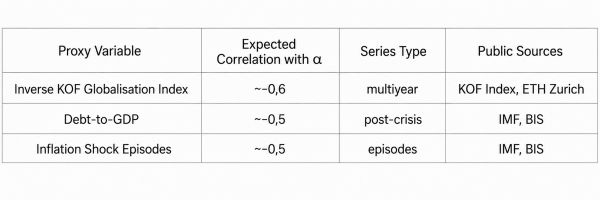
Extended econometric tests, series used, and model specifications are presented in the accompanying empirical document. The section has an operational illustrative role. It does not constitute exhaustive econometric validation of the model.
• A.6. Natural Language Interpretation of Endogenous Blockage Mechanisms
The model distinguishes three different mechanisms by which the financed arbitrage mechanism can become blocked. They are not identical and do not share the same dominant cause. This distinction is essential for empirical interpretation.
• Blockage of Type (A) - Insufficiency of Exploitable Differentials
Type (A) blockage occurs when the differences in price or yield between markets become too small to cover the cost of capital and the operational costs of the transaction. The gross opportunity exists, but the net gain disappears once interest and transaction costs are included. Capital no longer has the incentive to mobilize. Arbitrage stops due to the compression of differentials. The mechanism is purely economic in nature and relates to the convergence of prices and yields.
Example: The period of the "Great Moderation” and the pre-global financial crisis era (approx. 2004-2007).
Credit spreads and sovereign differentials compressed sharply at the global level. Risk premiums reached historical lows. Carry trade and arbitrage strategies experienced declining risk-adjusted returns.
Sources:
- Bank for International Settlements - Annual Economic Report 2007 - chapters on spread compression and the search for yield.
- IMF - Global Financial Stability Report, April 2007 - section on "search for yield”.
• Blockage of Type (B) - Increase in the Feasibility Threshold through Environmental Risk
Type (B) blockage occurs when the institutional and geopolitical environment increases the risk premium required by financiers more rapidly than exploitable differentials grow. Differentials may be large, but the perceived risk is even greater. Sanctions, capital controls, technological restrictions, legal risk, and payment risk raise the minimum acceptable return threshold. Financing refuses the transaction. Arbitrage becomes unfeasible due to the environment, not the market itself. The mechanism is one of risk and institutional regime.
Example: Major financial sanctions episodes and controls on access to payment systems after 2014 and after 2022 in relation to Russia.
Price and yield differentials became very large, but access to financing, payment infrastructure, and eligible counterparties was restricted. Many potentially profitable transactions were no longer financeable.
Sources:
- BIS - Annual Economic Report 2023 - chapters on financial fragmentation and sanctions.
- IMF - Geo-Economic Fragmentation and the Future of Multilateralism, 2023.
- World Bank - reports on post-2022 trade and financial restrictions.
• Blockage of Type (C) - Saturation of Financing Capacity
Type (C) blockage occurs when the level of indebtedness reaches a point at which debtors and the financial intermediary can no longer support additional credit. Differentials exist and risk is acceptable, but balance sheets are overloaded. Debt service already consumes the tolerable portion of cash flows. Lending standards tighten. Refinancing becomes defensive. Profitable projects remain unfunded. Arbitrage stops due to a lack of financing capacity. The mechanism is one of balance sheet constraint.
This distinction allows the empirical separation of situations in which arbitrage stops due to lack of margin, excess risk, or debt saturation.
Example: The global financial crisis of 2008-2009.
Bank balance sheets were overloaded with impaired assets. Capital requirements increased. New lending contracted sharply. Numerous projects with positive returns no longer obtained financing.
Sources:
- BIS - Annual Economic Report 2009 - contraction of bank balance sheets.
- IMF - Global Financial Stability Report, October 2009.
- Federal Reserve - Flow of Funds / Financial Accounts, 2009-2010 editions - banking and private sector deleveraging.
Table A.1 - Endogenous Blockage Mechanisms: Formal Conditions and Compatible Historical Episodes
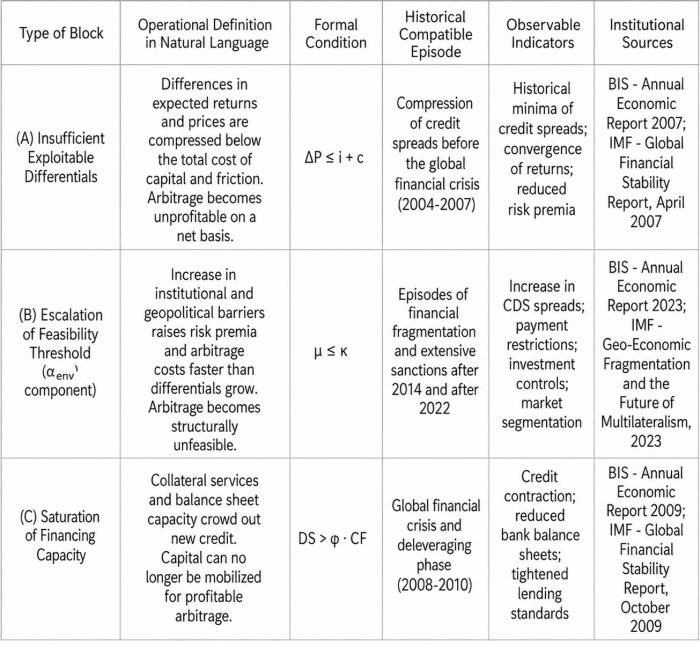
The table synthesizes the three endogenous blockage mechanisms defined in the model, their formal conditions, and compatible historical episodes documented in reports from international financial institutions. The examples serve an illustrative and methodological role, not causal demonstration.
The operational indicators defined in sections A.1-A.3 (IDN, IER, SCF) enable quantitative testing of the three endogenous blockage mechanisms summarized in Table A.1, through direct mapping of the formal conditions onto observable series and historically documented episodes in institutional reports.
• A.7. The Status of Blockage in Interest Rate Theory
Interest Rate Theory describes the defining mechanism of interest-bearing credit civilization, not the totality of economic processes. The model treats capital allocation through credit, the cost of capital, and financed arbitrage as the dominant structural mechanism of economic coordination.
Blockages of types (A), (B), and (C) do not imply the cessation of production, exchange, or ongoing economic activity. They involve the blockage of the structural mechanism through which the interest-bearing credit system reproduces its internal order and the convergence of differentials.
When exploitable differentials no longer exceed the cost of capital, when the feasibility threshold of arbitrage rises faster than the differentials, and when financing capacity becomes saturated, financed arbitrage loses its function as a structural regulator. At that point, interest no longer efficiently coordinates capital allocation at the systemic scale.
The result is not the disappearance of the economy, but the loss of the organizing principle specific to interest-bearing credit civilization. Capital allocation then migrates toward non-arbitrage mechanisms: administrative decision-making, fiscal constraint, capital controls, directed credit, or monetization.
The blockage of the mechanism does not describe a cyclical crisis, but a structural limit of the organizational regime based on interest-bearing credit.
• Annex B - Structural Globalization Index (ISG)
• Composite Derived Indicator for Measuring the Compression of Differentials and Component α
• B.1. Purpose of the Indicator
The Structural Globalization Index (ISG) is a composite indicator designed to measure the degree of structural integration of economic and financial space through the lens of differential compression. The indicator is constructed for operational use in the model's empirical tests and for evaluating the relationship between integration, the dispersion of financing costs, and the dynamics of spreads.
ISG does not replace existing globalization indices but provides a tool explicitly oriented toward the financial variables relevant to differentials and arbitrage.
• B.2. Construction Principle
ISG aggregates several observable dimensions of integration:
-dispersion of sovereign interest rates,
-dispersion of corporate spreads,
-convergence of price levels,
-intensity of cross-border capital flows,
-synchronization of monetary policy rates.
Each component is transformed into a standardized indicator to allow aggregation into a single score comparable over time.
• B.3. Components of the Indicator
• B.3.1. Dispersion of Sovereign Interest Rates
Measure: standard deviation of reference sovereign bond yields (10-year maturity) for a group of major economies.
Minimum recommended set: United States, Germany, United Kingdom, Japan, Canada.
Data sources: BIS - Long Series on Interest Rates; ECB; FRED.
Interpretation: lower dispersion → higher integration.
• B.3.2. Dispersion of Corporate Spreads
Measure: standard deviation of investment-grade spreads relative to sovereign bonds, across major jurisdictions.
Data sources: BIS - credit spreads; aggregated market databases.
Interpretation: lower dispersion → more uniform financial conditions → higher integration.
• B.3.3. Convergence of Price Levels
Measure: standard deviation of price level indices (PPP price level indices) between developed economies.
Data sources: OECD; World Bank PPP database.
Interpretation: lower deviation → greater convergence → deeper structural integration.
• B.3.4. Cross-Border Capital Flows
Measure: gross capital flows (inflows + outflows) relative to global GDP or the aggregate GDP of the sample.
Data sources: IMF - Balance of Payments Statistics.
Interpretation: higher flows relative to GDP → higher financial integration.
• B.3.5. Synchronization of Monetary Policy Rates
Measure: standard deviation of monetary policy rates among major central banks.
Data sources: BIS; national central banks.
Interpretation: lower deviation → greater synchronization → higher monetary integration.
• B.4. Standardization
Each component is transformed into a standardized score (z-score):
Z_i,t = (X_i,t − mean_i) / standard_deviation_i
For dispersion variables, the sign is inverted so that higher values of the score indicate higher integration.
• B.5. Index Formula
The ISG index at time t:
ISG_t = w1∙Z_suveran_t
+ w2∙Z_corporate_t
+ w3∙Z_pret_t
+ w4∙Z_fluxuri_t
+ w5∙Z_rate_t
Weights:
- Base variant: equal weights (w_i = 0.2);
- Robust variant: weights derived through principal component analysis (PCA).
The chosen method is explicitly stated and kept constant across the entire series.
• B.6. External Validation
ISG is validated through comparison with established indicators:
- correlation with the KOF Globalisation Index (KOF Swiss Economic Institute);
- correlation with IMF measures of financial integration;
- negative correlation with G7 spread dispersion.
Reported:
- correlation coefficients over the entire period,
- sign stability across sub-periods.
KOF sources: Gygli et al. (2019); KOF Swiss Economic Institute - index methodology.
• B.7. Use in the Model's Empirical Tests
ISG is introduced directly into regression specifications.
Example of test:
spread_it = β1∙ISG_t + β2∙credit_gap_it + fixed_effects + ε_it
Structural prediction of the model:
β1 < 0 - higher integration (higher ISG) is associated with lower spreads.
• B.8. Threshold Tests
ISG allows the definition of operational thresholds:
-high integration zones: ISG above the 75th percentile,
-fragmentation zones: ISG below the 25th percentile.
Tests check whether:
-leverage systematically increases after episodes with high ISG,
-widening of spreads follows episodes of sharp ISG decline.
• B.9. Replicability
All ISG components use public statistical series:
-BIS,
-IMF,
-OECD,
-World Bank,
-KOF,
-FRED,
-ECB.
The construction of the index is fully replicable on open data, without dependence on proprietary sets.
Figure A - Structural Globalization Index (IG/ISG), Historical Series 1970-2026 (with estimation)
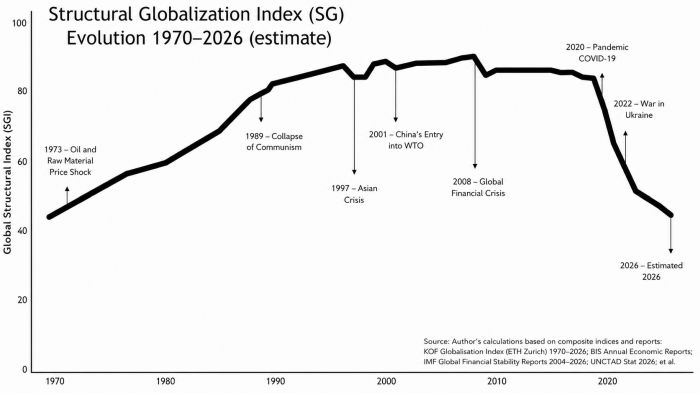
The Structural Globalization Index (IG/ISG) is a composite indicator constructed to measure economic and financial integration through the lens of interest rate differential compression, convergence of financial conditions, and the intensity of cross-border flows. The indicator aggregates components regarding the dispersion of sovereign yields, the dispersion of spreads, the convergence of price levels, capital flows, and the synchronization of monetary policy rates, based on institutional statistical series.
The series used come from public databases: Bank for International Settlements (interest rate and credit series), International Monetary Fund (capital flows and macro-financial data), KOF Swiss Economic Institute (globalization indicators), OECD and World Bank (price and convergence indicators). The full methodology for constructing and standardizing the index is presented in Annex B - Structural Globalization Index.
Values for the latest year include estimates based on the current trend of the components and recent structural shocks. The uncertainty interval for the estimate is indicated graphically. The indicator has a structural analytical role and does not represent a single official statistical series.
• BIBLIOGRAPHY
Literature on Financial Cycles and Global Liquidity
Rey, Helène (2013). Dilemma not Trilemma: The Global Financial Cycle and Monetary Policy Independence. Proceedings of the Jackson Hole Economic Policy Symposium. Federal Reserve Bank of Kansas City.
Bank for International Settlements - BIS (2014). Global liquidity and the financial cycle. BIS Quarterly Review, September 2014.
Borio, Claudio (2018). The financial cycle and macroeconomics: What have we learnt? Journal of Banking & Finance, vol. 45.
Borio, Claudio (2014). The financial cycle and macroeconomics. BIS Working Papers.
Financial Instability
Minsky, Hyman P. (1986). Stabilizing an Unstable Economy. Yale University Press.
Minsky, Hyman P. (1992). The Financial Instability Hypothesis. Levy Economics Institute Working Paper No. 74.
Kindleberger, Charles P.; Aliber, Robert Z. (2011). Manias, Panics and Crashes: A History of Financial Crises. Palgrave Macmillan.
Geo-Economic Fragmentation and Structural Risks
International Monetary Fund - IMF (2023). Geoeconomic Fragmentation and the Future of Multilateralism. IMF Staff Discussion Note.
International Monetary Fund - IMF (2024). World Economic Outlook - Fragmentation and Growth. World Economic Outlook, April 2024.
International Monetary Fund - IMF (2024-2025). Global Financial Stability Report. Successive editions.
Financial Integration and Global Capital Markets
Obstfeld, Maurice; Taylor, Alan M. (2004). Global Capital Markets: Integration, Crisis, and Growth. Cambridge University Press.
Acemoglu, Daron; Johnson, Simon; Robinson, James A. (2001). The Colonial Origins of Comparative Development. American Economic Review, vol. 91, nr. 5.
Globalization Indicators
KOF Swiss Economic Institute - ETH Zurich (2023). KOF Globalisation Index - Methodology and Data Release 2023. KOF Working Papers and Database Documentation.
Gygli, Savina; Haelg, Florian; Potrafke, Niklas; Sturm, Jan-Egbert (2019). The KOF Globalisation Index - revisited. Review of International Organizations, vol. 14.
Interest Rate, Yield, and Sovereign Spread Series
Bank for International Settlements - BIS. Long Series on Interest Rates (database).
Bank for International Settlements - BIS. Credit to the Non-Financial Sector Database.
European Central Bank - ECB. Statistical Data Warehouse - Government Benchmark Bond Yields and Yield Curves.
Federal Reserve Bank of St. Louis - FRED. US Treasury Constant Maturity Rates (10Y).
Federal Reserve Bank of St. Louis - FRED. German 10Y Government Bond Yield (aggregated series from OECD and ECB sources).
Debt, Credit, and Financial Fragility
International Monetary Fund - IMF. Global Debt Database.
International Monetary Fund - IMF. International Financial Statistics.
Institute of International Finance - IIF. Global Debt Monitor.
World Bank. World Development Indicators.
Organisation for Economic Co-operation and Development - OECD. Price Level Indices and Purchasing Power Parities.
• Note on Data Usage
All statistical series used in the empirical tests come from public institutional databases (BIS, IMF, KOF, ECB, FRED, World Bank, OECD, IIF). The series are replicable and independently verifiable.

























 Euro
Euro Dolar SUA
 Franc elveţian
 Liră sterlină
 Gram de aur