English

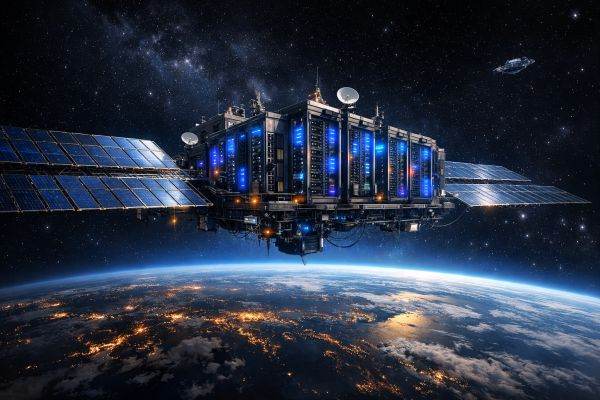
Tech giants are increasingly considering the possibility of moving data centers to space, an idea that until recently seemed like something out of science fiction. The stakes are high: continuous access to solar energy, eliminating costs and constraints on Earth and supporting the explosive development of artificial intelligence (AI), which is extremely energy-hungry, AFP reports. Interest in this direction has intensified after Elon Musk decided to absorb his artificial intelligence company, xAI, into the aerospace group SpaceX, fueling speculation about a direct integration between AI and space infrastructure.
• Who are the actors pushing data into the cosmos
This is not just a singular ambition. More than a dozen startups, along with major players in the aerospace and technology sectors, are already involved in tests and concrete plans for the development of orbital data centers. Elon Musk suggested as early as November 2025 that SpaceX could become the main vector for launching such infrastructures. In parallel, Tesla, his electric vehicle company, is expanding its activity in the area of humanoid robots, which, in the entrepreneur's vision, could ensure the maintenance of data centers in orbit. In turn, the American startup Starcloud placed an experimental satellite the size of a refrigerator, equipped with Nvidia graphics processors (GPUs), at the end of 2025, marking what the company called "the cosmic beginnings of mini-data centers".
• Google, Amazon and the networks of the future
The large groups are not missing from this race. Google announced the Suncatcher project in the fall of 2025, which envisages the launch of test satellites in early 2027, with the aim of developing space data centers powered exclusively by solar energy. In parallel, Blue Origin, the company founded by Jeff Bezos, is promoting the TeraWave project, a high-speed communications network located in space, designed to enable global wireless transfers between terrestrial data centers.
The main advantage of space is almost constant access to sunlight. Satellites can be placed in orbits that avoid the Earth's shadow, providing a constant source of energy and eliminating the need for classic cooling systems, which are extremely expensive on Earth.
In addition, moving data centers to space would eliminate problems related to land acquisition, local regulations and community opposition, increasingly vocal in the United States, where these facilities are criticized for their massive energy consumption and impact on electricity prices. Proponents of the projects argue that, after the pollution generated by launches is amortized, orbital data centers could become less harmful to the environment than terrestrial infrastructure.
• Cost, weight and technological limits
Until recently, the cost of launches was the main obstacle. But Starship, the reusable mega-rocket developed by SpaceX, promises to significantly reduce transportation costs.
However, skepticism persists. "If you've seen a server farm recently, they're heavy,” warned Matt Garman, general manager of Amazon Web Services (AWS), at the Cisco AI conference. He questioned the current ability to launch enough satellites to support a global infrastructure: "We're still a long way from that.” Added to these are major technical challenges: the equipment's resistance to radiation and extreme temperatures, the risk of collisions with space debris and the high cost of repairs, whether carried out by humans or robots.
For some experts, the key remains the evolution of artificial intelligence. "If AI doesn't grow exponentially, space won't make sense in the immediate future,” Philip Metzger, a physics professor at the University of Florida and former NASA researcher, explained in a post on the X platform.





















 Euro
Euro Dolar SUA
 Franc elveţian
 Liră sterlină
 Gram de aur